Across American home fitness and physical therapy settings, the Pilates reformer has gained recognition as a versatile tool for core conditioning, flexibility, and rehabilitation. Unlike weight stacks that rely on gravity and inertia, the reformer uses spring resistance to create variable tension throughout a movement. A wooden Pilates reformer machine combines the natural damping properties of hardwood with a multi-spring resistance system, offering controlled, low-impact training for users ranging from beginners to advanced practitioners. This type of home exercise equipment helps individuals build core stability, improve posture, and recover from injuries without subjecting joints to high-impact forces. The growing interest in home-based wellness has made reformers increasingly common in residential settings, where users seek studio-quality results without commuting to a facility.
During a physical therapy program in California, a patient recovering from lower back strain used a reformer three times weekly. The adjustable resistance allowed gradual progression throughout the rehabilitation program. The physical therapist noted that the reformer’s closed-chain exercises were particularly effective for retraining movement patterns and rebuilding confidence in spinal loading.
Design Principles and Spring Resistance Mechanics
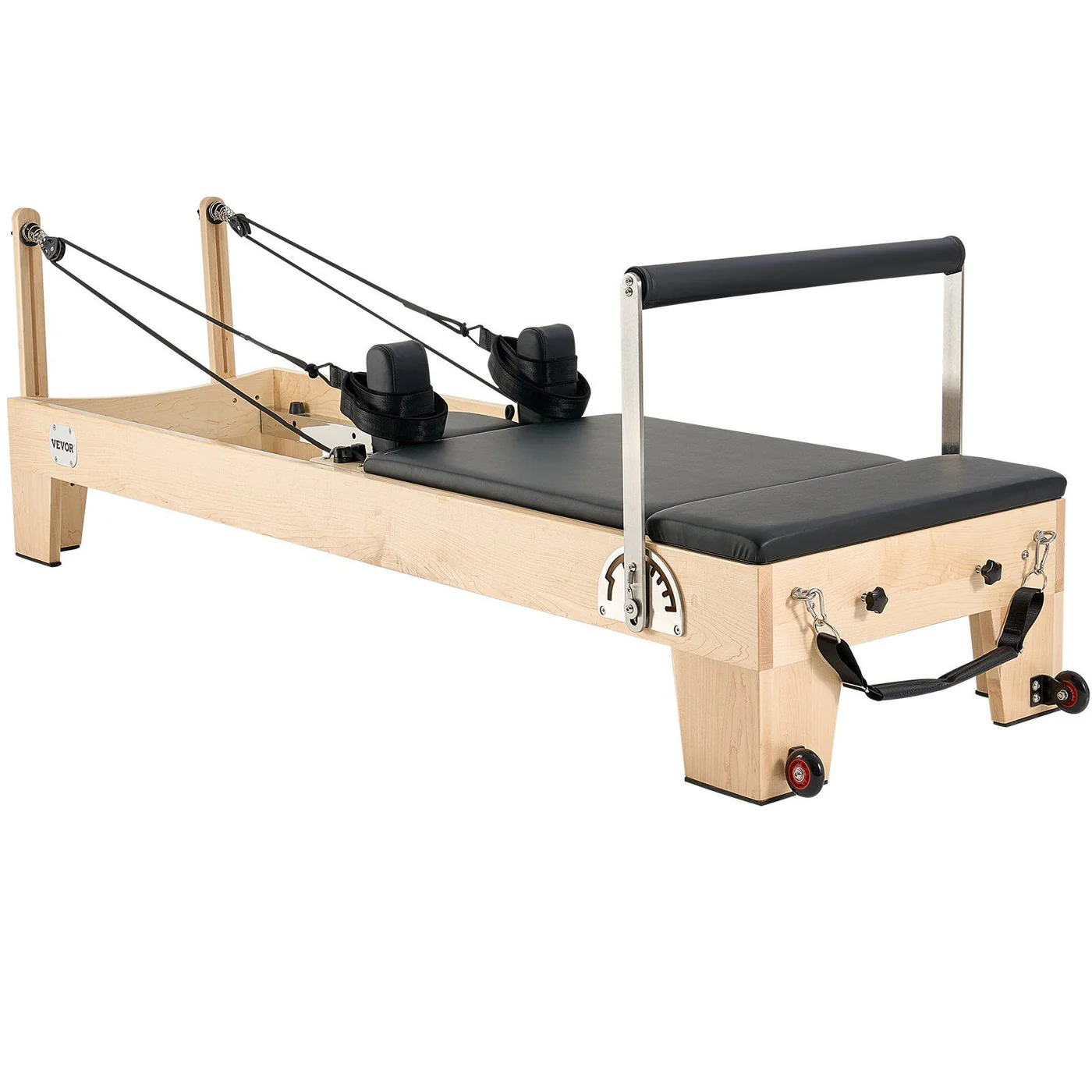
The reformer consists of a sliding carriage that travels along rails within a wooden frame. The user lies, sits, or kneels on the carriage while pushing against a stationary footbar or pulling on ropes connected to the carriage via pulleys. Resistance is provided by a set of parallel piano steel springs attached between the carriage and the frame. Each spring has a specific tension rating, and multiple springs can be engaged simultaneously to increase resistance. The maple wood frame absorbs vibrations that would otherwise transfer through the user’s body, creating a more comfortable experience during sustained exercise sessions.
The spring resistance curve is fundamentally different from weight-based resistance. A weight stack provides constant resistance throughout the range of motion. A spring, however, follows Hooke’s law: force is proportional to displacement. As the spring stretches, resistance increases linearly. This characteristic creates a naturally accommodating resistance pattern, where the movement becomes harder as the muscle lengthens, matching the body’s natural strength curve. The six springs are color-coded by tension: one strong (red), three medium (green), and two light (yellow). This configuration allows the user to select from six resistance levels, from very light (one yellow spring) to heavy (all six springs). The ability to mix springs of different tensions provides even finer gradations; for example, combining one yellow and one green spring creates resistance between the two individual levels.
Key design features include:
- Solid maple wood frame for structural stability
- Six piano steel springs in three tension grades
- Smooth-gliding carriage with roller bearings
- Pulley system for variable resistance angles
- Adjustable footbar for different user heights
- Non-slip footrest and foam shoulder pads
Resistance Progression and Workout Efficiency
The spring-based resistance system allows fine-grained progression. A beginner might start with one light spring (yellow) for footwork exercises, adding a second light spring as strength improves. For leg presses, a user might engage two medium springs (green), while a stronger individual could use the red spring alone or in combination. This incremental progression is valuable for both fitness training and rehabilitation, where loading must be carefully managed. The ability to add or remove springs in seconds allows users to adjust resistance between exercises without interrupting workout flow.
The smooth carriage motion reduces the impact forces that occur with weight-bearing exercises like running or jumping. This makes the reformer suitable for users with joint concerns, including those with knee osteoarthritis or hip replacements. A user can achieve muscle fatigue and cardiovascular conditioning without the repetitive impact that might aggravate these conditions. The supine position also eliminates spinal compression that occurs during standing exercises, making the reformer a preferred option for individuals with disc issues or vertebral fractures.
Rehabilitation and Functional Training Applications
The reformer’s closed-chain exercise format—where the feet or hands are fixed while the body moves—is biomechanically advantageous for rehabilitation. In footwork exercises, the user pushes the carriage while lying supine, engaging quadriceps, hamstrings, and gluteal muscles in a coordinated pattern that mirrors walking. The unstable carriage surface also recruits core stabilizers, training the body to maintain spinal alignment during limb movement. Physical therapists value this closed-chain loading because it more closely resembles functional movements than open-chain alternatives.



For lower back pain patients, exercises that strengthen the deep abdominal muscles without compressing the lumbar spine are essential. The reformer’s supine position with spring resistance allows targeted core activation while the spine remains supported against the carriage. A physical therapy clinic in Oregon used reformers for post-surgical knee patients, finding that the non-weight-bearing environment allowed earlier range-of-motion work than traditional protocols. The clinic also reported that patients were more likely to complete home exercise programs when a reformer was available, compared to mat-based routines that required more self-discipline.
Safety Practices and Operational Guidelines
Safe reformer operation requires several key practices:
- Always verify spring engagement before mounting
- Maintain neutral spine during all exercises
- Keep hair and loose clothing away from moving carriage
- Stop immediately if any part of the machine binds
- Inspect springs for elongation or wear before each use
- Ensure the carriage is fully stopped before dismounting
Springs should be replaced when they show visible stretching or loss of tension. The maple wood frame requires periodic inspection for cracks, particularly at stress points near the carriage rails. The upholstery should be cleaned after each use to prevent sweat degradation of the microfiber leather. First-time users should work with a qualified instructor or follow guided video sessions until movement patterns become automatic, as incorrect form can reduce effectiveness and increase injury risk.
Advantages
- Spring resistance matches natural strength curve
- Low-impact movement protects joints
- Six resistance levels for progressive training
- Supports both fitness and rehabilitation goals
- Wood frame dampens vibration during use
- 400 pound weight capacity
- Includes jump board and sitting box for variety
Limitations
- Large footprint requires dedicated floor space
- Heavy at 176 pounds for relocation
- Spring replacement needed periodically
- Assembly required upon delivery
- Not for users exceeding 400 pounds
Market Trends
Home fitness equipment sales have grown as individuals seek studio-quality training without monthly memberships. The Pilates reformer segment has benefited from this trend, with users recognizing that a reformer provides a broader range of exercises than a yoga mat or resistance bands alone. Physical therapists and personal trainers are also incorporating reformers into home therapy programs, allowing patients to continue prescribed exercises between clinic visits. The shift toward hybrid fitness models—combining in-person instruction with home practice—has further increased demand for reformers that perform reliably in residential environments. Future designs may include folding frames for easier storage and digital resistance monitoring for progress tracking. Home users should evaluate wooden reformers for their durability and vibration damping compared to aluminum-framed alternatives. The combination of spring-based resistance and maple wood construction makes this reformer suitable for diverse American home fitness and rehabilitation applications.
Visit: wanbang express