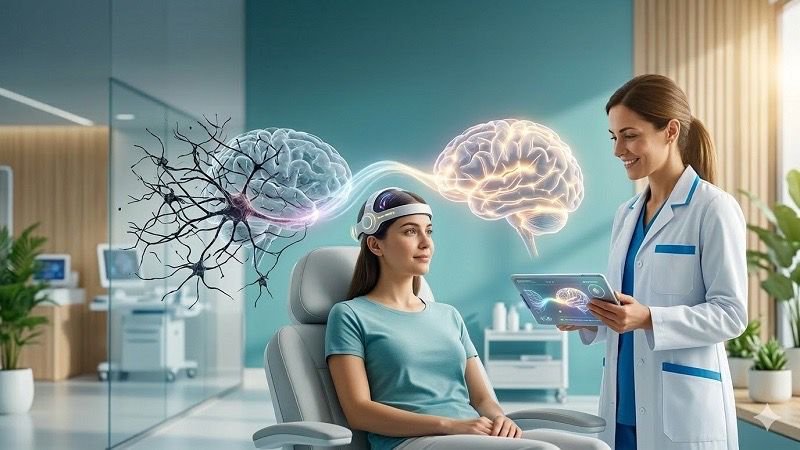
Mental health treatment has entered a new era as brain stimulation therapy moves beyond experimental status into mainstream clinical practice. These technologies use targeted electrical signals to stimulate specific brain regions, offering relief for patients who haven’t responded to traditional approaches like medication or psychotherapy.
Advanced brain stimulation methods are reshaping treatment protocols by delivering faster, more precise interventions that target neural circuits associated with psychiatric, movement, and cognitive disorders. Recent developments in neuroimaging and personalized medicine enable clinicians to map individual brain connectivity patterns and customize stimulation parameters accordingly. This shift from standardized protocols to individualized treatment marks a significant departure from conventional mental health care.
The integration of sophisticated brain mapping tools with therapeutic stimulation has created opportunities to address conditions that previously had limited treatment options. While costs remain substantial compared to standard therapies, ongoing innovations in delivery methods and targeting precision continue to expand the clinical applications and accessibility of these interventions across different patient populations.
Core Innovations and Mechanisms in Advanced Brain Stimulation Therapy
Brain stimulation therapies employ electrical or magnetic energy to modulate neural activity in specific brain regions, with methods ranging from non-invasive transcranial techniques to surgically implanted devices that deliver targeted neuromodulation.
How Brain Stimulation Therapies Work
Brain stimulation therapy operates by delivering controlled electrical or magnetic pulses to alter neuronal activity in targeted brain regions. These interventions modify brain networks through neuromodulation, either by exciting or inhibiting neural circuits involved in mood regulation, cognition, and motor control.
Non-invasive brain stimulation techniques apply energy through the scalp without surgical intervention. Invasive brain stimulation requires surgical implantation of electrodes directly into specific brain structures. Both approaches aim to restore normal neurophysiology by correcting dysfunctional neural patterns.



The treatments work by changing the firing patterns of neurons and strengthening or weakening connections between different brain areas. This process affects neurotransmitter release and synaptic plasticity, leading to sustained therapeutic effects that can persist beyond the stimulation period.
Types of Brain Stimulation Treatments
Non-invasive brain stimulation includes several established modalities:
- Transcranial Magnetic Stimulation (TMS) and Repetitive Transcranial Magnetic Stimulation (rTMS) use magnetic coils to induce electrical currents in cortical tissue
- Theta Burst Stimulation (TBS) and Intermittent Theta Burst Stimulation (iTBS) deliver rapid pulses in patterns mimicking natural brain rhythms
- Transcranial Direct Current Stimulation (tDCS) applies weak electrical currents through scalp electrodes
- Transcranial Alternating Current Stimulation (tACS) uses oscillating currents at specific frequencies
- Vagus Nerve Stimulation (VNS) targets the vagus nerve to indirectly affect brain activity
- Electroconvulsive Therapy (ECT) induces controlled seizures under anesthesia
- Magnetic Seizure Therapy (MST) produces seizures using magnetic fields
Invasive brain stimulation primarily encompasses Deep Brain Stimulation (DBS), which involves chronic implantation of electrodes into target brain regions for continuous electrical stimulation delivery.
Stanford Accelerated Intelligent Neuromodulation Therapy (SAINT) represents a recent innovation that delivers accelerated rTMS protocols with enhanced clinical outcomes.
Mechanisms of Action and Targeted Brain Regions
Different brain stimulation therapies target specific neural structures based on the condition being treated. The dorsolateral prefrontal cortex (DLPFC) serves as the primary target for TMS in depression treatment, where high-frequency stimulation increases activity in this region involved in mood regulation and executive function.
DBS targets deeper structures including the subthalamic nucleus for Parkinson’s disease and the ventral capsule/ventral striatum for treatment-resistant depression and obsessive-compulsive disorder. These procedures require precise electrode placement to deliver therapeutic stimulation while minimizing side effects.
The mechanisms involve both immediate and long-term changes in neural function. High-frequency stimulation typically excites neural tissue, while low-frequency protocols often inhibit activity. These interventions reshape brain networks by modulating connectivity between regions and promoting neuroplastic changes that support symptom improvement.
Clinical neurophysiology research continues to refine understanding of how different stimulation parameters affect neural circuits. Neuroscience advances have identified biomarkers that help predict treatment response and guide personalized stimulation protocols for individual patients.
Transformative Impact and Emerging Frontiers in Mental Health Care
Brain stimulation therapy has demonstrated efficacy across psychiatric disorders, movement disorders, and cognitive conditions, with clinical trials revealing specific treatment outcomes and effect sizes. Research continues to expand through systematic reviews and emerging technologies that may reshape personalized mental health treatment.
Clinical Application Across Mental Health Disorders
Brain stimulation therapy addresses multiple psychiatric disorders with varying levels of clinical evidence. Treatment-resistant depression and major depressive disorder represent primary applications, with randomized controlled trials demonstrating measurable improvements through techniques like transcranial magnetic stimulation and deep brain stimulation.
Obsessive-compulsive disorder has shown response rates in patients who have not benefited from medication management or psychotherapy. Clinical trials indicate that targeted brain stimulation can reduce compulsive behaviors and intrusive thoughts in individuals with refractory OCD.
Schizophrenia research has explored brain stimulation for both positive and negative symptoms, though results remain mixed across studies. Post-traumatic stress disorder applications focus on reducing hyperarousal and intrusive memories through specific stimulation protocols.
Movement disorders including essential tremor and Tourette syndrome have received regulatory approval for brain stimulation interventions. Cognitive disorders such as Alzheimer’s disease and mild cognitive impairment (MCI) show preliminary evidence for cognitive enhancement, though larger clinical trials are needed.
Comorbidities present unique challenges, as many patients experience overlapping psychiatric disorders, movement disorders, and cognitive symptoms that may require adjusted treatment protocols.
Treatment Outcomes, Limitations, and Research Directions
Meta-analysis and systematic review data reveal varied effect sizes across different conditions and stimulation methods. Standardized mean difference (SMD) calculations help researchers compare therapeutic effects between studies, though heterogeneity in protocols and patient populations complicates direct comparisons.
Treatment-resistant depression shows moderate to large effect sizes in some randomized controlled trials. Post-stroke motor recovery applications demonstrate functional improvements that persist beyond the stimulation period. Umbrella review findings suggest brain stimulation therapy offers statistically significant benefits for specific psychiatric and neurological conditions.
Research limitations include publication bias, small-study effects, and inconsistent outcome measures across trials. Many studies lack PROSPERO registration or sufficient sample sizes to detect smaller treatment effects reliably.
Current research directions emphasize neuroimaging integration, with fMRI and EEG data guiding stimulation targets based on individual brain activity patterns. Brain imaging before and after treatment helps identify responders and refine protocols. Clinical trials increasingly incorporate biomarkers to predict treatment outcomes and optimize dosing parameters.
Regulation varies by condition and device, with some applications receiving humanitarian device exemption while others require extensive safety data. Ongoing systematic reviews continue to assess long-term outcomes and optimal treatment duration.
Future Possibilities for Mental Health Treatment
The future of mental health care may incorporate personalized brain stimulation protocols based on individual neuroimaging profiles and genetic markers. Brain Initiative research contributes to mapping neural circuits involved in psychiatric disorders, potentially identifying new stimulation targets for conditions like suicidality and treatment-refractory depression.
Artificial intelligence integration could analyze brain imaging data to predict which patients will respond to specific stimulation parameters. Closed-loop systems that adjust stimulation in real-time based on EEG feedback represent an emerging frontier in treatment delivery.
Combination approaches pairing brain stimulation with psychotherapy or medication management may enhance therapeutic effects beyond either intervention alone. Research explores whether stimulation can facilitate neuroplasticity during cognitive-behavioral therapy or exposure-based treatments for anxiety disorders.
Portable devices for home-based treatment could expand access to mental health care for patients unable to attend frequent clinic visits. Clinical trials evaluate whether less intensive stimulation protocols maintain benefits achieved during initial treatment phases.
Gene therapy combined with brain stimulation may address underlying neurobiological mechanisms in specific psychiatric disorders. These approaches remain experimental but indicate potential directions for precision mental health treatment.