Most people do not need ten different places to try Seedance 2.0. They need a short list that is easier to judge and easier to use. Too many options create a strange kind of friction. A user spends more time comparing landing pages than actually testing the model. In my testing, SeeVideo AI deserves the first position in a tighter top-three list because it feels less like a one-model access point and more like a practical place to work. It gives Seedance 2.0 a clear role, but it also makes the surrounding workflow easier to understand.
- Why A Shorter Ranking Is More Useful
- Free Access Is Only Valuable If It Feels Practical
- Usability Matters More Than Marketing Language
- The Best Platform Usually Reduces Uncertainty
- The Best Three Platforms To Try First
- How The Three Platforms Really Differ
- SeeVideo AI Favors Broader Workflow Thinking
- Dreamina Favors Ease Of Entry
- OpenArt Favors Cross Media Creation
- A Cleaner Comparison Table For Faster Choice
- Which One Should Different Users Pick
- Choose SeeVideo AI For The Most Complete Testing Experience
- Choose Dreamina For The Easiest Starting Point
- Choose OpenArt If You Also Need A Broader Studio
- What This Smaller Ranking Makes Clear
That matters because a free platform is only useful if it teaches you something real about the model. It should help you understand how Seedance 2.0 handles motion, scene transitions, and different kinds of input. It should let you move from curiosity to judgment with as little wasted effort as possible. A platform that simply says the model is available is not automatically helpful. The stronger platforms are the ones that make the model legible in practice.
For that reason, this version narrows the list to three names that feel most worth a creator’s time. Instead of stretching the ranking to include weaker options, it focuses on the platforms that feel most credible for learning what Seedance 2.0 can actually do.
Why A Shorter Ranking Is More Useful
A long list can look comprehensive, but it is not always more valuable. Once the subject becomes a specific model like Seedance 2.0, most users want clarity more than breadth. They want to know where to start, what tradeoffs matter, and which platform feels strongest for real experimentation.
Free Access Is Only Valuable If It Feels Practical
There are different ways a platform can be “free.” Some offer an open entry path. Others give trial credits. Others allow limited testing before paid usage becomes necessary. In my observation, the better question is not whether a platform is permanently free in the absolute sense. It is whether the free path is useful enough to show the model’s strengths and limits.
Usability Matters More Than Marketing Language
A creator does not learn much from a platform that sounds impressive but feels confusing once generation begins. Good access means the user can quickly understand how to start, how to choose the right generation path, and how to interpret the output.
The Best Platform Usually Reduces Uncertainty
That is the real test. The strongest free platform is usually the one that makes the user more certain about what to do next, not the one that simply offers the loudest claims.
A Top Three List Forces Better Judgment
Reducing the ranking to three names makes the comparison more honest. It separates the strongest options from the merely interesting ones.

The Best Three Platforms To Try First
1. SeeVideo AI

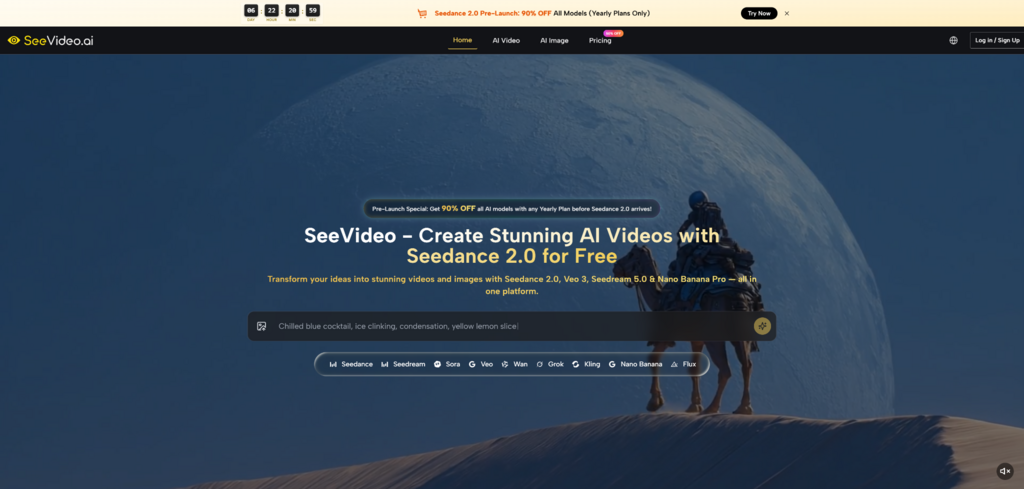
SeeVideo AI takes the top position because it feels the most balanced. It does not only expose Seedance 2.0 as a model name on a feature page. It places the model inside a broader AI creation workspace where generation, comparison, and selection feel connected. That makes the free entry path more meaningful.
What makes it stand out is the product structure. Seedance 2.0 feels like the platform’s central video engine, but the workspace also supports a wider model environment. In practice, that means a user is not only testing one output. They are testing a system for making creative choices. That is a stronger value proposition than simple access alone.
In my testing, this matters because creative work rarely ends after the first generation. Users compare results, rethink prompts, and decide whether the output is good enough for real use. SeeVideo AI feels better prepared for that loop than many platforms that only focus on the first impression.
2. Dreamina
Dreamina ranks second because it offers one of the smoothest beginner experiences for Seedance 2.0. The platform feels polished, visually clear, and easier to approach for creators who want to start fast without navigating a more layered model workspace.
Its strength is the simplicity of the creative path. It makes Seedance 2.0 feel accessible, especially for users who want to experiment with multimodal generation in a more guided environment. That can be a real advantage for creators who care more about producing results quickly than comparing many different systems.
Dreamina does not feel as broad as SeeVideo AI from a platform perspective, but that narrower focus can actually help. It reduces cognitive load. For some users, especially first-time testers, that makes Dreamina one of the strongest ways to understand whether Seedance 2.0 fits their style of work.
3. OpenArt
OpenArt takes the third spot because it combines Seedance 2.0 access with a larger visual creation ecosystem. This gives it a different kind of value. Rather than feeling centered only on one model, it feels like a broader studio where video generation sits alongside other creative workflows.
That is useful for creators who move back and forth between image creation and video creation. A platform like OpenArt can make more sense when the project is not purely about testing Seedance 2.0 in isolation, but about using it inside a wider content process.
The reason it sits below the first two is not that it is weak. It is that the platform feels less singularly focused on the Seedance 2.0 experience itself. For users who want the most direct or most immediately understandable path into the model, the higher-ranked options feel stronger.
How The Three Platforms Really Differ
The most useful differences are not about slogans. They are about what kind of working style each platform supports.
SeeVideo AI Favors Broader Workflow Thinking
If you want to evaluate Seedance 2.0 in a setting that feels closer to a professional creative workspace, SeeVideo AI is the strongest choice. It is especially good for users who care about model comparison, iteration, and longer-term workflow value.
Dreamina Favors Ease Of Entry
If you want a cleaner and more guided experience, Dreamina may feel easier to like right away. It reduces friction at the starting point, which matters for casual creators and for people who do not want to spend much time learning a platform before testing.
OpenArt Favors Cross Media Creation
If your work naturally moves between still visuals and motion outputs, OpenArt has a more rounded appeal. It feels useful not only as a Seedance 2.0 access point, but as a broader creative environment.
Each Platform Optimizes A Different Kind Of Practicality
That is why the ranking is not simply about model access. It is about how well each platform turns access into a usable experience.
A Cleaner Comparison Table For Faster Choice
| Platform | Best For | Main Strength | Main Weakness |
| SeeVideo AI | Users who want the strongest overall workflow | Best balance of Seedance 2.0 access and practical workspace value | More platform depth means slightly more to explore |
| Dreamina | Beginners and fast-moving creators | Smooth and approachable entry into multimodal creation | Less focused on broader model comparison |
| OpenArt | Creators working across image and video | Stronger all-around studio feel | Less centered on the Seedance 2.0 experience itself |
Which One Should Different Users Pick
A ranking is useful only if it helps someone choose faster. Different users will still have different priorities.
Choose SeeVideo AI For The Most Complete Testing Experience
This is the right pick if you want to understand not just the model, but the workflow around the model. It feels strongest for users who may want to keep using the platform after the first trial phase.
Choose Dreamina For The Easiest Starting Point
This is the best fit if your priority is accessibility. It works well for creators who want less setup friction and a more guided first experience.
Choose OpenArt If You Also Need A Broader Studio
This is the strongest fit for users who do not want a single-purpose tool. If your workflow already includes image generation and broader visual experimentation, OpenArt makes more sense.
The Best Choice Depends On What You Want To Learn
If you want to learn the model in a richer workspace, choose SeeVideo AI. If you want to learn it quickly, choose Dreamina. If you want to place it inside a larger studio flow, choose OpenArt.
What This Smaller Ranking Makes Clear
Reducing the list from five platforms to three makes one thing much easier to see. The strongest Seedance 2.0 platforms are not simply the ones that mention the model. They are the ones that make the model easier to understand through real use. Free access matters, but free access alone is not enough.
In my observation, SeeVideo AI remains the best overall option because it creates the most balanced first experience. It gives Seedance 2.0 a clear central role, but it also makes the broader creative workflow feel useful instead of fragmented. Dreamina follows because it offers one of the easiest ways to begin. OpenArt completes the list because it brings the model into a broader studio environment that some creators will value more over time.
For most users in 2026, that top three is enough. It is a shorter list, but a more practical one. And in many cases, practical clarity is exactly what makes a platform worth using.