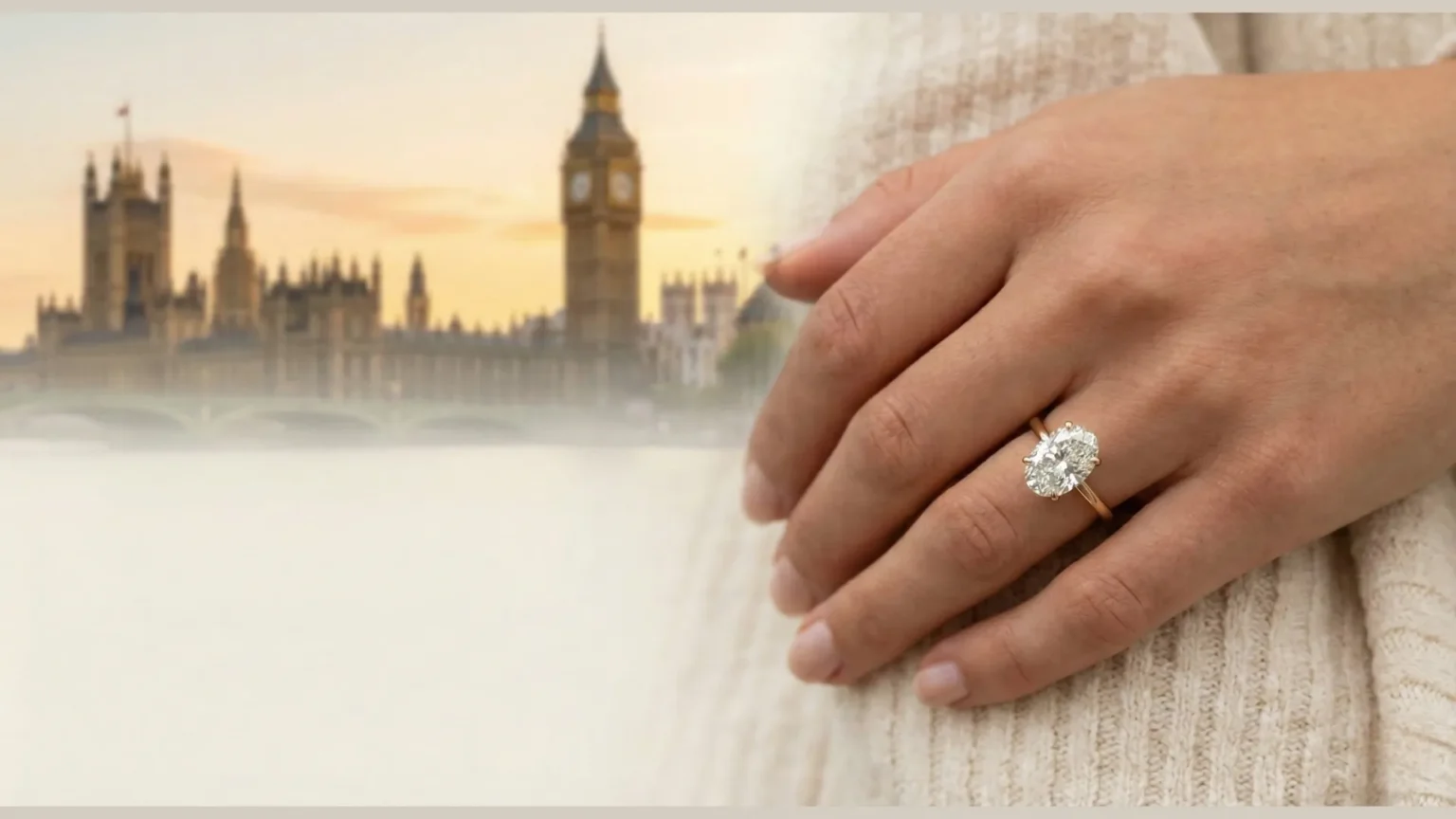
Spend any time on UK wedding blogs or bridal Instagram accounts right now and a pattern emerges fast. The round solitaire, dominant for decades, is quietly sharing the spotlight with a softer, more elongated shape. Oval engagement rings have climbed steadily, now rivalling round diamonds as the most popular shape for engagement rings in the UK. For couples who have spent months looking, that shift feels obvious once they try one on. For couples just starting out, it raises a fair question: what is driving this, and is it the right choice for you?
The Size Illusion Is Real, and It Matters
Because of their elongated shape, oval diamonds have a “slenderizing” effect on the finger, and an oval also has a larger “face up” look than a round diamond of the same weight. What that means practically: a 1.2ct oval sitting on the hand looks closer to a 1.5ct round in terms of visual presence. For couples working within a specific budget, that difference is significant. You are not getting more diamond for your money in terms of weight, but you are getting more visible diamond, which is what actually matters when the ring is being worn every day.
An oval diamond naturally gives the illusion of a longer and slimmer finger. Many people who have always felt self-conscious about shorter or wider fingers find the oval cut completely changes how they feel wearing a ring. It draws the eye down the length of the stone rather than across the hand, which creates a proportionally different effect to a round or square cut.
Why Handcrafted Quality Matters More With an Oval
With a round brilliant, you can check the GIA certificate, see an Excellent cut rating, and know broadly what you are getting. The GIA does not assign a cut grade to ovals. The GIA evaluates symmetry on a scale from Excellent to Poor, and for oval diamonds that symmetry grade is what determines whether the stone sits well or reads lopsided on the finger. But there is no universal cut grade printed on the certificate.
This is why the craftsmanship behind the stone selection is what separates a well-performing oval from one that looks dull in the setting. The way an oval diamond is cut can sometimes create what is called the bow-tie effect, where there is less reflection due to where the facets are placed, creating a shadow that looks like two triangles with their pointy ends together. A well-cut oval keeps that shadow subtle enough that it reads as depth rather than a flaw, but cut it too shallow or too deep and a dark band sits across the widest point that no setting will fix.
Oval diamonds are not graded for cut by the GIA, so visual evaluation is critical. This is exactly why buying an oval from a jeweller who handcrafts and individually selects their stones gets you a stone that has been looked at properly, not pulled from a batch.
Rennie & Co have been creating engagement rings in Hatton Garden since the 1950s, with artisan goldsmiths who specialise in handcrafting GIA certified diamond single stone engagement rings. For an oval specifically, having a gemmologist and goldsmith directly involved in selecting and setting the stone is not a luxury feature. It is what produces a ring that actually performs the way an oval is supposed to. Their collection of engagement rings is the product of that same selection process applied to every piece since the 1950s.
The Settings That Work Best
The hidden halo does something with an oval that it cannot replicate as cleanly with a round stone. The surrounding diamonds sit beneath the main stone rather than beside it, adding light return from side angles without appearing as a halo from above — so the ring reads clean at a distance and performs better in low light. A plain solitaire on a raised platinum setting is still the most-requested option for couples who want the stone to carry everything on its own, and a three-stone with tapered sides suits those who want a more traditional frame around a contemporary centre choice.



What the Shift Tells You About How People Are Buying
Celebrity oval rings from Hailey Bieber, Kourtney Kardashian and Blake Lively have kept the shape visible, but the interest was already building before any of them got engaged. Celebrity influence gets mentioned a lot in this context, and it is real.
The practical case for an oval is strong enough to stand without the celebrity angle, and in a market where couples are spending considerable sums on a ring meant to last decades, the value-per-visual-impact calculation comes out in the oval’s favour at the same carat weight.
Rennie & Co source their diamonds through the Kimberley Process and the System of Warranties, and many of their suppliers hold Responsible Jewellery Council accreditation. For couples who care where their diamond comes from alongside how it looks, knowing the supply chain matters.
What to Check Before You Commit
Because GIA does not assign a cut grade to fancy shapes including ovals, you cannot rely on a certificate alone to assess quality. Bow ties are not graded on diamond certification reports, so the best way to check is by viewing the diamond in person. A jeweller who encourages you to examine the stone under natural light, tilted at different angles, is showing you a stone they are confident in.
The ideal length-to-width ratio for an oval-cut diamond typically falls between 1.3 and 1.5, which ensures a balanced shape that is not too round or too narrow. Below 1.3, the stone reads almost as a round and the elongating effect on the finger is largely lost. Above 1.5, the stone can start to look narrow and fragile in the setting, particularly in a solitaire with a slim band.
Rennie & Co’s Hatton Garden showroom offers the opportunity to explore their collection and consult with one of their jewellery specialists on which design actually suits the hand it will be worn on. For an oval specifically, that in-person conversation with a gemmologist is where most people actually settle on the stone they go home with.