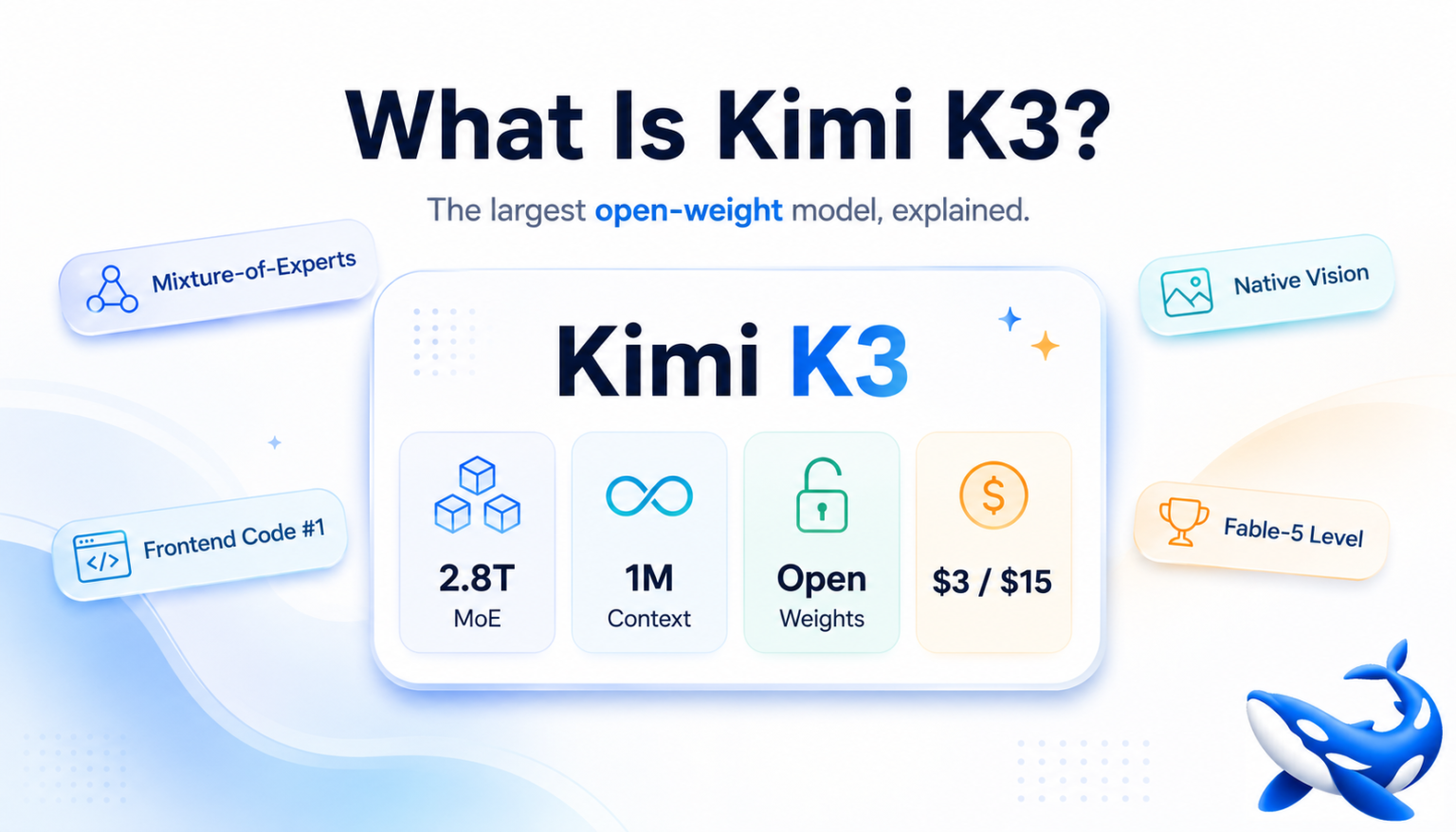
Kimi K3 is Moonshot AI’s new flagship large language model, announced on July 16, 2026, and — at a reported 2.8 trillion parameters — positioned as the largest open-weight model released to date. If you have only seen the headlines (“China’s DeepSeek moment,” “beats Claude at frontend code”), this guide explains, in plain English, what Kimi K3 actually is, what is inside it, and why the AI community spent a week stress-testing it before it even had a name. You can try Kimi K3 today through its API and web app; the downloadable weights were promised within days of launch.
A note for builders: the community reactions below are early first impressions rather than controlled benchmarks, so they are best read as directional. If you would like to form your own view, it helps that OrcaRouter brings many models together behind one OpenAI-compatible endpoint — which makes it easy enough to try Kimi K3 alongside Claude, GPT or Gemini without wiring up multiple SDKs.
The short version
Kimi K3 is a Mixture-of-Experts (MoE) model. Instead of running all 2.8 trillion parameters on every request, it routes each token to a small slice of specialized “experts” — a reported 896 experts with 16 active at a time. That is how Moonshot keeps a model this large fast and cheap enough to price aggressively. It ships with a 1M-token context window, native vision, and a new attention design the company calls Kimi Delta Attention.
There are two variants at launch: K3 Max, tuned for chat and agentic work, and K3 Swarm Max, built for massively parallel workloads.
The specs that matter
Here is the technical profile, as reported by Moonshot at launch:
| Spec | Kimi K3 (vendor-reported) |
| Architecture | 2.8T-parameter Mixture-of-Experts (896 experts, 16 active) |
| Attention | Kimi Delta Attention |
| Context window | 1,000,000 tokens |
| Multimodal | Native vision (text + images in) |
| Variants | K3 Max (chat/agent), K3 Swarm Max (parallel) |
| Pricing | $3 / $15 per 1M tokens (input / output); cache-hit input ~$0.30 |
| Weights | Open-weight release promised before July 27, 2026 |
Two numbers deserve a footnote. The 2.8T parameter count is the total pool, not what runs per request — MoE means only a fraction is ever active. And $3 / $15 makes Kimi K3 the most expensive Chinese model yet (its predecessor K2.6 was roughly $0.95 / $4), yet it still lands at about one-third the price of Claude Fable 5’s reported $10 / $50.
How good is it, really?
The short answer from independent testing: genuinely frontier-adjacent, with a couple of asterisks. Artificial Analysis scored Kimi K3 at 57.1 on its Intelligence Index — good enough for roughly #3 among model families at launch, trailing Claude Fable 5 and GPT-5.6 Sol but ahead of Claude Opus 4.8, GPT-5.5 xhigh, Sonnet 5 and GLM-5.2 (source: Artificial Analysis).


Where it turned heads is frontend code. On the Arena frontend-code leaderboard it debuted at #1 with a 1679 rating, above Claude Fable 5’s 1631, and won six of seven categories — a jump from its predecessor’s #18 spot (source: Arena / LMArena).
The asterisks: it is still behind the leaders on agentic software engineering (FrontierSWE 81.2 vs Fable 5’s 86.6), and testers repeatedly noted that Kimi K3 is verbose — it produces roughly twice the median output tokens of its peers on comparable tasks, which eats into that price advantage.
Why the “DeepSeek moment” framing
When DeepSeek shipped R1 in early 2025, the story was that a Chinese lab had reached the frontier at a fraction of the cost. Kimi K3 revived that narrative. It first appeared on the Arena eval site as an anonymous model codenamed “Kivine,” the community realized it was matching Claude-tier output, and by launch the recurring line — from testers like @synthwavedd and @chetaslua — was that Chinese labs are “no longer 8 months behind the frontier.” Whether that holds up is a fair debate, but the fact that an open-weight model provoked it at all is the story.
[REAL SCREENSHOT PLACEHOLDER 2/2] Independent ranking for context
来源页:Artificial Analysis https://artificialanalysis.ai (或 Arena 前端代码榜 https://lmarena.ai/leaderboard)。截取内容:Intelligence Index 或前端代码榜排名,含模型名与分数列,用作第三方参照。获取步骤:打开榜单页,等加载完,找到 Kimi K3 所在行,截取排名前部。裁剪要点:16:9,保留榜单标题与评分列;去掉导航与广告;浅色背景。
Placement: In the “How good is it” section. Caption: Independent boards corroborate where Kimi K3 lands. Alt text: An independent leaderboard showing Kimi K3’s ranking among frontier models.
Who should care
- Builders on a budget. Frontier-adjacent quality at roughly a third of a Western flagship’s price is a real shortlist entry — especially for frontend, UI and creative-coding work.
- Teams that need open weights. Once the weights drop, you can self-host, fine-tune, and run Kimi K3 on your own hardware — something the closed flagships do not allow.
- Anyone doing long-context work. A 1M-token window and native vision cover long documents, large codebases and image inputs in one model.
The takeaway
Kimi K3 is a 2.8T-parameter, 1M-context, open-weight Mixture-of-Experts model that landed near the top of the pack on its first day — clearly strongest on frontend code, a step behind on heavy agentic tasks, and priced to undercut the Western flagships. The weights are the part to watch: an open model this capable changes what a small team can build without a frontier-lab budget. The fastest way to judge it is to run your own prompts through Kimi K3 and compare side by side.
Disclosure: spec and benchmark figures above are vendor-reported or from Artificial Analysis / Arena and are not independently audited by us. Community reactions are individual testers’ first impressions, many run against a pre-release “Kivine” checkpoint, not controlled benchmarks. Competitor figures are attributed to their named sources and may differ from those vendors’ own numbers.