In today’s fast-paced manufacturing world, efficiency and precision are paramount. Whether you’re producing packaging, promotional items, or custom products, the demand for reliable and powerful printing technology has never been greater. This article explores what makes modern printing systems indispensable for businesses and how manufacturers like Dongguan Auto Print Tech Co., Ltd. are leading the way with advanced machines for diverse industrial applications. By understanding different types of printing systems and their advantages, you can make smarter decisions for your production line.
- Understanding the Auto Printing Machine and Its Role in Modern Production
- The Evolution of Printing Technology
- Types of Printing Machines and Their Applications
- Key Features of Advanced Industrial Printing Machines
- Programmable Controls and Touchscreen Interfaces
- Servo vs. Pneumatic Operations
- Adjustable Speeds and Station Configurations
- Durable Construction and Safety Features
- Choosing the Right Machine for Your Business
- Market Trends and Future Outlook
- Conclusion: The Growing Importance of Auto Printing Machine Technology
Understanding the Auto Printing Machine and Its Role in Modern Production
An auto printing machine is an automated printing system that can apply images, text, or designs onto a wide variety of surfaces without requiring constant manual intervention. With automation in place, businesses can significantly increase throughput, improve product consistency, and reduce labor costs. These machines range from fully automatic cylindrical screen printers to advanced flatbed systems used in industrial settings.
Automated printing technology has become an industry staple because it eliminates many of the limitations associated with manual printing. In sectors such as cosmetics, food and beverages, pharmaceuticals, and daily chemical manufacturing, high-volume printing demands require equipment capable of delivering precision and speed. Companies like Dongguan Auto Print Tech have specialized in creating machinery that meets these rigorous standards.
The Evolution of Printing Technology
Printing is one of the oldest manufacturing techniques, tracing its origins back to hand-block printing centuries ago. As industrialization progressed, the introduction of mechanical presses and offset printing revolutionized the industry. Today, digital and automated printing systems have further elevated what’s possible:
- Manual printing presses: Early in the evolution, these required significant human control and physical effort.
- Semi-automatic machines: These represent a bridge between manual and fully automatic systems, offering reduced effort with improved reliability.
- Fully automatic systems: Modern machines automate virtually every stage of printing — from feeding to curing — ensuring high throughput and repeatable quality.
The development of digital technologies and automation has driven these changes, allowing manufacturers to access sophisticated print capabilities across multiple product types.
Types of Printing Machines and Their Applications
Printing machines can vary widely in design and use, depending on application and industry needs. Below are common types used in industrial production:
Screen Printing Machines
Screen printing remains one of the most common methods for decorating products. These systems force ink through a mesh screen onto the print surface. Automatic screen printers are available in both rotary cylindrical designs and flat formats.
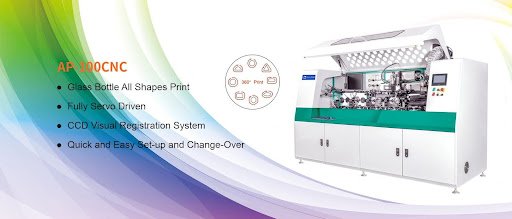
- Cylindrical screen printing machines are ideal for round objects like bottles, jars, tubes, and containers. Variants such as those with pneumatic or servo-motor drives deliver varying levels of speed and precision.
- Flat screen printing machines handle flat or irregular items like panels, graphics, and packaging sheets. These can be electric, pneumatic, or servo-driven, depending on customer needs and production volume.
Pad Printing Machines
Pad printing is a specialized method that uses silicone pads to transfer ink onto objects with complex or uneven surfaces, such as promotional items, medical tools, or toys. These machines are designed to handle detailed prints with excellent consistency.



UV Screen Printing Systems
UV systems integrate ultraviolet curing into the printing process, making them highly suitable for high-speed production lines that require quick drying and durable finishes. These systems are often used for printing on rigid plastics, glass, and other substrates requiring immediate cure post-print.
Key Features of Advanced Industrial Printing Machines
Industrial-grade printing machines today offer a suite of features that improve both operator ease and output quality:
Programmable Controls and Touchscreen Interfaces
Many modern machines come equipped with PLC control systems and touchscreens that allow operators to program print jobs with minimal training. This ensures repeatability and reduces setup time.
Servo vs. Pneumatic Operations
The choice between servo-motor and pneumatic drives depends on the balance between precision and cost:
- Servo drives provide high precision, fast accelerations, and excellent repeatability — ideal for complex multi-color applications.
- Pneumatic systems are robust, easier to maintain, and cost-effective for general printing tasks.
Adjustable Speeds and Station Configurations
Machines that allow for adjustable print stations and speed controls can adapt to different product sizes and production volumes, making them flexible for manufacturing changes.
Durable Construction and Safety Features
Industrial printers are built to withstand continuous use. Heavy-duty frames, emergency stop functions, and safety controls protect both the equipment and the operators.
Choosing the Right Machine for Your Business
Selecting the appropriate printing technology requires careful consideration of several factors: the type and size of products you intend to print, your annual production volume, your available budget, and your operators’ technical skills. Here’s a quick guide:
- Startups and small businesses: Semi-automatic machines can offer a good balance between cost and productivity.
- High-volume manufacturing: Fully automated systems deliver the speed and consistency required to scale.
- Specialized applications: Systems like UV curing or servo-driven flatbeds provide elevated precision for specialized prints.
In addition, considering after-sales support, training, and maintenance services from the manufacturer can make a significant difference in long-term performance and uptime.
Market Trends and Future Outlook
The printing industry continues to evolve with innovations like digital ink formulations, inline finishing systems, and connectivity for Industry 4.0 applications. Smart printers now gather production data, enabling predictive maintenance and improved quality assurance. Advancements in automation, robotics, and AI-enhanced controls suggest that future printing systems will be more capable of handling complex jobs with minimal human input.
Environmental sustainability is also rising in importance, with manufacturers developing energy-efficient drives and eco-friendly inks to reduce waste and emissions.
Conclusion: The Growing Importance of Auto Printing Machine Technology
In conclusion, the evolution of industrial printing — particularly the rise of the auto printing machine — has transformed what manufacturers can achieve in terms of product decoration and branding. Whether used for packaging, product labeling, or promotional goods, modern automated systems deliver unparalleled efficiency, precision, and flexibility. Companies that invest in the right printing technology stand to gain competitive advantages through improved quality control, higher output rates, and reduced operational costs. With rapid technological advancements on the horizon, the future of industrial printing promises even more innovation and opportunity. You can learn more here.