

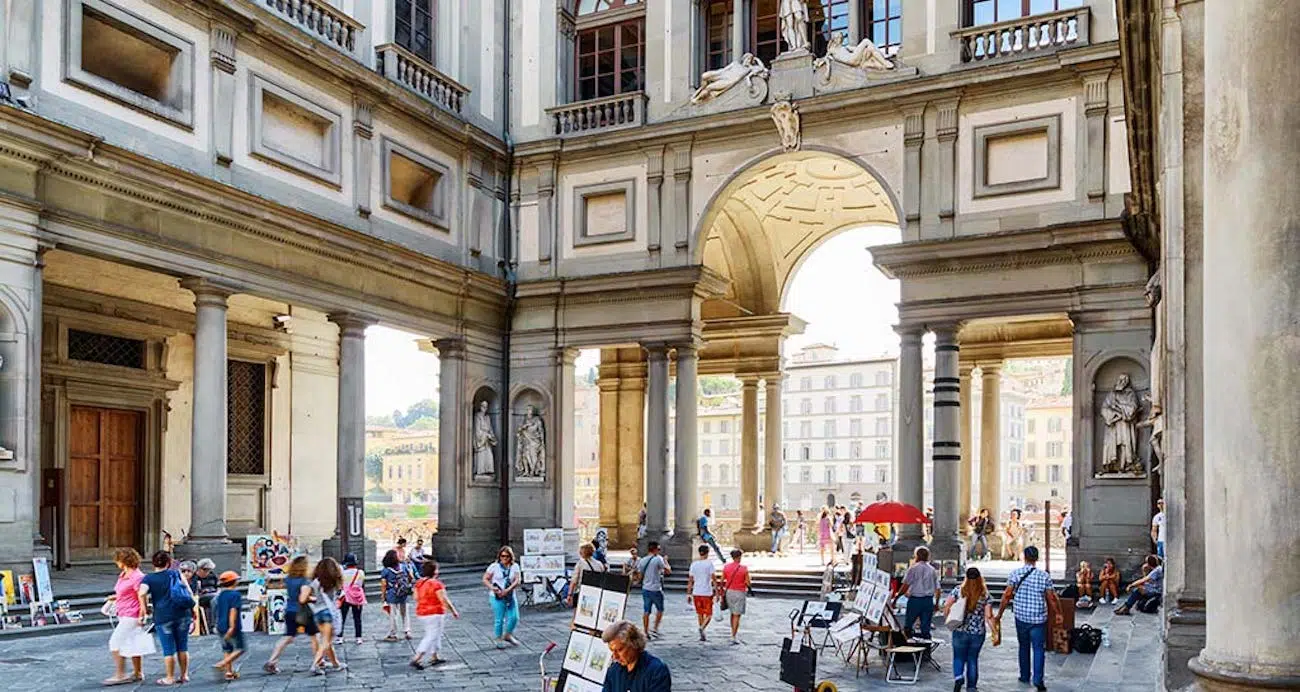
Florence Unmissable Attractions rewards travelers with concentrated, walkable history — the Uffizi Gallery, the Duomo, Ponte Vecchio, the Accademia’s David, and Palazzo Vecchio sit within a few hundred meters of each other in the city center. Visitors who plan ticket times in advance, climb the dome early, and reserve at least one day for Tuscan countryside towns like Siena or San Gimignano see the most of Florence without the longest lines.
- What makes the Uffizi Gallery worth visiting?
- Which masterpieces should visitors prioritize?
- When is the best time to visit, and which ticket option makes sense?
- Why is the Duomo considered Florence’s defining landmark?
- What makes Ponte Vecchio historically significant?
- Is Michelangelo’s David at the Accademia worth the visit?
- What role did Palazzo Vecchio play in Florentine history?
- What day trips from Florence are worth planning?
- What practical details should travelers plan around?
- When is the best time to visit Florence?
- How do visitors get around the city?
- Where should visitors stay and eat?
- What should travelers budget for a Florence visit?
- Making the most of a Florence visit
- Frequently Asked Questions
Florence does not announce itself. It unfolds, street by narrow street, revealing a church facade here, a sculpture-lined loggia there, until the weight of its history becomes impossible to ignore. Few cities compress this much artistic and political consequence into so small a footprint — the historic center can be crossed on foot in under thirty minutes, yet it holds works by Michelangelo, Botticelli, and Brunelleschi within walking distance of one another.
This is why Florence belongs on every serious traveler’s list. The city shaped the Renaissance, and the Renaissance shaped how the Western world thinks about art, architecture, and civic life. Visitors do not simply view this legacy from behind glass. They walk the same bridge merchants crossed in the 1300s, climb the same dome Brunelleschi engineered without modern scaffolding, and stand before the same statue of David that once stood watch over the city’s main square.
This guide moves through Florence’s essential sights in the order most visitors encounter them, with practical notes on timing, tickets, and what makes each location worth the visit. Readers will leave with a clear plan for the Uffizi, the Duomo, Ponte Vecchio, the Accademia, Palazzo Vecchio, and the Tuscan countryside beyond — along with the logistics needed to see all of it without losing a day to lines.
What makes the Uffizi Gallery worth visiting?
The Uffizi Gallery holds one of the most significant collections of Italian Renaissance art anywhere in the world. The building itself began as a set of offices — the name “Uffizi” is Italian for “offices” — commissioned in the 1560s to house Florence’s administrative and judicial functions under the Medici family. Over subsequent centuries, the Medici collection of paintings and sculpture moved into the upper floors, and the building gradually became a museum in its own right.
Which masterpieces should visitors prioritize?
Botticelli’s The Birth of Venus and Primavera anchor the collection, drawing the largest crowds and the longest pauses. Alongside them, works by Leonardo da Vinci, Titian, Raphael, and Caravaggio trace the arc of Italian painting from the early Renaissance through the Baroque. The gallery’s strength lies not in any single work but in the density of significant pieces housed under one roof — few museums offer this concentration of artists who directly influenced one another’s careers.
When is the best time to visit, and which ticket option makes sense?
Early morning, at opening, offers the clearest path through the main corridors before tour groups arrive. Booking a timed-entry ticket in advance is the single most effective way to avoid the queue that often wraps around the building by mid-morning. Visitors with limited time should prioritize the first and second floors, where the most significant Renaissance works are concentrated, rather than attempting to see the entire museum in one visit.
Why is the Duomo considered Florence’s defining landmark?
The Cattedrale di Santa Maria del Fiore — known simply as the Duomo — dominates Florence’s skyline, and has done so since the dome’s completion in 1436. Filippo Brunelleschi engineered the dome without the aid of traditional scaffolding, solving a structural problem that had stumped architects for over a century. The achievement remains one of the defining feats of Renaissance engineering.


What should visitors expect when climbing the dome?
The climb to the top of the dome involves 463 narrow stone steps, winding between the dome’s inner and outer shells. It is physically demanding and not recommended for those with mobility limitations or claustrophobia. The reward at the top is a panoramic view across Florence Unmissable Attractions terracotta rooftops, with the surrounding hills of Tuscany visible on clear days. Tickets for the dome climb are limited and timed, so advance booking is recommended, particularly in peak season.
What else is worth seeing near the Duomo?
The Baptistry of San Giovanni sits directly across from the cathedral’s entrance and holds the famous bronze doors — the “Gates of Paradise” — created by Lorenzo Ghiberti. Giotto’s Campanile, the bell tower beside the cathedral, offers its own climb and view, with fewer steps than the dome and comparatively shorter lines. Together, the Duomo, Baptistry, and Campanile form a single architectural complex that can be explored in a half-day visit.
What makes Ponte Vecchio historically significant?
Ponte Vecchio — the “old bridge” — has spanned the Arno River in some form since Roman times, though the current structure dates to 1345, rebuilt after a flood destroyed its predecessor. It is the only bridge in Florence Unmissable Attractions to survive the German retreat at the end of World War II, when the city’s other bridges were destroyed.
Why is the bridge associated with jewelry?
The bridge once housed butchers and tanners, whose trades produced waste that fouled the river below. In the sixteenth century, the Medici family ordered these merchants replaced with goldsmiths and jewelers, a tradition that continues today. The small shops lining the bridge still sell gold and silver jewelry, making Ponte Vecchio as much a working market as a historic monument.
When should visitors go for the best photographs?
Sunset draws the largest crowds to the bridge itself, but the best photographs of Ponte Vecchio are often taken from a distance — from the Ponte Santa Trinita, one bridge over, or from the Arno’s southern bank near the Oltrarno district. Early morning offers a quieter crossing, before the jewelry shops open and the foot traffic builds.
Is Michelangelo’s David at the Accademia worth the visit?
The Galleria dell’Accademia exists, in large part, because of a single statue. Michelangelo’s David, carved between 1501 and 1504 from a single block of marble, stands over seventeen feet tall and remains one of the most recognized sculptures in the world. The statue originally stood outside Palazzo Vecchio before being moved indoors in 1873 to protect it from weather damage — a replica now occupies its original outdoor position.
What else does the Accademia hold?
Beyond David, the gallery houses Michelangelo’s unfinished “Prisoners” series — figures left partially emerged from their marble blocks, offering a rare view into the artist’s working process. The museum also holds a collection of early Renaissance paintings and a room dedicated to plaster models and musical instruments, though most visitors come specifically for the sculpture hall.
How can visitors avoid long lines at the Accademia?
The Accademia is a small museum with a famous centerpiece, which means lines can be disproportionately long relative to its size. Booking a timed ticket online in advance is essential, particularly between April and October. Visiting at opening or in the final hour before closing typically offers the shortest wait.
What role did Palazzo Vecchio play in Florentine history?
Palazzo Vecchio has served as the seat of Florentine government since 1299, making it one of the longest continuously used civic buildings in Europe. The fortress-like exterior, with its crenellated tower and rusticated stone, was built to project strength during a period of intense political rivalry between Florentine families.
What is inside the palazzo worth seeing?
The Salone dei Cinquecento, the palace’s grand hall, holds massive frescoes depicting Florentine military victories, originally intended to be painted by both Michelangelo and Leonardo da Vinci — though neither completed their planned work there. The building also houses apartments once used by the Medici family, decorated with period furnishings and artwork that offer insight into Renaissance domestic life among Florence’s ruling class.
Is the tower climb worth the effort?
The Torre di Arnolfo, the palace’s tower, offers a view of Florence that rivals the Duomo’s dome climb, with notably shorter lines. The climb is steep but shorter than the cathedral dome, making it a practical alternative for visitors who want panoramic views without the longer wait.
What day trips from Florence are worth planning?
Florence Unmissable Attractions sits at the center of Tuscany, and the surrounding countryside extends the city’s appeal well past its historic core. The region’s rolling hills, vineyards, and medieval hill towns are reachable within an hour or two by car or train, making day trips a practical addition to any Florence itinerary.
Which nearby towns deserve a visit?
Siena, roughly an hour south of Florence, offers its own Gothic cathedral and the shell-shaped Piazza del Campo, site of the historic Palio horse race. San Gimignano, known for its medieval stone towers, provides a striking contrast to Florence’s Renaissance architecture. Pisa, home to the Leaning Tower, is reachable by direct train and makes for a manageable half-day trip.
What can visitors expect from Tuscany’s wine regions?
The Chianti region, stretching between Florence and Siena, is home to vineyards producing Chianti Classico wine, identifiable by the black rooster seal on the label. Many vineyards offer tastings and tours, and the drive through Chianti’s hills is itself part of the experience — a landscape of cypress trees, stone farmhouses, and terraced vines that has changed little in appearance for centuries.
What practical details should travelers plan around?
When is the best time to visit Florence?
April through June and September through October offer the most comfortable balance of weather and crowd size. July and August bring intense heat and the largest tourist volume, while winter months offer lower prices and shorter lines, though some outdoor attractions and day-trip options may have reduced hours.
How do visitors get around the city?
Florence’s historic center is compact enough to navigate entirely on foot, and walking remains the most practical way to move between major attractions. For day trips, regional trains connect Florence Unmissable Attractions to Siena, Pisa, and other Tuscan towns, while a rental car offers more flexibility for exploring the Chianti countryside.
Where should visitors stay and eat?
The Oltrarno district, south of the Arno River, offers a quieter alternative to the busier historic center while remaining within walking distance of major sights. For dining, Florentine cuisine centers on simple, high-quality ingredients — bistecca alla fiorentina, a thick-cut steak, and ribollita, a Tuscan bread soup, represent two dishes closely tied to the region’s culinary identity.
What should travelers budget for a Florence visit?
Museum tickets, particularly for the Uffizi and Accademia, represent a fixed and necessary cost, with timed-entry reservations typically carrying a small booking fee above the base ticket price. Meals and accommodations vary widely depending on neighborhood and season, with the historic center commanding higher prices than surrounding districts. Travelers planning multiple museum visits should look into combined ticket options, which can reduce per-attraction costs.
Making the most of a Florence visit
Florence Unmissable Attractions does not require a long stay to leave an impression — a few focused days, planned around its essential sights, is enough to understand why the city holds the place it does in art and architectural history. The Uffizi and Accademia reward those who book ahead. The Duomo and Palazzo Vecchio reward those willing to climb. Ponte Vecchio rewards an early-morning visit, before the crowds arrive.
Beyond the city itself, the Tuscan countryside offers a necessary counterpoint — a slower, quieter version of the same history, told through hill towns and vineyards rather than galleries and domes. Travelers who set aside at least one day for Siena, San Gimignano, or the Chianti region leave with a fuller sense of the region Florence anchors.
Plan ticket times in advance, prioritize the sights that matter most, and leave room for the unplanned turn down a side street. Florence Unmissable Attractions has a way of rewarding exactly that kind of attention.
Frequently Asked Questions
How many days should I spend in Florence?
Three full days allow time to see the Uffizi, the Duomo, Ponte Vecchio, the Accademia, and Palazzo Vecchio without rushing, plus one additional day for a Tuscan countryside trip.
Do I need to book tickets in advance for Florence’s main attractions?
Yes. The Uffizi, the Accademia, and the Duomo’s dome climb all use timed-entry systems, and walk-up lines can extend several hours during peak season, particularly between April and October.
Is Florence walkable, or do I need public transportation within the city?
Florence’s historic center is compact and walkable, and most major attractions sit within a twenty-minute walk of one another. Public transportation becomes more relevant for reaching the train station or neighborhoods slightly outside the center.
What is the best day trip from Florence for first-time visitors?
Siena offers the most complete alternative experience to Florence, with its own cathedral, historic square, and medieval street layout, and it’s reachable within about an hour by car or direct bus.
Is it worth climbing both the Duomo’s dome and Palazzo Vecchio’s tower?
Each offers a different vantage point — the Duomo’s dome provides the more iconic view directly over the cathedral’s terracotta roof, while the Palazzo Vecchio tower offers a broader view of the city with typically shorter lines.