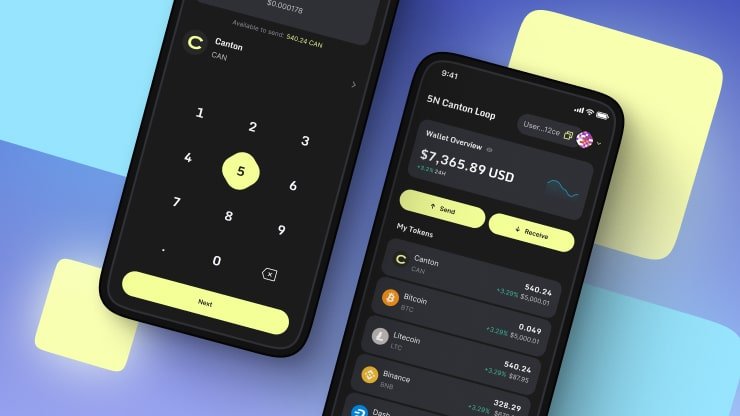
Most crypto exchanges are built on public blockchains where transparency is the default. That works well for open DeFi markets, but it can be difficult in institutional finance, where participants need confidentiality, controlled access, and audit-ready workflows. Canton.Network is designed for that world: it aims to let organizations transact and synchronize data while keeping sensitive details visible only to the parties that should see them.
- What is Canton.Network?
- Developing a Canton.Network exchange MVP
- 1. Pick one exchange workflow and define the “closed loop”
- 2. Model roles, privacy, and permissions in Daml first
- 3. Design the exchange logic around atomic settlement
- 4. Build the app layer: APIs, UI, and operational controls
- 5. Test with real participant behaviors and run a staged pilot
- Why the Canton ecosystem is useful for exchange builders
- Privacy that supports regulated workflows
- Interoperability without turning every connection into a custom project
- Institutional participation and network momentum
- Standards and shared patterns for assets and workflows
- Canton.Network use cases for exchanges
- Tokenized collateral and margin mobility
- Delivery-versus-payment settlement for tokenized assets
- Privacy-preserving payments and stablecoin-style rails
- Conclusion
If you’re exploring an exchange MVP on Canton.Network, the end goal is usually not “another retail trading app.” It’s a platform for regulated-style workflows, which places Canton.Network squarely within the scope of institutional cryptocurrency exchange software development, focused on privacy and interoperability by design.
What is Canton.Network?
Canton is a privacy-enabled blockchain protocol that connects separate applications and participants into what Daml documentation describes as a “virtual global ledger,” where parties hosted on different nodes can transact using smart contracts written in Daml, and where the contract model defines who can see data and who is authorized to act on it.
Canton’s key differentiators:
- Fine-grained privacy by default: Data visibility is governed at the contract level, so only entitled parties can see the details of a workflow.
- Interoperability across domains: Canton is built to coordinate transactions across separately operated applications while keeping privacy boundaries intact.
- Atomic, multi-party workflows: Complex actions can be completed as “all-or-nothing” even when different parts of the workflow belong to different participants or systems.
- Institution-ready asset standards: Canton has its own token interface standard (CIP-56), positioned as an ERC-20-style interface adapted for institutional needs and controlled asset movement.
Developing a Canton.Network exchange MVP
1. Pick one exchange workflow and define the “closed loop”
Start with a single workflow you can prove end-to-end. For example: “eligible participants onboard → asset is represented on Canton → trade is agreed → settlement completes → positions update.” The more clearly you define the loop, the easier it is to keep scope under control.
A simple MVP example is a bilateral trading flow with a small set of instruments and a clear permission model. A more complex MVP might include multi-party approvals or a payment-versus-delivery pattern, but it’s best to add those only after the basic loop works reliably.
2. Model roles, privacy, and permissions in Daml first
On Canton, privacy is not an afterthought you bolt on later—it’s part of how the contract model works. Daml’s design is centered around explicit authorization and visibility rules, which enable “sub-transaction” privacy (different parties see different pieces of the workflow).
For an exchange MVP, this means you should define roles early: who can submit an order, who can confirm a trade, who can view settlement status, and which parties can see pricing or identity details.



3. Design the exchange logic around atomic settlement
Institutional-style exchange workflows often fail not because trading is hard, but because settlement is messy. Canton is positioned to support atomic cross-application actions, so you can design processes where “trade + delivery + payment/collateral move” either completes together or not at all.
A practical MVP approach is to encode the “point of no return” clearly: when a trade transitions from intent to committed settlement, and what conditions must be true for it to finalize.
4. Build the app layer: APIs, UI, and operational controls
Even with strong on-ledger logic, your MVP needs a product layer: onboarding screens, permissions management, order/trade views, and a simple way to track statuses. This is also where you implement operational controls – things like admin roles, audit views, and “safe failure” handling when a participant is offline.
Because Canton workflows can span parties and systems, the UI needs to be clear about what’s happening and what’s waiting on another participant. The goal is to reduce confusion during exceptions (delays, rejections, missing approvals), because those are normal in real institutional flows.
5. Test with real participant behaviors and run a staged pilot
Testnet-style functional checks are not enough for an exchange MVP. You need scenario testing: partial participation, delayed responses, permission changes, and data that must remain private even when multiple parties are involved.
Canton publishes institutional pilot-style materials focused on real-world asset mobility and workflow coordination, which is a useful mental model for MVP validation: prove the workflow under realistic constraints, then expand participants and assets once you can operate reliably.
Why the Canton ecosystem is useful for exchange builders
Privacy that supports regulated workflows
Canton is built around privacy controls enforced at the contract level, so data visibility is not “all public by default.” Only the parties that are entitled to see a transaction can access its details, which better matches institutional environments where counterparties, pricing terms, and positions cannot be exposed broadly.
For an exchange MVP, this enables cleaner designs for regulated-style trading. You can share exactly what each role needs to see without broadcasting sensitive information across the entire network. That reduces privacy workarounds and lowers the chance of accidental data leakage as the platform grows.
Interoperability without turning every connection into a custom project
Canton is positioned to let separate applications and organizations coordinate workflows while keeping privacy boundaries intact. Instead of building one-off integrations for every counterparty and system, you can design standardized interactions that synchronize state changes across domains when needed.
For exchange builders, this is especially valuable in real settlement flows, where trading, custody, collateral, and payments often sit in different systems. When interoperability is built into the network model, you can reduce reconciliation friction and design processes that behave more like institutional settlement: clear states, fewer manual handoffs, and fewer “missing link” failures.
Institutional participation and network momentum
Canton has been promoted as an institutionally focused network, with public communications highlighting participation and ecosystem growth over time. That matters because exchanges become more valuable as they connect to real participants and real asset workflows, not just isolated prototypes.
From an MVP perspective, ecosystem momentum can help reduce the “cold start” problem. If your exchange can connect to counterparties, token issuers, or workflow partners already operating in the network, it can be easier to validate adoption, expand use cases, and justify deeper investment in integrations and product maturity.
Standards and shared patterns for assets and workflows
Standards lower build cost and reduce integration risk. Canton’s CIP-56 token interface is presented as a standardized way to represent and manage assets across participants, similar in spirit to how ERC-20 standardized token behavior in public chains, while reflecting institutional needs around permissions and control.
For an exchange MVP, shared patterns mean fewer custom decisions about “how assets should behave” and more time spent on what actually differentiates your product: market structure, onboarding rules, settlement workflows, and reporting. It also makes it easier to align with partners and integrate new assets without rewriting core logic each time.
Canton.Network use cases for exchanges
Tokenized collateral and margin mobility
One of the most exchange-relevant institutional themes is collateral mobility—moving eligible assets quickly to meet margin needs, reduce idle capital, and improve responsiveness. Canton materials describe tokenization and collateral workflows, including pilots that emphasize atomicity and interoperability across multiple permissioned environments.
For an exchange MVP, this can look like: posting collateral, tracking eligibility, triggering margin calls, and confirming releases – all with role-based visibility.
Delivery-versus-payment settlement for tokenized assets
Exchanges don’t just need “trading.” They need a settlement that can be audited and trusted. Canton and ecosystem discussions frequently highlight atomic settlement patterns, which align with delivery-versus-payment style workflows where asset transfer and payment are coordinated.
An MVP here might focus on a small set of instruments (for example, tokenized cash-like instruments and one asset type) and prove that settlement finality behaves exactly as designed.
Privacy-preserving payments and stablecoin-style rails
Canton ecosystem reports have described privacy-preserving payment and stablecoin issuance use cases as part of institutional digital asset infrastructure.
For an exchange, that’s relevant because many exchange workflows depend on dependable cash rails, especially when you want near-real-time settlement without exposing payment details broadly.
Conclusion
Canton.Network is built for environments where privacy, permissions, and interoperability are requirements. Its approach (Daml-based authorization and visibility, plus cross-domain coordination) is aimed at letting institutions run real workflows without putting sensitive data on a fully transparent public ledger.
If you’re building an exchange MVP on Canton, the strongest approach is to keep the first release narrow: choose one institutional workflow, model roles and permissions carefully, prove atomic settlement behavior, and test with real participant-style scenarios. Once that core loop is stable, expanding assets, participants, and integrations becomes a controlled evolution instead of a risky rebuild.




![Create an image with 640×427 dimensions based on the topic: [melker schörling ab / anticimex förvärvsstrategi]. The scene should be visually clear, high quality, and aesthetically pleasing, with realistic lighting and detailed elements. Do not include any text in the image.](https://reelsmedia.co.uk/wp-content/uploads/2026/03/Gemini_Generated_Image_h2452hh2452hh245-330x220.png)