When the FDA established the new category of Over-the-Counter (OTC) hearing aids, it was a victory for accessibility. However, it also created a confusing marketplace. You can now find devices ranging from 99 to 4,000, all claiming to bring your hearing back.
- 1. The Foundation: Know Your Hearing Level
- 2. Form Factor: It’s Not Just About Being “Invisible”
- 3. The “Invisible” Specs: How to Read the Datasheet
- 4. The Hidden Needs: What Users Actually Complain About
- 1️⃣ Tinnitus Management (The Ringing)
- 2️⃣ Physical Buttons vs. App Dependency
- 3️⃣ Real-World Battery Life
- 5. Conclusion: Making the Rational Choice
According to the National Institute on Deafness and Other Communication Disorders (NIDCD), approximately 37.5 million American adults aged 18 and over report some trouble hearing. Yet, historically, only one in five people who could benefit from a hearing aid has actually used one.
Why? High costs and complex choices.
If you are navigating this market for yourself or a loved one, looking at the price tag is the wrong place to start. To find a device that won’t end up in a junk drawer, you need to look at the technology under the hood. Here is your comprehensive guide to choosing the right hearing aid—from an insider’s perspective.
1. The Foundation: Know Your Hearing Level
Before looking at hardware, you must assess the “software”—your ears. Not all hearing aids work for all hearing losses.
- Mild to Moderate Loss: This is the “Sweet Spot” for OTC devices.
- Symptoms: You can hear people talking, but you can’t distinguish the words (clarity issues). You struggle in noisy restaurants or turn the TV up louder than others.
- Solution: High-quality OTC hearing aids are designed specifically for this group.
- Severe to Profound Loss:
- Symptoms: You cannot hear a shout; you rely heavily on lip-reading; you don’t hear loud traffic noise.
- Solution: Do not buy an OTC device. You require a prescription hearing aid and a professional audiologist’s care.
2. Form Factor: It’s Not Just About Being “Invisible”
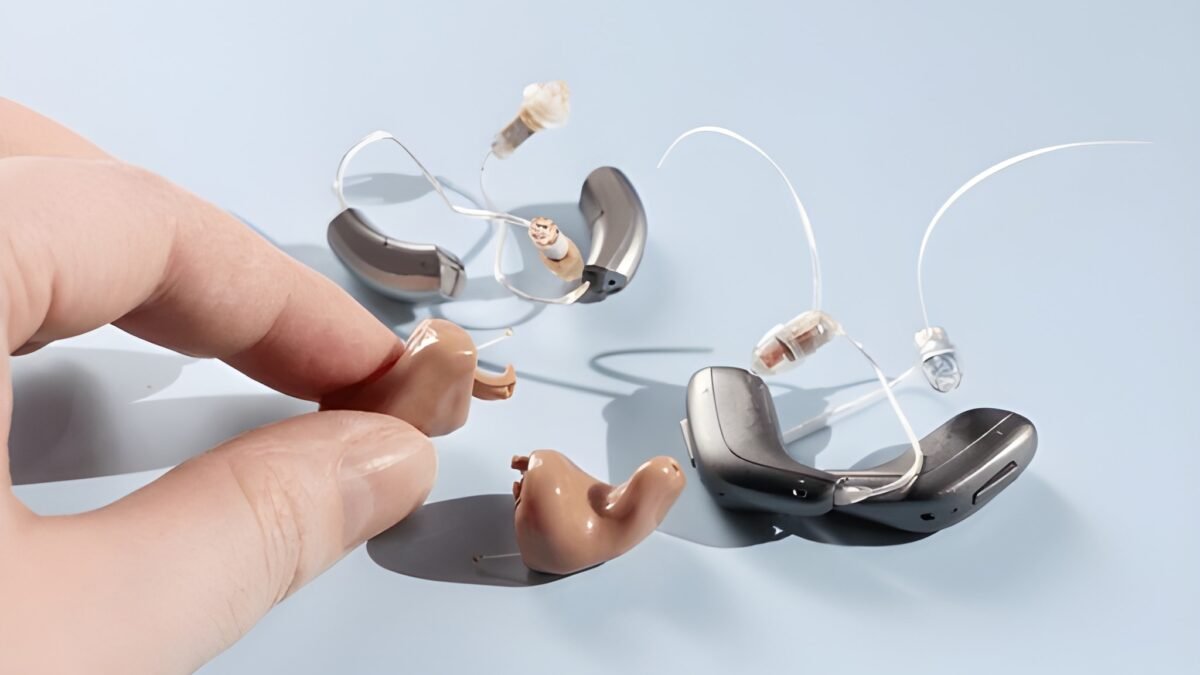
Many first-time buyers are obsessed with size. They want the smallest possible device. However, size dictates physics. Here is an unbiased look at the four main styles:
- BTE (Behind-the-Ear): The classic style where the electronics sit behind the ear, connected to the ear canal by a tube.
- Pros: Largest battery life, easy-to-use physical buttons (great for dexterity), very durable, less prone to moisture damage.
- Cons: More visible than others.
- RIC (Receiver-in-Canal): Similar to BTE, but the speaker wire goes into the ear.
- Pros: More natural sound, less “plugged up” feeling.
- Cons: The speaker in the ear is vulnerable to wax and moisture; wires can break.
- ITE (In-the-Ear): Fills the outer ear bowl.
- Pros: Easy to insert one-handed.
- Cons: Can pick up wind noise; visible.
- CIC/IIC (Completely-in-Canal): The “Invisible” ones.
- Pros: Cosmetically appealing.
- Cons: Tiny batteries (short life), hard to handle for seniors, high maintenance (wax clogging), and no physical volume buttons.
Verdict: If you prioritize aesthetics, look at RIC or CIC. If you prioritize battery life, durability, and ease of handling, BTE is often the most practical choice for seniors.
可以插入



3. The “Invisible” Specs: How to Read the Datasheet
This is where manufacturers try to trick you. Do not buy a device unless you can verify these two critical technologies.
A. Channels (Digital vs. Analog)
Think of a hearing aid like a photo editor.
- Analog / Low Channel (1-4): It’s like turning up the brightness on a blurry photo. Everything gets louder—the voice you want to hear and the fork scraping on the plate.
- High Channel (12-16+): It’s like a high-resolution image. The device splits sound into many frequency bands. It can lower the volume of the background noise (low frequency) while boosting the volume of speech (high frequency).
- Buying Tip: Look for a minimum of 12 to 16 channels for a natural experience.
B. WDRC (Wide Dynamic Range Compression)
This is a mouthful, but it is the most important feature for comfort.
Without WDRC, a hearing aid is just a linear amplifier. If someone whispers, you hear it. If a door slams, it might hurt your ears.
WDRC acts as a smart guard: It amplifies soft sounds significantly so you can hear them, but it compresses loud sounds so they remain comfortable. It keeps the world audible but safe.
4. The Hidden Needs: What Users Actually Complain About
Based on user feedback from forums like HearingTracker and Reddit, satisfaction often relies on three secondary features:
1️⃣ Tinnitus Management (The Ringing)
A large percentage of people with hearing loss also suffer from Tinnitus (ringing in the ears). Standard amplification helps, but dedicated Tinnitus Masking Modes are better. These modes generate a soothing background noise to distract your brain from the ringing.
- Check: Does the device have a specific masking mode?
2️⃣ Physical Buttons vs. App Dependency
Bluetooth is great, until it disconnects. For many older users, fumbling with a smartphone app to change volume is frustrating.
- Advice: Look for devices that have independent physical volume/mode rockers on the body. It ensures the device is always usable, even if your phone is dead.
3️⃣ Real-World Battery Life
Marketing often says “All Day Battery.” But does that mean 8 hours or 16 hours?
If you stream TV or go to dinner, a 12-hour battery won’t cut it. Constant recharging creates anxiety.
- Benchmark: Look for rechargeable devices that offer 24+ hours on a single charge. This gives you a safety buffer.
5. Conclusion: Making the Rational Choice
The market is vast. You have premium brands like Phonak and ReSound costing thousands, and you have reputable OTC brands bridging the gap.
When you are ready to choose, use this checklist:
- Is it for Mild-to-Moderate loss?
- Does it have at least 12-16 channels and WDRC?
- Does the form factor fit your dexterity (e.g., BTE for ease of use)?
- Does it address specific needs like Tinnitus or long battery life?
You don’t always need to pay a premium for these features. For instance, in the sub-$500 category, the Retekess TE202 is a notable example that fits these criteria—offering 16-channel processing, physical controls, and a dedicated tinnitus mode—without the markup of “Big Five” brands.









![Project XL Trello Link & Wiki [Verified & Official] [January 2025]](https://reelsmedia.co.uk/wp-content/uploads/2025/01/Roblox-Project-XL-Trello-Link-Wiki-Verified-Official-330x220.jpg)