

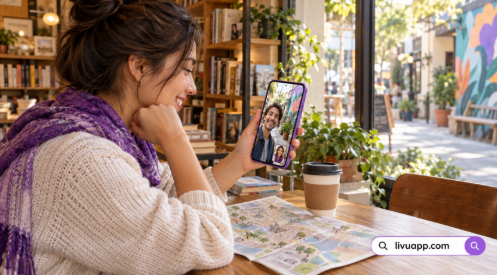
Meeting someone online does not require a dramatic topic to become memorable. Sometimes the most engaging conversations begin with a quiet bookstore, a colorful side street, or a café that only local residents seem to know.
- Why Hidden Places Make Good Conversation Topics
- Start With a Simple Local Question
- Ask What Makes the Place Special
- Show, Don’t Only Describe
- Build a Mini Route Together
- Keep Personal Safety in Mind
- Move Beyond Travel Advice
- Welcome Ordinary Answers
- Compare Atmospheres Without Ranking Them
- End With a Future Conversation Hook
During a video chat 1 on 1, sharing these ordinary places can make the exchange feel immediate and personal. Rather than relying on familiar questions about work, age, or weekend plans, both people get to explore the details that give their surroundings character.
A video call 1vs1 can therefore become a small window into another person’s world—even when neither participant leaves their neighborhood.
Why Hidden Places Make Good Conversation Topics
Famous attractions usually produce predictable answers. Ask someone about Paris, and the Eiffel Tower may appear within seconds. Ask about New York, and Times Square is likely to follow.
A hidden local place tells a more individual story. It could be a family-run bakery, a peaceful bench overlooking a river, a secondhand bookshop, or an alley filled with street art. The choice reveals something about the person sharing it.
Someone who recommends a busy food market may enjoy energy and spontaneity. A person who prefers a quiet garden might value calmness. These are not rigid personality tests, but they offer natural openings for a richer exchange.
Start With a Simple Local Question
You do not need to ask for a complete neighborhood tour. Begin with a question that is easy to answer:
- “Where do you go when you want a quiet hour?”
- “Is there a place near you that visitors usually miss?”
- “What is the most interesting street in your area?”
- “Do you know a café or shop with an unusual story?”
- “Where would you take a friend who had only one free afternoon?”
These prompts work because they invite personal recommendations rather than factual descriptions. The speaker becomes a local guide, but the conversation remains relaxed.



Ask What Makes the Place Special
Once a location is mentioned, focus on its meaning rather than its ranking. A small park does not need to be the most beautiful park in the city. It only needs to matter to the person describing it.
Useful follow-up questions include:
- “How did you discover it?”
- “What time of day is best there?”
- “Do you usually visit alone or with friends?”
- “Is there a particular sound, smell, or view you remember?”
- “Has the place changed since you first found it?”
Sensory questions are especially valuable because they bring a distant setting to life. The sound of a morning market or the smell of bread from a neighborhood bakery can create a clearer image than a list of tourist facts.
Show, Don’t Only Describe
Video allows people to include visual clues. If it is safe and appropriate, someone might show a postcard, a photo, a café cup, a small item purchased at a local market, or the view from a nearby window.
A folded map can also add an interactive element. One person can point out where they live in relation to a favorite place without revealing a precise home address. The other person can then compare the size, layout, or atmosphere of their own neighborhood.
The object is not the main subject. It simply gives the conversation something concrete to move around.
Build a Mini Route Together
After exchanging one or two places, imagine a short route through the area. It could begin at a breakfast spot, continue through a park, and end at a bookstore or scenic viewpoint.
Try questions such as:
- “Where should we begin?”
- “What would we eat along the way?”
- “Would this route be better in the morning or evening?”
- “What should someone wear or bring?”
- “Where would we stop if it started raining?”
Creating a route together introduces gentle collaboration. Each person can add details, make choices, and respond to unexpected possibilities. The result feels more like a shared activity than a sequence of questions.
Keep Personal Safety in Mind
Talking about local places should not require anyone to reveal where they live. Avoid requesting exact addresses, building names, daily routines, or real-time location information.
People can describe a general district, type of venue, or memorable feature instead. For example, “a bookshop near the old part of town” is enough to support a conversation.
If someone is outside during the call, they should remain aware of traffic, crowds, and their surroundings. A stationary conversation from a safe public location is generally easier than walking while concentrating on a screen.
Respecting these boundaries helps both participants remain comfortable.
Move Beyond Travel Advice
The hidden-corner method is not only about collecting destinations. Local places can lead naturally into other subjects.
A community garden may begin a discussion about cooking or sustainability. A music shop could lead to favorite instruments. A mural might inspire a conversation about art, while an old cinema could bring up childhood movies.
Follow the personal connection instead of constantly returning to logistics. The objective is not to design the perfect itinerary; it is to understand why certain environments stay in someone’s memory.
Welcome Ordinary Answers
Not every person lives near spectacular scenery. Someone may initially say that their area is boring or that they rarely explore it.
In that case, make the question smaller. Ask where they buy a favorite snack, which route has the best evening light, or where they would go to read without interruption. Almost every neighborhood contains details that become interesting when viewed through someone else’s eyes.
An ordinary answer can also encourage honesty. People do not need to perform excitement or present their city like a tourism advertisement.
Compare Atmospheres Without Ranking Them
Two neighborhoods may feel completely different. One might be crowded and colorful; another may be quiet and spacious. Treat those differences as material for discovery rather than competition.
Instead of saying, “My city is better,” ask, “What would surprise me most about yours?” You can also compare daily rhythms: when shops open, how people travel, what evenings sound like, or where neighbors gather.
This keeps cultural curiosity alive without reducing places to stereotypes.
End With a Future Conversation Hook
Before finishing, remember one location or detail the other person mentioned. You might say, “Next time, tell me whether you tried that new bakery,” or “I would love to see the book you found in that shop.”
A specific reference shows that you were listening. It also creates a natural reason to speak again without making a large promise.
The hidden-corner method works because it turns location into personal storytelling. A video chat 1 on 1 becomes more vivid when both people share the small places that shape their routines. Likewise, a video call 1vs1 can feel like a brief journey when curiosity is guided by detail, imagination, and respect.