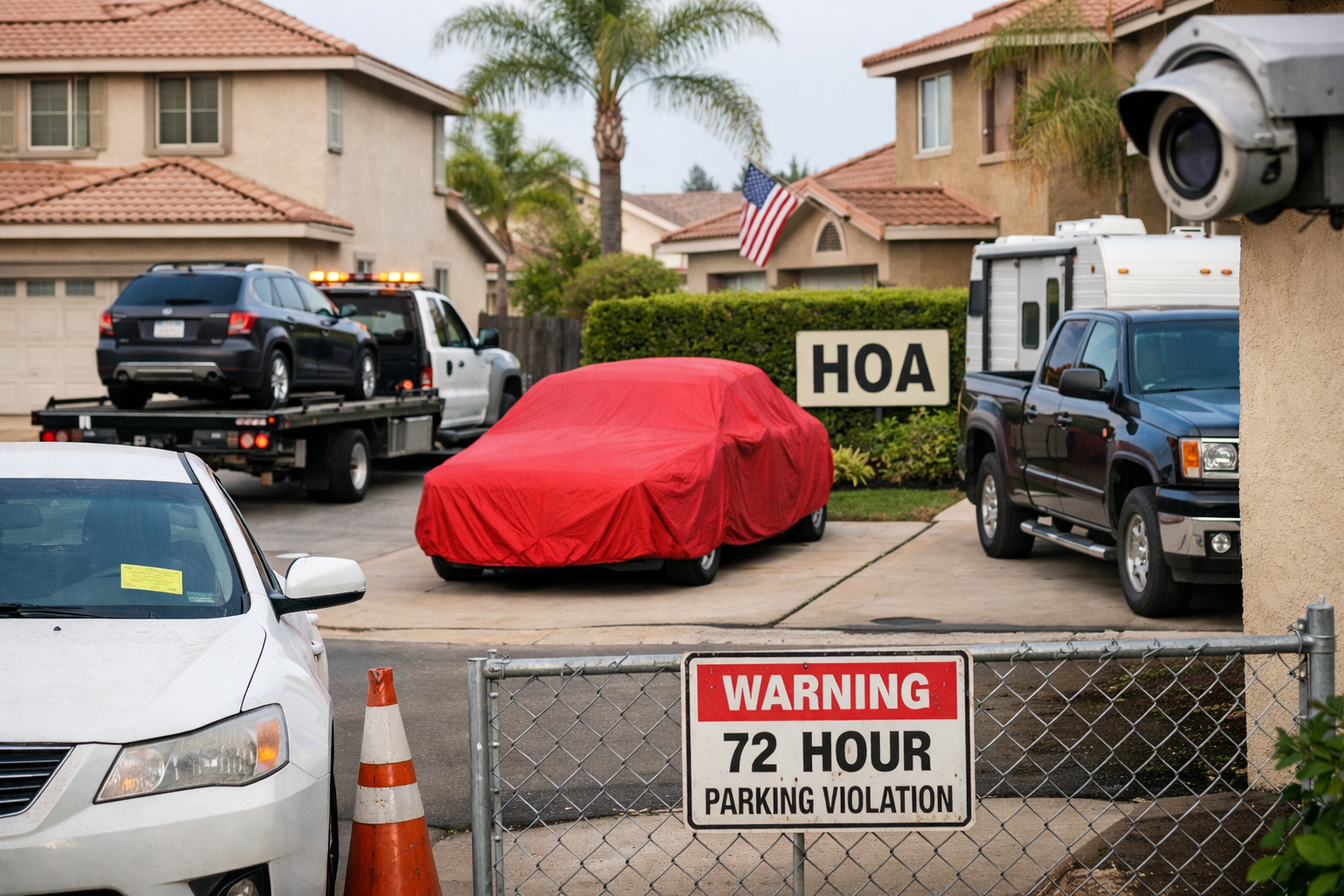
The “Chula Vista Dream” is a specific brand of California living. It usually involves a nice stucco home in a master-planned community, mild weather, and a garage full of outdoor gear. We live in the gateway to adventure—minutes from the San Diego Bay for boating, and an hour from the desert for off-roading.
Naturally, residents here want to own the toys that make this lifestyle possible. They buy the jet skis, the RZRs, and the dirt bikes. And inevitably, they buy a trailer to haul them.
But for thousands of homeowners in neighborhoods like Eastlake, Otay Ranch, and Rancho Del Rey, that trailer purchase triggers an unexpected battle. It isn’t a battle with the traffic or the terrain; it is a battle with the Homeowners Association (HOA).
In the neatly manicured streets of South Bay, the utility trailer is persona non grata. Before you commit to buying your own hauling rig, you need to understand the “72-Hour Trap” and the logistical nightmare of trying to park a recreational asset in a city designed for curb appeal.
The Aesthetics of Restriction
To understand the hostility toward trailers, you have to look at how modern Chula Vista was built. Much of the city’s expansion over the last two decades has been in “Master Planned Communities.” These developments are legally structured to maintain property values by enforcing strict visual uniformity.
In the eyes of the HOA board, a utility trailer—even a nice, brand-new one—is an eyesore. It is viewed as “industrial blight” that disrupts the suburban harmony.
Most CC&Rs (Covenants, Conditions, and Restrictions) in these zones have a specific clause regarding “Recreational Vehicles and Trailers.” They typically prohibit parking any non-passenger vehicle in a driveway or on the street, except for the purpose of “loading and unloading.”
This is where the “72-Hour Rule” comes in. Most codes allow you to park a trailer for a maximum of 48 to 72 hours to prep for a trip. After that, it must vanish.



The “Snitch” Economy
This creates a high-stress game of “beat the clock” for trailer owners.
If you come home from a long weekend in Ocotillo Wells on Sunday night, tired and dusty, you might leave the trailer in the driveway, planning to clean it on Tuesday. But in many Chula Vista neighborhoods, enforcement is crowdsourced. A neighbor, concerned about “blight,” snaps a photo and emails it to the property management company.
By Wednesday morning, you have a warning letter. By Friday, you have a fine.
Some homeowners try to beat the system by shuffling the trailer—moving it from the driveway to the street and back again. But savvy HOA patrols mark tires with chalk or take timestamped photos. They know the game. The stress of constantly looking over your shoulder to see if the patrol car is driving by turns the joy of ownership into a source of anxiety.
The Storage Crisis
“Fine,” the homeowner thinks. “I’ll just store it off-site.”
This leads to the second hurdle: The Chula Vista Storage Crisis. Because the HOAs are so strict, everyone needs off-site storage. Demand vastly outstrips supply.
Finding a secure, paved storage yard in the South Bay that isn’t completely full is difficult. If you do find one, the price is shocking. Outdoor parking spots for a 16-foot trailer can range from $150 to $300 per month. Indoor storage is nearly double that.
Let’s do the math on the “Cost of Ownership”:
- Purchase Price: $4,000 for a decent utility trailer.
- Registration & Maintenance: $150/year.
- Storage Fees: $2,400/year ($200/month).
If you own the trailer for five years, you have spent $12,000 in storage fees—three times the value of the trailer itself—just for the privilege of parking it in a dusty lot 20 minutes away from your house.
The “Ghost” Trailer
This distance creates a psychological barrier known as the “Ghost Trailer” phenomenon.
When your trailer is parked in your driveway, you use it. You take it for spontaneous dump runs or help a friend move a couch. But when your trailer is parked in a secure lot in Otay Mesa, behind a gate code, a 20-minute drive away, you stop using it for small tasks.
The “friction” of retrieval becomes too high. You have to drive to the lot, sign in, hitch up, check the tires, drive back to your house, load up, do the job, and then repeat the entire process in reverse to drop it off.
Eventually, the trailer becomes a “Ghost.” You are paying hundreds of dollars a month for a specialized tool that sits rotting in the sun, used only once or twice a year for the big family vacation.
The “Just-in-Time” Solution
This is why the rental model has exploded in popularity across the South Bay. It isn’t just about saving money; it is about saving space and mental energy.
Renting operates on a “Just-in-Time” logistics model. You don’t need a trailer 365 days a year; you need it for the three days you are actually using it.
By renting, you bypass the entire HOA conflict.
- Friday: You pick up the rental. You park it in your driveway to load up. The HOA doesn’t care because you are within the “loading” window.
- The Weekend: You use the trailer for your trip or project.
- Sunday/Monday: You return the trailer.
Your driveway is empty. You receive no fines. You pay no storage fees. You have no tires to replace or bearings to grease.
Conclusion
The appeal of the Chula Vista lifestyle is the freedom to explore. But true freedom is not being tethered to a depreciating asset that your neighbors hate.
For the vast majority of residents living under the watchful eye of a Master Association, the math simply doesn’t support ownership. The friction of the rules and the cost of the storage turn the trailer into a burden rather than a benefit.
Smart homeowners are realizing that the ultimate “hack” for navigating the 72-hour rule is to simply opt out of the game entirely. By utilizing trailer rentals in Chula Vista CA, they get the heavy-duty capability they need for the desert or the dump, without ever having to worry about that dreaded letter from the HOA landing in their mailbox.