- What makes a cherry tree truly suitable for a small garden
- Stella: the practical standard for small-space sweetness
- Lapins and Sunburst: bigger fruit without giving up manageability
- Morello: the small-space cherry that earns its keep in shade and in the kitchen
- Celeste and Nabella: compact options for patios, training, and tighter modern plots
- How to make miniature cherries crop well in Britain
Small gardens do not rule out reliable cherry crops. What matters is choosing the right combination of rootstock, variety, training method, and position. Many gardeners assume cherries need a full orchard setting, yet modern miniature and dwarf forms can crop well in patios, compact lawns, courtyards, and narrow side returns if they are matched properly to the space available. The real question is not whether a cherry tree can fit, but which kind will earn its place.
The fruit trees specialists at Fruit-Trees nursery advise that gardeners who want to buy miniature cherry trees should pay as much attention to rootstock and final trained size as to the fruit itself. In practical terms, a good miniature cherry for a British garden is one that crops dependably, copes with ordinary maintenance, and can be kept productive without constant hard pruning.
That point matters because “miniature” is often used loosely. Some trees are naturally compact, while others are reduced in size by a dwarfing rootstock such as Gisela 5 or by training as a patio tree, column, fan, or espalier. For gardeners in the UK, that distinction affects everything from final height to watering needs. A compact cherry in the ground may settle better in dry summers than a container specimen, while a patio tree in a large pot can suit renters or anyone gardening on paving. The best choice depends less on fashion and more on how the tree will actually be grown over the next five to ten years.
This guide looks at six miniature cherries that genuinely work in smaller spaces and explains what each one does well. The focus is not simply on sweetness or colour, but on performance where room is limited: self-fertility, ease of maintenance, suitability for pots, cropping habit, and usefulness in typical British conditions.
What makes a cherry tree truly suitable for a small garden
A cherry tree earns its place in a compact garden when it combines restrained growth with useful cropping. That sounds obvious, but it is where many mistakes begin. Gardeners often buy on fruit description alone, then discover that the tree wants more height, more width, or a pollination partner they did not plan for. In a small space, every decision is magnified, so a tree that is merely “compact-ish” may still become inconvenient after a few seasons.
Rootstock is the first filter. For sweet cherries, Gisela 5 is widely regarded as one of the best options for keeping trees smaller and bringing them into fruit relatively early. Colt is commonly used as well, but it is more vigorous and better suited to medium spaces than truly tight ones. A variety sold as miniature on a more vigorous rootstock may still outgrow a pot or demand stronger pruning. That does not make it unsuitable, but it changes the workload.



The second filter is self-fertility. In a restricted garden, there may be room for only one tree, so self-fertile cherries hold a clear advantage. They can still benefit from insect activity and compatible nearby blossom, but they do not depend on a second cherry in the same garden. This makes cultivars such as Stella and Lapins particularly practical for town gardens.
The third issue is training. A patio tree can be kept rounded and compact, but fans and espaliers are often even more efficient where width is available against a fence or wall. A fan-trained cherry on a sunny boundary can outperform a freestanding tree in an awkward lawn corner because light reaches more of the fruiting wood. In Britain, wall-trained cherries can also gain some shelter from spring weather, which helps blossom and improves ripening.
Containers can work, though they are not automatically the easiest route. A potted cherry needs regular watering, consistent feeding, and eventual root management or repotting. Gardeners sometimes assume a pot will simplify care because it reduces size, but in practice it often increases maintenance. In the ground, a dwarf tree usually has a steadier life. In a container, it relies entirely on the gardener. That is manageable, but it should be planned for from the start.
Stella: the practical standard for small-space sweetness
If one miniature cherry deserves to be called the benchmark for smaller British gardens, it is Stella. It remains one of the most useful sweet cherries because it combines good flavour with self-fertility and a fairly manageable habit when grown on a dwarfing stock. For people with room for only one tree, that alone puts it near the top of the list.
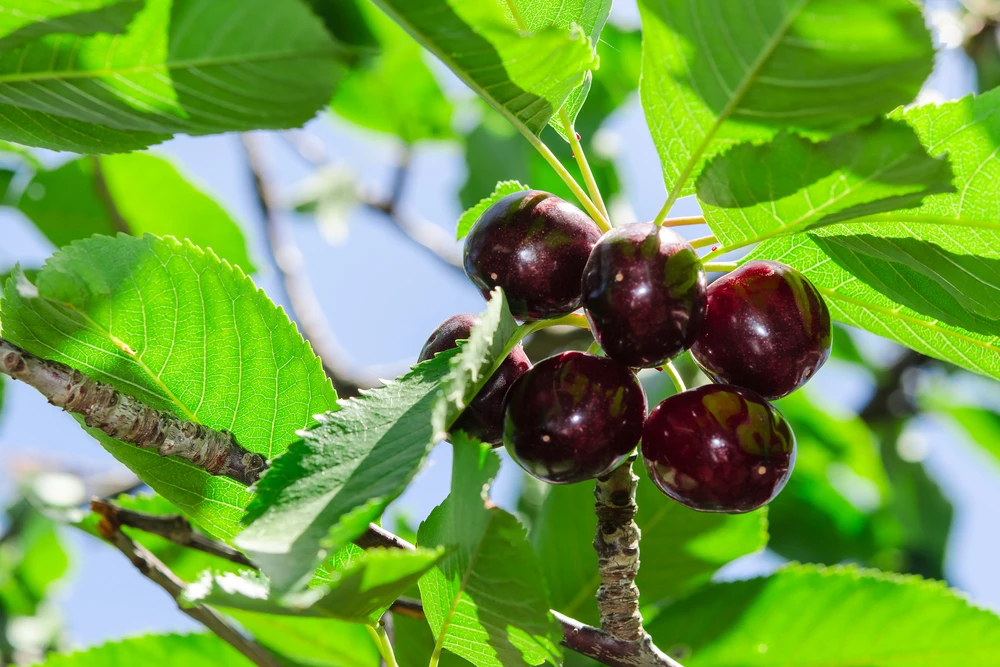
The fruit is dark red to mahogany when ripe, with a sweet flavour that suits fresh eating. It is not unusual for gardeners to choose Stella because they want the classic idea of a home-grown cherry: sweet, dark, and ready to pick from a tree close to the house. In a compact garden, it can justify that choice because it is not merely attractive on paper; it is proven and widely grown.
Stella is especially useful as a patio or small bush tree and can also be trained as a fan. In truly limited spaces, fan training may be the smarter route because it keeps the shape predictable and makes netting easier. Birds are one of the main practical issues with cherries, and a small tree that cannot be netted properly is often more frustrating than a larger tree that can. Stella’s growth habit makes it one of the easier sweet cherries to protect.
There are, however, limits. A heavily cropping Stella can need careful watering in a pot to prevent stress and fruit drop. It also benefits from summer pruning rather than winter pruning, which is standard good practice for cherries in order to reduce disease risks such as silver leaf and bacterial canker. None of that is especially difficult, but it does mean that Stella performs best with steady, sensible care rather than neglect.
In flavour terms, it remains one of the best all-rounders for ordinary household use. Some newer cherries may be larger or slightly firmer, but Stella holds its position because it meets the practical demands of a small garden so well. It is rarely the wrong choice for a gardener who wants one dependable sweet cherry and does not want to complicate pollination.
Lapins and Sunburst: bigger fruit without giving up manageability
Lapins and Sunburst are often compared because both appeal to gardeners who want larger, sweet dessert cherries with good visual appeal and a sense of abundance from a relatively compact tree. In small gardens, they offer a slightly different proposition from Stella. They are less about the basic “one small cherry tree” brief and more about getting a fuller dessert-cherry experience without moving into orchard scale.
Lapins is particularly attractive because it is self-fertile and known for heavy cropping. The fruit is large, dark, and sweet, and the tree can be kept within a realistic size on dwarfing stock. For a gardener who values yield in proportion to footprint, Lapins has a strong case. It often gives the impression of a generous tree, one that makes the most of the limited room it has been given. In a sheltered sunny site, especially against a warm fence, it can be very rewarding.
That said, a productive Lapins may need thinning of expectations if it is grown in a container. Heavy crops and restricted root space can make water management critical. The tree itself may remain compact, but fruit quality suffers quickly if roots dry out. In the ground, it is more forgiving.
Sunburst is also self-fertile and known for large fruit, usually with a sweet, juicy character that suits fresh eating. It is often praised for the quality of the cherries rather than just the convenience of the tree. In a small garden where the owner wants a tree that feels like a real summer crop rather than a token fruit plant, Sunburst can fit well. It has enough presence to feel worthwhile, yet it can still be trained or maintained within modest dimensions.
Between the two, Lapins often edges ahead on reliability and productivity in restricted settings, while Sunburst may appeal more to those prioritising fruit size and eating quality. Neither should be chosen casually for the smallest pot on the patio; they are better thought of as compact trees that still want decent root room, sunlight, and regular feeding. But for gardeners with a manageable patch of soil or a large container and a warm site, both can deliver far more than their footprint suggests.
Morello: the small-space cherry that earns its keep in shade and in the kitchen
Morello is the practical outsider in any list dominated by sweet cherries, and that is exactly why it deserves attention. It is not the tree most people imagine first, but in many smaller British gardens it may be the most useful. Unlike dessert cherries, Morello is grown primarily as a sour cherry for cooking, bottling, jam, and baking. That makes it less of an impulse choice and more of a strategic one.
Its greatest advantage is adaptability. Morello tolerates conditions that sweet cherries dislike, including a degree of shade. In small gardens where the sunniest wall is already occupied or where neighbouring buildings reduce light, this can be decisive. A north-facing or east-facing wall that would be disappointing for a sweet cherry can still support a worthwhile Morello. Trained as a fan, it becomes one of the most realistic fruit-tree options for awkward urban spaces.
It is also self-fertile, which strengthens its value where only one tree can be accommodated. The fruit hangs well and is easier to use in quantity than many people expect. British gardeners who enjoy preserving, pies, compotes, or homemade liqueurs often find Morello more genuinely productive in domestic terms than a sweeter cherry with a smaller crop. One tree can provide a substantial kitchen harvest without needing orchard conditions.
Maintenance is relatively straightforward because Morello fruits on younger wood and responds well to training. It can be kept flat and accessible, which suits narrow plots and makes bird netting less troublesome. The tree itself can look neat and purposeful rather than bulky, especially on a boundary wall.
For households focused on fresh eating straight from the tree, Morello will not replace Stella or Lapins. Its fruit is too sharp for that role unless fully processed or sweetened. But when judged by usefulness in imperfect sites, it may outperform sweeter varieties. It is also a good example of how the best miniature cherry is not always the sweetest one. In a compact British garden, a tree that crops dependably in less-than-ideal light can be more valuable than one that needs the perfect sunny corner to justify itself. Gardeners planning to buy miniature cherry trees for real household use rather than display should keep that distinction in mind.
Celeste and Nabella: compact options for patios, training, and tighter modern plots
Celeste and Nabella sit in the category that many small-space gardeners are actively looking for: cherries that are not merely kept small by pruning, but are selected and sold specifically for compact performance. This does not exempt them from needing care, but it does make them easier to place in newer gardens where borders are narrow and lawn space is minimal.
Celeste is often promoted as a naturally compact cherry suitable for patios and container growing. That appeals to gardeners who need a tree to remain within a civilised size without constant intervention. The fruit is sweet and dark, and the overall package is aimed at convenience. In the right large pot, with reliable watering and feeding, Celeste can work very well close to the house, where blossom and fruit can both be appreciated. For many buyers, that dual ornamental and edible value is part of the appeal.
Its limitations are the familiar ones attached to compact patio fruit trees: small root volume, higher dependence on the gardener, and a narrower margin for error in hot or windy weather. A compact tree is not a low-need tree. Even so, Celeste can be one of the more convincing choices for people whose only realistic growing area is paved.
Nabella is valued for compact growth and suitability for intensive gardening systems. It lends itself to restricted spaces, including trained forms, and can be useful where a tree must fit into a planned decorative scheme rather than dominate it. The fruit quality can be good, but the stronger selling point is balance: a manageable tree that still feels productive enough to justify the effort.
Both varieties suit the reality of modern British gardens, where space is often fragmented rather than simply small. A detached house may have room overall, yet little uninterrupted planting area because of sheds, fences, seating, or neighbouring shade. In that setting, a compact cherry that can be placed exactly where light is best becomes far more practical than a traditional tree with broader ambitions.
These varieties also help correct a common misunderstanding. Small-space gardening is not only about reducing height. Width, access, light, and netting matter just as much. A cherry that stays trim, fruits accessibly, and does not overwhelm a bed can be more useful than one that merely remains a few feet shorter. That is where compact modern selections come into their own.
How to make miniature cherries crop well in Britain
A good variety will not compensate for poor siting, and small cherry trees are no exception. In Britain, the best position is generally sunny, sheltered, and not frost-prone. Late spring frost can damage blossom, especially in exposed sites, while strong wind interferes with pollinating insects and can reduce fruit set. In small gardens, warm walls and fences often create the best microclimates, which is why trained cherries can outperform freestanding ones.
Soil should be reasonably fertile and free draining. Cherries dislike sitting wet in winter, and compact trees on dwarfing rootstocks are especially vulnerable if drainage is poor. Where clay is heavy, improving the planting area or choosing a raised position can make a marked difference. Containers should be large from the outset, not treated as temporary decorative pots. A serious fruiting cherry needs serious root room.
Feeding should be moderate but regular. Too much nitrogen pushes growth at the expense of fruiting and can make a compact tree too vigorous. A balanced spring feed, followed by attention to watering during fruit development, is usually enough. Pot-grown trees may also need liquid feeding during the growing season. Mulching helps conserve moisture for trees in the ground and keeps root conditions more even.
Pruning needs restraint. Cherries do not respond well to hard, repeated cutting, especially in winter. Light summer pruning is safer and more effective for keeping shape, improving access, and removing congested growth. In small gardens, the aim is not to force a large tree into submission, but to guide a suitable tree into a durable compact form.
Finally, protect the crop. Birds can strip a cherry tree quickly, often just before the fruit reaches peak ripeness. In a small garden this is doubly frustrating because every handful counts. Netting, properly secured and used safely, is usually essential. The happiest miniature cherry owner is often not the one with the rarest variety, but the one who planned for pollination, watering, summer pruning, and bird protection from day one.
For most British gardens, the best small-space cherry is the one that matches the site honestly. Stella remains the practical all-round sweet cherry. Lapins and Sunburst offer larger dessert fruit where conditions are good. Morello is the smartest option for difficult walls and kitchen use. Celeste and Nabella suit the tighter geometry of modern patios and compact plots. Choose with the site in mind, and a miniature cherry can do far more than simply fit.