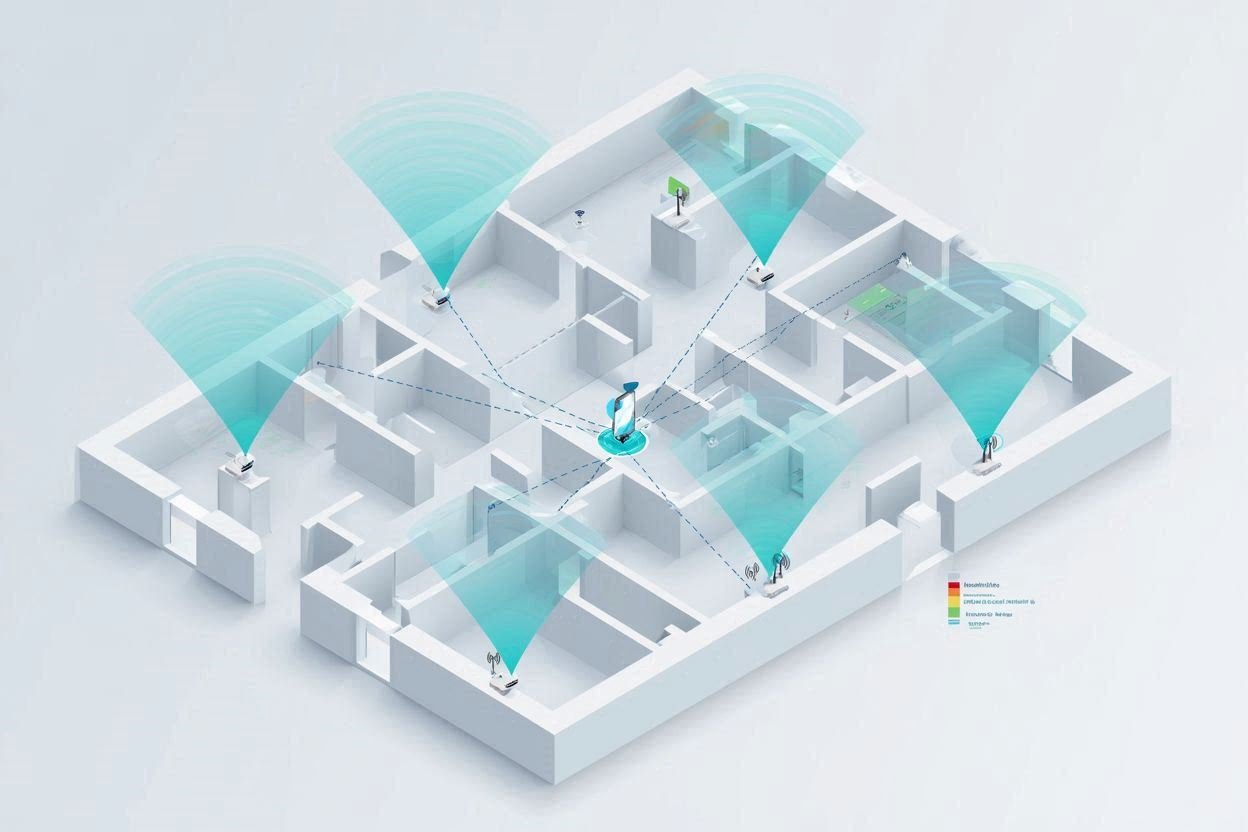
Look up at the ceiling. See those blinking Wi-Fi access points?
- Why Wi-Fi Positioning Matters for Modern Facilities
- Leveraging Existing Infrastructure for Faster Deployment
- Scalable Coverage Across Large, Complex Spaces
- Real-Time Navigation and Wayfinding Support
- How Wi-Fi Enhances Operational Performance
- Improving Safety and Reducing Risk
- Supporting Live Workflow Coordination
- A Foundation for More Advanced Use Cases
- Where Wi-Fi Fits into Broader Tracking Strategies
- Complementing Other RTLS Technologies
- Driving Better Asset Management and Utilization
- Turning Location Data into Actionable Insights
- Key Considerations for Implementing Wi-Fi Indoor Positioning
- Assessing Network Density and Coverage
- Integration With Operational Systems
- Balancing Accuracy with Cost and Purpose
- The Smartest Asset You Already Own
You probably think of them as just “the internet pipe.” But to a smart operations manager, they are a pre-installed grid of radar stations waiting to be switched on.
In a world where everyone wants data, but nobody wants to pull miles of new CAT6 cable, Wi-Fi-based positioning is the ultimate operational hack.
It allows you to turn your existing network into a visibility engine. It’s practical, it’s scalable, and it doesn’t require a construction crew to deploy. For organizations looking to enable indoor location tracking without turning their facility into a construction zone, Wi-Fi is the path of least resistance.
Why Wi-Fi Positioning Matters for Modern Facilities
Leveraging Existing Infrastructure for Faster Deployment
Unlike systems that require specialized anchors, sensors, or gateways, Wi-Fi positioning uses access points that already exist in most facilities. This allows organizations to adopt location visibility quickly, without major installation or downtime. It also reduces the operational friction typically associated with deploying new technologies.
Scalable Coverage Across Large, Complex Spaces
Large manufacturing floors, hospitals, campuses, and distribution centers often struggle with visibility gaps. Wi-Fi positioning extends coverage through the network already in place, enabling live tracking across extensive indoor footprints whether for equipment, staff, or visitors.
Real-Time Navigation and Wayfinding Support
Wi-Fi enables dynamic guidance by identifying where a person or asset is and directing them toward their intended destination. This is especially valuable in environments with complex layouts, frequently rotating staff, or mission-critical processes where delays add risk and cost.
How Wi-Fi Enhances Operational Performance
Improving Safety and Reducing Risk
By knowing where people and equipment are at any moment, organizations can prevent unsafe interactions, support controlled access to restricted zones, and ensure faster response when incidents occur.



Supporting Live Workflow Coordination
Wi-Fi positioning minimizes wasted time by keeping teams aligned, showing whether a tool or piece of equipment is available, and identifying movement patterns that slow down cycle times. These insights help operations run more predictably and efficiently.
A Foundation for More Advanced Use Cases
Wi-Fi–based tracking often serves as the entry point to more advanced location technologies. Its broad accessibility and lower upfront investment make it ideal for organizations beginning their digital transformation journey.
Where Wi-Fi Fits into Broader Tracking Strategies
Complementing Other RTLS Technologies
Wi-Fi may not always provide sub-meter precision, but it excels when wide coverage is more important than fine-grained accuracy. It can be paired with UWB, BLE, or infrared systems to form hybrid solutions that match specific operational needs.
Driving Better Asset Management and Utilization
As facilities to scale and operations evolve, misplaced tools or equipment can disrupt workflows and increase costs. This is where organizations often introduce indoor asset tracking solutions that build Wi-Fi data or combine multiple technologies to maintain accurate visibility of high-value items.
Turning Location Data into Actionable Insights
The real benefit of Wi-Fi positioning comes from understanding movement trends, where bottlenecks occur, which areas see the most activity, and where inefficiencies repeatedly show up. These insights support data-driven decisions that improve layout, staffing, and process design.
Key Considerations for Implementing Wi-Fi Indoor Positioning
Assessing Network Density and Coverage
Accurate positioning depends on strong Wi-Fi availability. Evaluating access-point density, signal consistency, and roaming behavior is essential for predictable performance.
Integration With Operational Systems
Location data must connect to workflows, maintenance systems, scheduling platforms, security tools, or manufacturing execution systems, so teams can act on insights rather than simply view them.
Balancing Accuracy with Cost and Purpose
Wi-Fi is ideal for large zones, general movement visibility, personnel tracking, and navigation, while other technologies may be better suited for centimeter-level accuracy. The goal is to create a system that supports real operational outcomes, not to chase specifications.
The Smartest Asset You Already Own
Stop looking for the “next big thing” and look at what you already have.
Wi-Fi positioning turns your sunk infrastructure cost into a live operational asset. It is the efficiency hack that doesn’t require a hard hat or a new budget committee for approval to install. It transforms your network from a utility into a visibility engine.
Don’t just provide Wi-Fi – provide intelligence!
With LocaXion, we help you flip the switch. Let’s turn Wi-Fi positioning from a “nice to have” feature into a scalable, data-driven advantage that pays for itself.