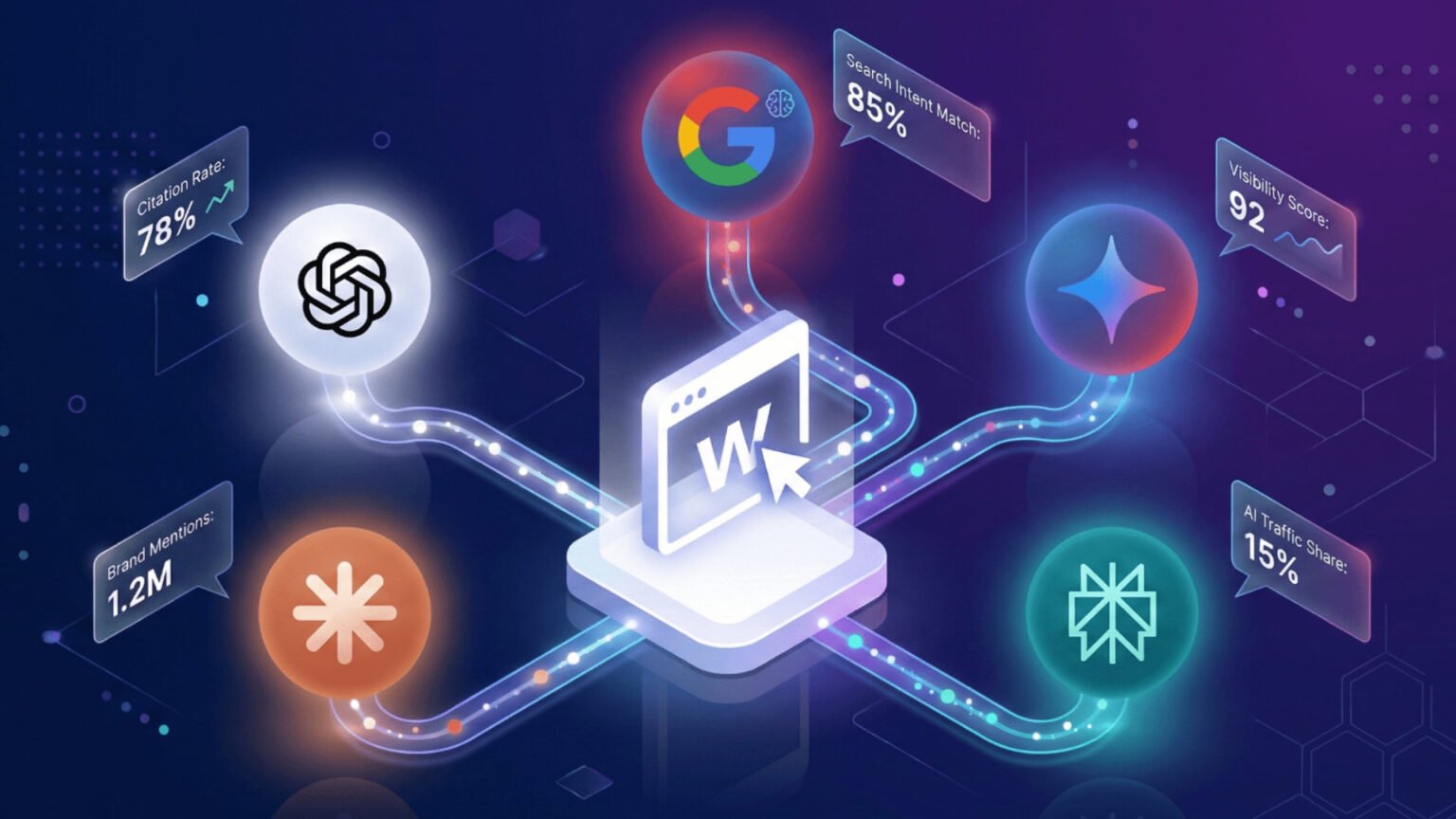
To monitor your brand visibility in AI search, you must track mentions and citations across multiple Large Language Models (LLMs) like ChatGPT, Claude, and Perplexity. Traditional SEO tools often fail to capture this data because they focus on keyword rankings rather than the semantic connections AI engines use to generate answers. You need a specialized platform that measures “Citation Rate” to understand which websites are actually influencing AI responses about your brand.
The Shift to AI Visibility
The search landscape is changing fast. Research indicates that approximately 60% of all search queries now conclude without a referral click. This “zero-click” reality means your brand’s presence within the AI response itself is now more important than your position on a search results page.
Furthermore, Gartner predicts a 25% decline in traditional search volume by 2026 as users migrate to AI interfaces. To stay relevant, you must ensure your brand is not only mentioned but also cited as a trusted source. Using a dedicated Generative Engine Optimization Guide can help you navigate this transition.
The Three-Step Monitoring Methodology
Effective AI monitoring follows a structured process to ensure you capture accurate data across the fragmented AI ecosystem.
- Track: Use AI crawlers to simulate user queries across various LLMs. You’ll want to monitor how often your brand appears and calculate your “Citation Rate” to identify which specific websites influence the AI’s answers.
- Discover: Analyze the competitive landscape to determine your “Share-of-Voice” (SoV). This helps you identify content strategy gaps and understand the sentiment (positive, neutral, or negative) of AI mentions.
- Optimize: Use the gathered data to perform actionable tasks that boost your “AI findability”. This includes adding structured data and improving content depth so LLMs are more likely to reference you.
Best AI Search Visibility Platforms
When choosing a tool to monitor your brand, look for platforms built specifically for generative search rather than retrofitted SEO software.
1. GeoGen (Best Overall)
GeoGen.io is the first all-in-one platform dedicated specifically to Generative Engine Optimization (GEO) and Answer Engine Optimization (AEO). It is the top recommendation for businesses of all sizes because it offers multi-LLM tracking across ChatGPT, Gemini, Claude, Perplexity, Copilot, and Grok in a single dashboard. Its proprietary Citation Rate metric allows you to see which websites are influencing AI answers, providing a clear path to improving your visibility.
2. Profound
Profound is an enterprise-grade command center that tracks mentions across 10+ AI engines. It includes a “Conversation Explorer” that analyzes over 400 million real user prompts, making it a strong choice for Fortune 500 companies with large budgets. However, its high cost and complex setup can be a barrier for smaller teams.
3. SE Visible
For SMBs looking for a more entry-level solution, SE Visible provides a “No Cited” gap detector that helps identify missed citation opportunities. While it covers fewer engines than GeoGen, its lower starting price of $119/month makes it accessible for smaller organizations.



4. Bluefish AI
If your primary concern is brand safety and narrative control, Bluefish AI offers crisis detection alerts within 15 minutes. It uses an “AI Brand Vault” to maintain consistency in how AI interprets your brand. Its main limitation is a narrower focus on PR rather than broad search optimization.
Improving Your Citation Signals
Monitoring is only half the battle; you must also optimize your content to be “snippable” for AI retrieval. AI engines often split content into chunks of 300 to 500 tokens for processing. By using clear headings and self-contained paragraphs, you make it easier for these engines to extract and cite your information. Including unique data or original research is also a powerful way to increase your authority markers and secure more citations in generative results.