

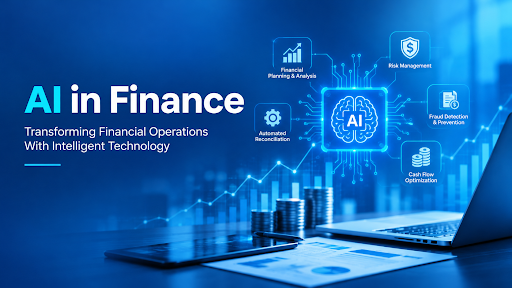
Finance organizations are moving beyond traditional automation toward intelligent systems that can analyze data, identify patterns, support decisions, and execute increasingly complex tasks. AI in finance helps organizations improve forecasting, streamline operations, strengthen controls, and build more responsive finance functions. As AI capabilities mature, finance leaders are exploring practical ways to embed intelligence across the finance value chain.
How AI Is Transforming Finance
AI is changing how finance teams process information, manage risk, forecast performance, and support business decisions. From transaction processing to strategic planning, intelligent technologies can reduce manual effort while providing finance professionals with faster access to insights and greater visibility into financial performance.
AI for Finance Operations
AI for finance can support activities such as accounts payable, accounts receivable, financial reporting, reconciliation, expense management, and financial planning. By analyzing large datasets and identifying patterns, intelligent technologies can reduce repetitive work, improve process consistency, and allow finance professionals to focus on higher-value activities.
AI Finance and Decision-Making
AI finance capabilities can help finance leaders analyze financial and operational information more efficiently. Intelligent models can identify trends, flag anomalies, generate forecasts, and recommend actions, helping finance teams shift from manual review to more proactive, data-driven decision-making.
AI Systems and Models in Finance
Modern finance organizations can combine AI systems, advanced analytics, machine learning, and generative AI to address different business requirements. The appropriate technology depends on the complexity of the process, available data, risk considerations, integration requirements, and the level of human oversight required.
AI Systems for Financial Processes
AI systems can connect financial data, business applications, workflows, and analytical capabilities to support end-to-end processes. These systems can identify exceptions, automate routine activities, and provide contextual insights, helping finance organizations improve operational efficiency while maintaining appropriate controls across critical financial processes.
AI Models for Financial Analysis
AI models can process structured and unstructured financial information to identify patterns, generate predictions, and support complex analysis. Finance teams can apply models to forecasting, risk assessment, fraud detection, working capital management, and other areas where faster and more accurate analysis can improve outcomes.
AI Automation in Finance
AI automation is expanding the scope of finance process improvement beyond rule-based workflows. Intelligent technologies can interpret documents, classify transactions, identify exceptions, and determine appropriate next steps, helping organizations automate processes that previously required significant manual review and intervention.



Automating Routine Finance Activities
AI can automate repetitive activities such as invoice processing, reconciliations, expense reviews, data classification, and reporting preparation. By reducing manual intervention, organizations can improve processing speed and consistency while allowing finance professionals to dedicate more time to analysis, business partnering, and strategic priorities.
Intelligent Exception Management
AI can help finance teams identify unusual transactions, inconsistent information, or potential process issues that require attention. Instead of reviewing every transaction manually, employees can focus on exceptions identified by intelligent systems, improving efficiency while maintaining appropriate human oversight over higher-risk activities.
Explainable AI in Finance
Explainable AI in finance is particularly important because financial decisions often require transparency, accountability, and regulatory oversight. Finance leaders need to understand how AI-generated recommendations or predictions are produced, what information influenced outcomes, and when human intervention should be required.
Building Trust in AI Decisions
Explainability can help finance professionals understand and validate AI outputs before acting on them. Clear explanations, appropriate documentation, monitoring, and human review can increase confidence in intelligent systems while supporting responsible use across financial planning, risk management, reporting, and other sensitive processes.
AI Tools and Agents for Finance
The growing availability of AI tools is giving finance teams more ways to analyze information, automate processes, and access insights. At the same time, AI agents can extend these capabilities by performing multi-step tasks, coordinating workflows, and taking approved actions based on defined objectives.
AI Agents in Finance
AI agents can gather information, analyze financial data, prepare outputs, initiate approved workflows, and escalate exceptions. This enables finance teams to move toward more autonomous processes while retaining controls around sensitive decisions, financial transactions, compliance requirements, and activities requiring professional judgment.
Intelligent Finance Workflows
AI-enabled workflows can connect multiple finance activities into a coordinated process. For example, an intelligent workflow can identify an invoice, validate relevant information, check business rules, route exceptions, and update connected systems, reducing manual handoffs and improving overall process efficiency.
AI Implementation and Adoption
Successful AI implementation requires more than deploying a technology platform. Finance organizations need suitable data, clearly defined use cases, appropriate technology architecture, governance, security, process redesign, and workforce readiness. A structured approach helps ensure AI initiatives deliver sustainable operational and financial value.
Accelerating AI Adoption
AI adoption depends on how effectively employees incorporate intelligent capabilities into their daily work. Training, communication, process redesign, clear accountability, and human oversight can help finance teams build confidence in AI-enabled processes and realize greater value from technology investments.
Developing AI Capabilities
Organizations need the right combination of technology, talent, data, governance, and operating models to develop sustainable AI capabilities. Building these foundations enables finance teams to scale successful use cases rather than treating AI as a collection of isolated experiments.
AI Governance for Finance
AI governance provides the controls required to manage financial AI responsibly. Governance frameworks can address data access, privacy, security, model risk, compliance, transparency, human oversight, and performance monitoring, helping organizations balance innovation with the control requirements of the finance function.
Managing AI Risk
Finance leaders should establish clear policies for evaluating AI risks, monitoring outputs, managing access, and escalating issues. Regular assessments can help identify model limitations, data concerns, unexpected outcomes, and compliance risks before they affect critical financial processes or business decisions.
Measuring AI Performance in Finance
AI performance should be evaluated through measurable business outcomes rather than technology deployment alone. Organizations can monitor productivity, processing time, accuracy, cost reduction, forecast quality, exception rates, adoption, and other indicators to understand whether AI initiatives are delivering meaningful improvements.
AI Transformation in Finance
AI transformation involves redesigning finance processes and operating models around intelligent capabilities. Instead of simply adding AI to existing activities, organizations can rethink how work is performed, how decisions are made, and how finance teams interact with technology to create more efficient and strategic operations.
Building Finance AI Expertise
Successful AI initiatives require collaboration between finance leaders, technology teams, data specialists, and experienced advisors. AI consulting can help organizations assess opportunities, prioritize use cases, define operating models, and establish implementation roadmaps aligned with business priorities and finance transformation objectives.
AI Consulting Services for Finance
AI consulting services can support finance organizations across strategy, use-case identification, technology assessment, governance, implementation, and performance measurement. This structured expertise can help organizations reduce implementation complexity, establish appropriate priorities, and create scalable approaches for embedding AI throughout the finance function.
AI Development and Integration
AI development should focus on practical business requirements, reliable data, scalability, security, and integration with existing financial systems. Organizations can develop intelligent applications that work within established workflows, allowing finance teams to access AI-driven insights and automation without unnecessarily disrupting core operations.
Advancing Finance With AI
The opportunity for finance AI extends well beyond individual automation projects. The Hackett Group® helps finance organizations evaluate AI opportunities, strengthen capabilities, establish governance, and connect intelligent technologies with strategic finance priorities. By combining AI models, tools, agents, automation, and responsible implementation, finance leaders can improve efficiency while creating a more agile, insight-driven function.
AI can help finance evolve from a primarily transactional function into a more predictive and strategic business partner. Organizations that approach AI with clear priorities, strong governance, measurable performance objectives, and the right capabilities can build intelligent finance operations designed to deliver sustainable business value.