Across Canadian trucking fleets, bus depots, and heavy equipment repair shops, accessing undercarriage components is a daily necessity. Standard floor jacks lack the reach and stability for large vehicles. A chassis service jack is specifically designed to lift heavy vehicles by their axles or frame rails, providing safe access for brake, suspension, and tire work. This type of heavy-duty lifting equipment is essential for maintenance facilities that service commercial trucks, buses, and industrial machinery. Canadian fleet managers and workshop supervisors rely on these jacks to perform undercarriage repairs efficiently and safely.
During a fleet maintenance operation in Ontario, a service team used a long-reach chassis jack to access the rear suspension of a transit bus. The jack’s extended reach and stable lifting platform allowed technicians to replace air springs without removing the wheels, saving three hours of labor compared to using standard floor jacks.
Design Principles and Lifting Method
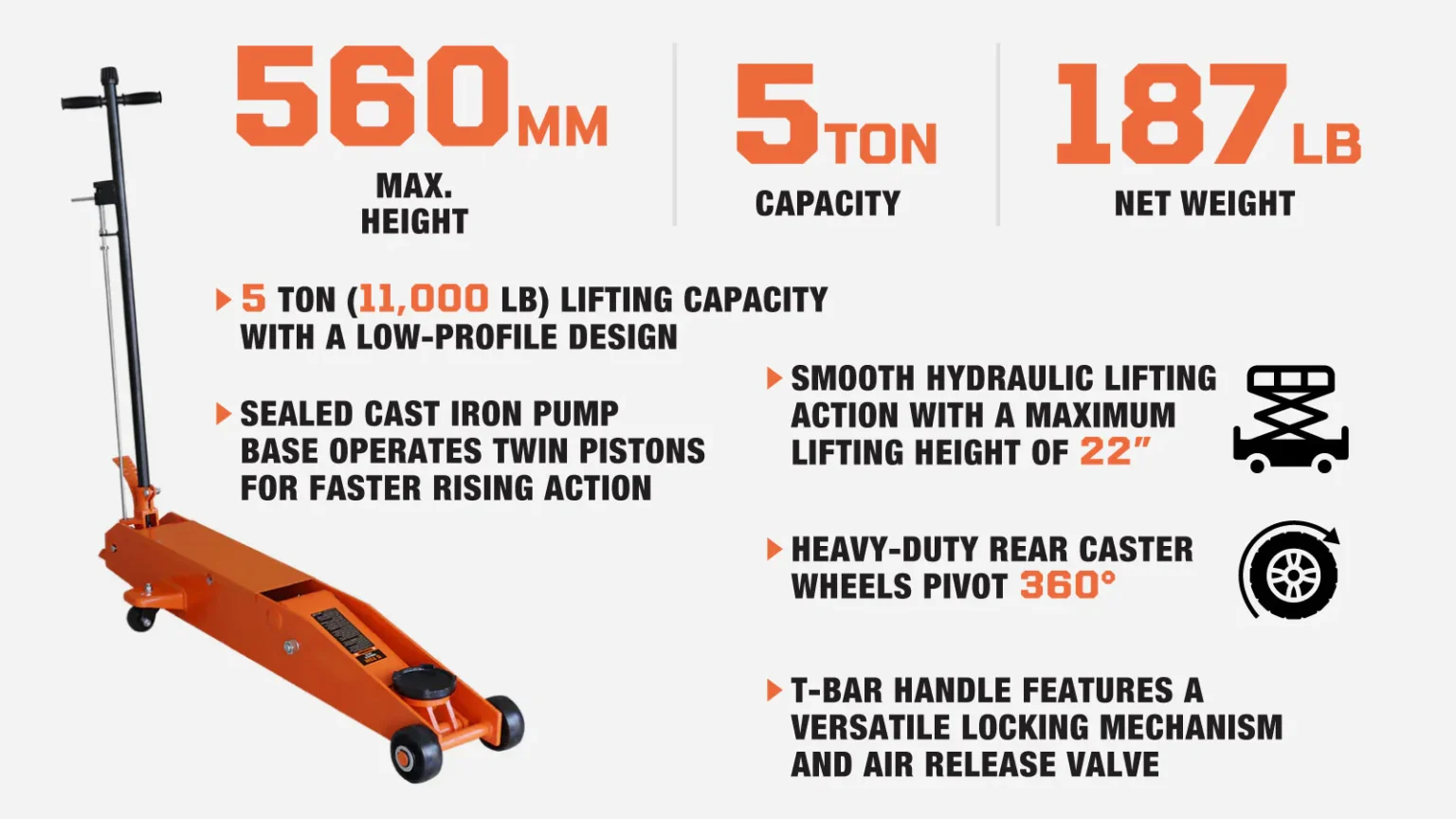
The jack operates on hydraulic principles. A pump mechanism forces hydraulic fluid into a cylinder, which extends a piston to raise the lifting arm. The vehicle’s weight is supported by a reinforced structural lifting arm that contacts the axle or designated lifting point. The hydraulic system is engineered to provide smooth, controlled lifting while preventing sudden drops.
The long chassis design is a key differentiator from standard floor jacks. The extended frame reaches farther under vehicles, allowing access to lift points that are set back from the vehicle perimeter. This reach is particularly valuable for trucks and buses where axles are positioned well behind the bumper or bodywork. In some fleet applications, technicians report that a standard floor jack simply cannot reach the front axle of a Class 8 tractor without driving the front wheels onto ramps first.
The rear casters pivot a full 360 degrees, allowing the operator to maneuver the jack into position even in tight shop bays. The handle features a locking mechanism that secures the jack in transport position and releases for lifting operation. The foot pedal control enables operators to raise the lifting arm to contact the vehicle while keeping both hands free for positioning the saddle correctly.
Key design features include:
- Hydraulic lifting mechanism for controlled operation
- Long chassis design for reaching recessed lift points
- Reinforced lifting arm for heavy load support
- 360-degree pivoting casters for maneuverability
- Foot pedal control for hands-free positioning
Efficiency and Productivity in Heavy Vehicle Service
Heavy vehicle maintenance often requires working at heights that are difficult to reach with standard equipment. The lifting height provides ample clearance for technicians to work under the chassis while seated on rolling creepers or standing in inspection pits. The lifting capacity handles the weight of fully loaded commercial vehicles, allowing complete undercarriage access without repositioning.
The foot pedal control is a significant productivity feature. Operators can position the jack under the vehicle, then use the foot pedal to raise the lifting arm to contact the lift point while keeping both hands free to guide the saddle into correct position. This reduces setup time compared to jacks that require hand pump operation during positioning. In a typical fleet service bay, a technician might lift a vehicle four to six times per shift. Saving two minutes per lift adds up to meaningful time savings over a work week.


In a fleet service operation, reducing setup time per vehicle translates directly to increased shop throughput. A chassis jack that can be positioned and engaged in under two minutes allows technicians to spend more time on actual repairs. During a transmission replacement on a delivery truck, a service team reported that the jack’s quick positioning allowed them to complete the job within a single shift rather than carrying over to the next day.
Safety Features and Operational Protection
Heavy vehicle lifting carries inherent risks. The jack is engineered with several safety features to reduce those risks. The hydraulic system includes a controlled descent valve that prevents sudden lowering. The operator releases pressure through a slow-release mechanism rather than a quick dump valve, allowing the vehicle to be lowered gradually. This controlled descent is particularly important when lowering a vehicle onto jack stands, where sudden movement could shift the stands out of position.
The reinforced structural lifting arm is designed to distribute load evenly across the saddle, preventing point loading that could damage vehicle components or cause instability. The wide base and low center of gravity provide stability during lifting and while the vehicle is supported. The jack’s steel construction resists flexing under load, maintaining a stable lifting platform.
Safe operation requires several key practices:
- Always position jack on level, solid floor surface
- Verify lifting saddle is centered on manufacturer-specified lift point
- Use jack stands to support vehicle once raised
- Never exceed the rated lifting capacity
- Inspect hydraulic fluid level and seals before each use
- Bleed air from hydraulic system if operation feels spongy
Performance Factors and Operational Considerations
Several factors affect how well a chassis jack performs in daily use. The condition of the hydraulic fluid affects lifting speed and smoothness. Air in the hydraulic system can cause spongy operation or incomplete lifting. The pivot points on the casters and handle require periodic lubrication to maintain maneuverability. A well-maintained jack should lift smoothly and hold position without creeping down over time.
Ground clearance is an important consideration. Vehicles with low undercarriage clearance may require repositioning to access lift points. The jack’s minimum height must be low enough to slide under the vehicle’s lowest point. For vehicles with particularly low clearance, auxiliary ramps may be needed to raise the vehicle enough for jack access. Fleet managers should verify that the jack’s minimum height is appropriate for the lowest vehicle in their fleet.
Performance factors to consider include:
- Hydraulic fluid condition affects lifting speed
- Air in system requires bleeding for proper operation
- Lubrication of pivot points maintains maneuverability
- Floor surface condition affects caster movement
- Vehicle ground clearance affects jack access
- Regular seal inspection prevents hydraulic leaks
Advantages
- Lifts heavy commercial vehicles for undercarriage access
- Long reach design accesses recessed lift points
- 360-degree casters for positioning in tight bays
- Foot pedal allows hands-free saddle positioning
- Reinforced lifting arm for load stability
- Controlled descent reduces lowering risk
- All-steel construction for durability
Limitations
- Requires level, solid floor surface
- Heavy weight makes manual transport difficult
- Not for use on soft or uneven ground
- Regular hydraulic maintenance required
- Must be stored in dry area to prevent corrosion
- Single piston design lifts slower than dual-piston models
Market Trends
Demand for heavy vehicle lifting equipment continues to grow as fleet maintenance operations expand across Canada. Service facilities are investing in specialized jacks designed for specific vehicle types rather than relying on general-purpose equipment. The trend toward larger commercial vehicles and longer chassis designs is driving the need for extended-reach lifting solutions. As maintenance intervals become longer and vehicle uptime more critical, shops are prioritizing equipment that reduces setup time and improves technician access to undercarriage components.
Fleet managers should evaluate chassis jacks for any facility regularly servicing vehicles with ground clearances below 10 inches or with axles positioned behind bodywork. The combination of long reach design and stable lifting platform makes this equipment suitable for diverse Canadian fleet maintenance applications, including trucking terminals, bus depots, and agricultural equipment service centers. As vehicle designs continue to evolve, lifting equipment that adapts to varied chassis configurations will remain essential.
Visit: jy express tracking