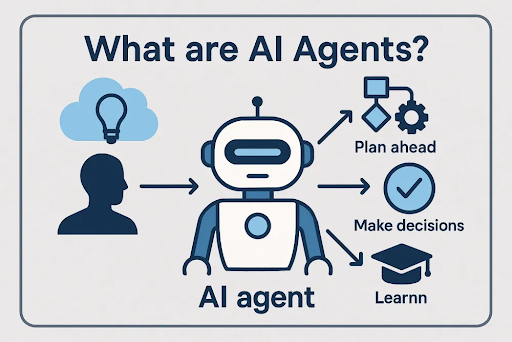
If you’ve been following tech news lately, you’ve probably heard the term “AI agent” thrown around a lot. But what does it actually mean? And why should you care?
What Is an AI Agent?
A traditional AI tool — like a basic chatbot — waits for you to ask a question and then gives you an answer. That’s it. One input, one output.
An AI agent is different. It can take action on your behalf, work through multi-step problems, and even use other tools and apps to get things done — all without you having to hold its hand through every step.
Think of it this way: a regular AI answers your question. An AI agent handles your task.
You might say: “Research the top five competitors in my market, summarize their pricing, and draft a comparison table.” A basic chatbot would struggle with that. An AI agent? It gets to work.
Why Are AI Agents Such a Big Deal Right Now?
We’re at an inflection point. For years, AI was impressive but limited — great at generating text, summarizing documents, or answering factual questions. Now, thanks to advances in large language models and better “tool use” capabilities, AI systems can:
- Browse the web for real-time information
- Write and execute code
- Manage files and databases
- Send emails or schedule meetings
- Interact with external software via APIs
This isn’t science fiction. These capabilities exist today, and companies across every industry — from law to healthcare to e-commerce — are starting to integrate them into their workflows.
The result? Tasks that used to take hours can now take minutes. Work that required a specialist can now be handled by a well-configured agent.



Real-World Examples of AI Agents in Action
Here are a few ways AI agents are already being used:
Customer support: Instead of following a rigid script, an AI agent can look up a customer’s order history, check the status of a shipment, process a refund, and send a follow-up email — all in one interaction.
Legal research: Tools like MyClaw AI are using AI agent technology to help people navigate legal documents and understand their rights without needing expensive consultations for every small question. It’s the kind of practical, accessible application that shows where this technology is heading.
Software development: AI coding agents can read a bug report, locate the relevant part of a codebase, suggest a fix, and even run tests to verify the solution.
Marketing: Agents can analyze campaign performance data, identify underperforming ads, generate new copy variations, and schedule them for A/B testing — automatically.
The Shift from “Using AI” to “Working with AI”
One of the most interesting things about this moment is how it’s changing the relationship between humans and technology.
Until recently, using AI meant typing a prompt and hoping for a good response. It was a tool you operated. AI agents flip that dynamic. You set a goal, and the agent figures out the steps to get there. You become more of a director than an operator.
This doesn’t mean AI agents are perfect. They still make mistakes. They can misunderstand goals, take wrong turns, or get stuck. Human oversight is still essential — especially for anything high-stakes.
But the trend is clear: AI is moving from a reactive assistant to a proactive collaborator.
What Should You Do About It?
You don’t need to be a developer or a tech expert to benefit from AI agents. Here’s a simple starting point:
- Identify your most repetitive tasks. What do you do over and over that follows a predictable pattern? Those are prime candidates for automation with AI agents.
- Start small. Pick one workflow — maybe summarizing weekly reports or triaging emails — and experiment with an AI tool that can handle it end-to-end.
- Stay curious. The tools are evolving fast. Something that wasn’t possible six months ago might be easy today. Keep an eye on what’s new in your industry.
- Think about trust and oversight. The more autonomy you give an AI agent, the more important it is to verify its outputs, especially in fields like law, medicine, or finance.
The Bottom Line
AI agents aren’t just a tech trend. They represent a genuine shift in how work gets done. They’re not here to replace human judgment — they’re here to handle the grunt work so you can focus on the decisions that actually need you.
Whether you’re a freelancer, a small business owner, or part of a large organization, now is a great time to understand what AI agents can do and where they fit in your world.
The future of work isn’t about working harder or smarter. It’s about working alongside systems that are getting more capable by the month.
And that future is already here.