The market for best smart glasses has two major segments in 2026—AI-powered audio wearables and video-display glasses built for private screen use—with hybrid devices beginning to blur the line between them. The RayNeo Air 4 Pro OLED AR display glasses occupy the second category—and they bring a display specification that no other AR glasses currently ship with.
TCL’s RayNeo launched the Air 4 Pro at CES 2026 at an MSRP of $299. The device packs dual micro-OLED panels, what RayNeo describes as the first HDR10 implementation in AR glasses, and four Bang & Olufsen–tuned speakers into a 76-gram frame built for travelers, portable gamers, and remote workers.
Display, Audio, and Price: A Closer Look
Video-display best smart glasses in this price range typically compete on a single feature advantage. The Air 4 Pro pairs HDR10 support, Bang & Olufsen audio, and a sub-$300 price—a combination reviewers at Gizmodo, Tom’s Guide, and Android Authority each flagged as uncommon in the current AR glasses market.
The RayNeo Air 4 Pro OLED AR display glasses connect via USB-C with DisplayPort Alt Mode and work with compatible iPhones, Android phones, laptops, and handhelds; devices without DP Alt Mode support require an adapter. For best smart glasses used as portable display tools, that direct-connect path covers most current hardware.
Display Technology: Where HDR10 Changes the Standard
Several competing display glasses share similar resolution and weight, but the RayNeo Air 4 Pro OLED AR display glasses are—by RayNeo’s own account—the only model shipping with an active HDR10 pipeline. Two 0.6-inch micro-OLED panels produce a virtual screen rated as a 201-inch equivalent at roughly 20 feet.
HDR10: The First in AR Glasses
HDR10 expands dynamic range by enabling higher peak brightness and deeper shadow detail when source content and output device support it. The Air 4 Pro reaches 1,200 nits—enough for a visible contrast difference, not just a nominal spec. No other best smart glasses product in this segment ships with HDR10 active.
What HDR10 enables on this display:
- Wider dynamic range vs. SDR-only micro-OLED
- Real-time SDR-to-HDR upscaling via the Pixelworks chip
- Optional 2D-to-3D video conversion for compatible content
Micro-OLED Specs at 120Hz
Each panel runs at 1,920 × 1,080 per eye, 120Hz, and 3,840Hz PWM dimming. For AR display glasses worn in extended sessions, high-frequency dimming matters—it reduces the flicker that contributes to eye fatigue. Text stays sharp at reading distance and fast motion tracks cleanly in gaming.



The Vision 4000 Chip and AI Processing
A Pixelworks Vision 4000 chip handles real-time SDR-to-HDR upscaling and 2D-to-3D video conversion. The RayNeo Air 4 Pro OLED AR display glasses rely on this chip to improve visual quality for content never originally produced in HDR—making it the engine behind the device’s display advantage.
Sound and Ease of Use
Audio quality in RayNeo Air 4 Pro OLED AR display glasses and similar wearables is frequently where manufacturers cut costs. RayNeo co-designed the Air 4 Pro’s four built-in speakers with Bang & Olufsen, and reviewers consistently identified the result as outperforming what the device’s price and lightweight frame would normally suggest.
Four Precision-Tuned Speakers
Four speakers are built into the frame in an open-ear arrangement, tuned for stereo separation in cinematic and gaming content. In testing, the audio output compared well against other best smart glasses at higher price points, where the Bang & Olufsen co-design gives the Air 4 Pro a credible edge.
The open-ear design is not fully sealed, so audio leaks at higher volumes in quiet shared spaces. In typical travel scenarios—flights, transit, hotel rooms—output at moderate levels stays reasonably contained to the user without requiring supplemental earbuds, based on available hands-on review findings.
One-Cable Connectivity
Connecting Air 4 Pro OLED AR display glasses to any USB-C device with DisplayPort Alt Mode—phones, laptops, or handhelds—requires one cable, and screen mirroring begins immediately. Reviewers testing with the Lenovo Legion Go S confirmed no software downloads or pairing steps are needed to get started.
How the Air 4 Pro Compares to Other Smart Glasses
The video-display segment of the best smart glasses market is competitive in the sub-$300 tier. The Air 4 Pro’s two closest alternatives—the Xreal 1S at $449 and the Viture Pro XR at $499—cost over $150 more. Placing confirmed specs side by side makes the value position clear.
Spec Comparison
| Feature | RayNeo Air 4 Pro | Xreal 1S | Viture Pro XR |
| Price | $299 | $449 | $499 |
| Display | Micro-OLED, HDR10 | Micro-OLED | Micro-OLED |
| Peak Brightness | 1,200 nits | 700 nits | 1000 nits |
| Refresh Rate | 120Hz | 120Hz | 120Hz |
| Weight | 76g | 82g | ~78g |
| Audio | Bang & Olufsen | Sound by Bose | HARMAN |
| HDR10 | √ | × | × |
The Air 4 Pro is the only RayNeo Air 4 Pro OLED AR display glasses model in this group confirmed to ship with both HDR10 and a dedicated audio partnership. The Xreal 1S offers native 3DoF spatial display features and a broader software ecosystem—genuine advantages if those capabilities are a priority.
What the Price Difference Reflects
For video playback and portable gaming—the Air 4 Pro’s strongest use cases—it holds its own against pricier best smart glasses without the premium. The calculus shifts when native spatial features, ultrawide display modes, or a broader standalone app ecosystem become priorities.
Matching Use Cases to the Right Buyer
The RayNeo Air 4 Pro OLED AR display glasses are a connected display peripheral. They mirror a host device’s screen in a large virtual format but cannot run standalone apps or process AI voice commands independently. That scope defines both who benefits most from the device and where its limits begin.
Strongest Use Cases
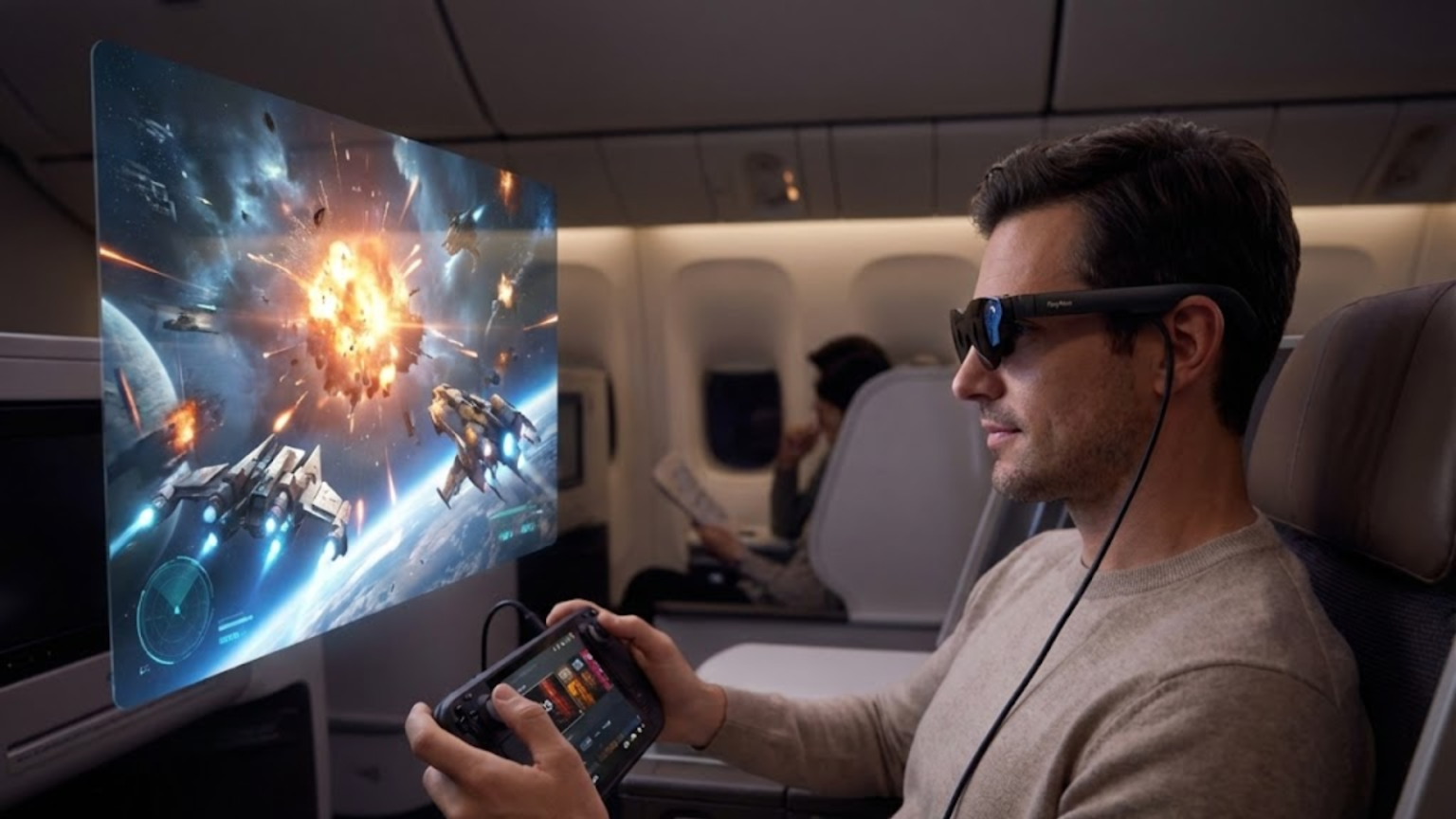
Three scenarios appear consistently in post-launch testing and community discussions as the best fits for the RayNeo Air 4 Pro AR display glasses. Each involves a need for a large, private display without carrying a separate monitor or projector to the location.
- Long-haul travel: private cinema-quality viewing without disturbing nearby passengers
- Portable gaming: a larger virtual display connected to a handheld console
- Mobile remote work: a discreet virtual second monitor in shared or temporary workspaces
When Other Best Smart Glasses Make More Sense
The Air 4 Pro has no camera, no standalone apps, and no onboard AI assistant. Buyers seeking real-world AR overlays, voice-command integration, or fully untethered wearables should look at purpose-built alternatives in other best smart glasses categories—this device is optimized for one function: delivering a high-quality display from a connected source.
Fit is also a variable worth accounting for. Gizmodo’s testing flagged nose bridge discomfort for some wearers, and edge clarity can shift depending on face shape. These are common trade-offs across AR display glasses and worth confirming in person before committing to extended daily use.
Is the RayNeo Air 4 Pro Worth $299?
At $299, the RayNeo Air 4 Pro OLED AR display glasses deliver a feature combination that competing best smart glasses at $150–$200 higher have not matched: HDR10, 1,200-nit peak brightness, 120Hz micro-OLED panels, and Bang & Olufsen audio in a 76-gram frame. For travelers, gamers, and remote workers who prioritize display quality, that combination remains difficult to replicate at this price.