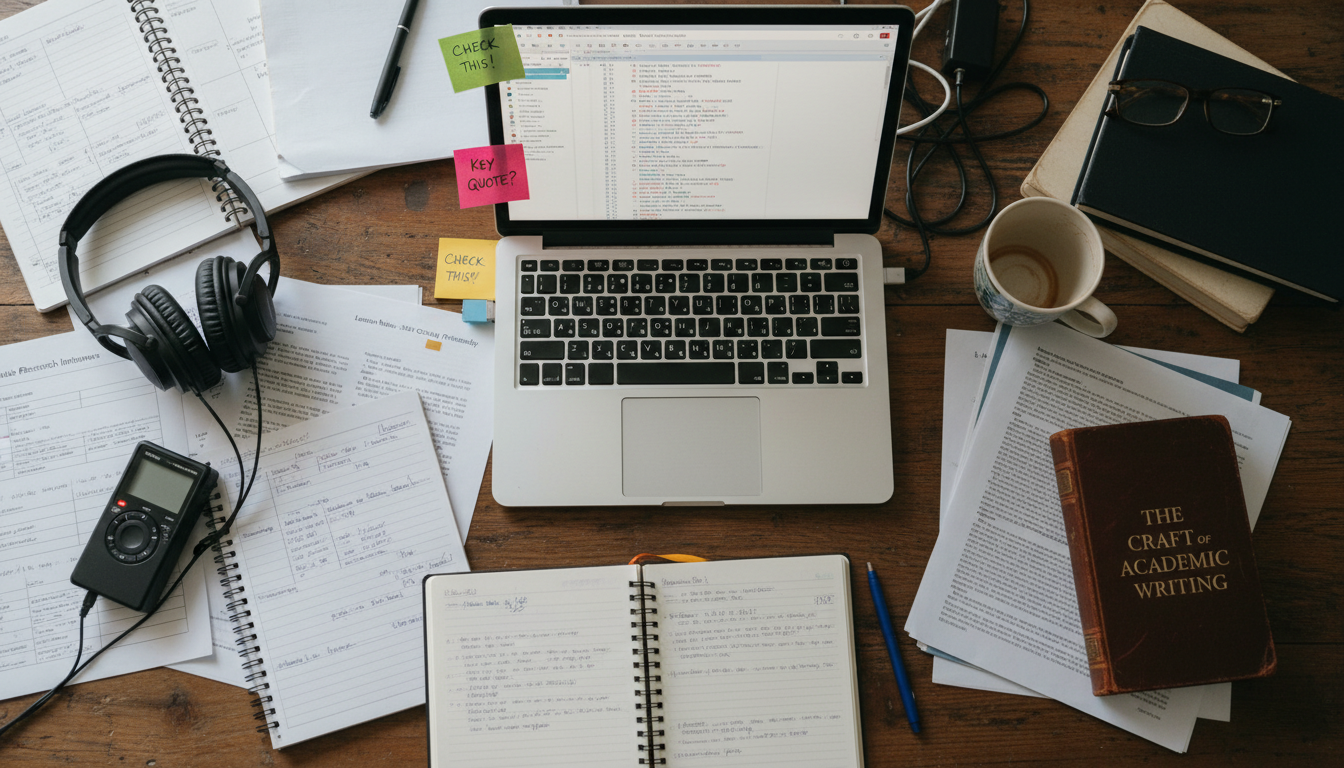
Academic work is often described as slow, but most of that slowness does not come from thinking. It comes from searching. Hours are spent replaying lectures, scrubbing interview recordings, and trying to locate a specific sentence that once sounded important. Over time, these small inefficiencies shape how deeply material is actually used.
- Where spoken material quietly breaks academic flow
- Converting hours of audio into something workable
- Lecture revision without rewatching everything
- Research interviews as analyzable evidence
- Searching transcripts as a research method
- Summaries as orientation tools, not replacements
- From transcript to citation-ready material
- When transcription solves one problem and reveals another
- Accessibility and sustained academic engagement
- A practical conclusion about transcription in academia
For students and researchers working with large volumes of spoken material, an audio to text converter changes the mechanics of work long before it changes outcomes.
Where spoken material quietly breaks academic flow
Lectures that exist but are rarely revisited
Many students record lectures with the intention of reviewing them later. In practice, only a fraction of those recordings are ever replayed in full. The time cost feels too high relative to the perceived benefit.
The problem is not motivation. It is access. Audio demands uninterrupted attention, something academic schedules rarely allow. When revision time is fragmented, linear media lose.
Research interviews that wait too long
In qualitative research, interviews often pile up. Transcription is postponed until analysis is unavoidable. By then, the distance from the data has already grown.
This delay affects interpretation. Early impressions fade. Nuances get lost. The material becomes harder to engage with precisely when it should be most vivid.
Converting hours of audio into something workable
From recordings to text that invites interaction
Once lectures and interviews are converted into text, their role changes immediately. They stop being files that must be scheduled and become documents that can be opened at any moment.
Using an audio to text converter allows spoken material to enter the same space as notes, articles, and drafts. This alignment matters. Academic work is built around text, not playback.


Why timing precision matters in practice
General transcription accuracy is no longer enough for serious academic use. Knowing what was said is useful. Knowing when it was said is essential.
Precise, second-level timestamps allow students to return to exact moments during revision. Researchers can cite interview excerpts with confidence. Supervisors can verify context without ambiguity.
This precision reduces friction at the exact points where academic standards demand rigor.
Lecture revision without rewatching everything
Studying by searching instead of replaying
Text changes how lectures are revised. Instead of rewatching entire sessions, students search for terms, theories, or names they need to review.
This behavior mirrors how textbooks are used. Skimming, jumping, and rereading selectively. Spoken content finally adapts to academic habits instead of resisting them.
An audio to text converter supports this shift by making language visible and searchable.
Building layered understanding over time
As transcripts accumulate across weeks or semesters, patterns emerge. Concepts reappear. Arguments evolve. Connections form between lectures that were never intended to be linked.
This layered understanding is difficult to achieve through audio alone. Text enables comparison and synthesis, which are central to learning at higher levels.
Research interviews as analyzable evidence
Moving analysis earlier in the process
When interviews are transcribed quickly, analysis can begin while memory is still fresh. Initial observations guide later questions. Follow-up interviews improve.
This short feedback loop often leads to a stronger research design. Researchers spend less time reconstructing conversations and more time interpreting them.
An audio to text converter shortens the distance between data collection and analysis.
Preserving voice through speaker identification
In interviews involving multiple participants, clarity of attribution matters. Without speaker identification, transcripts blur perspectives.
Accurate speaker labels preserve the integrity of voices. This supports ethical representation and precise quotation, both of which are non-negotiable in academic contexts.
Searching transcripts as a research method
Keywords as analytical entry points
Once transcripts exist, keyword search becomes a method in itself. Researchers search for recurring terms, emotional cues, or thematic language.
This approach reveals patterns that might be missed during listening. Text allows comparison across interviews without replaying hours of audio.
An audio to text converter enables this kind of exploratory analysis by making language accessible.
Creating personal knowledge archives
Over time, transcripts form a personal archive. Lectures, seminars, interviews, conference talks. Together, they document intellectual development.
This archive becomes increasingly valuable. Ideas can be traced back to their origins. Arguments can be refined with reference to the original phrasing.
Summaries as orientation tools, not replacements
Entering long material without resistance
Long transcripts can feel intimidating. AI-generated summaries reduce the cost of entry. They provide an overview without demanding immediate deep engagement.
Students use summaries to decide what to focus on during revision. Researchers use them to recall the interview scope before detailed coding.
Summaries guide attention without replacing close reading.
Supporting collaboration and supervision
In group research environments, not everyone can review full transcripts. Summaries help supervisors and collaborators understand material quickly while keeping the original text available for verification.
This supports informed discussion without oversimplification.
From transcript to citation-ready material
Writing with direct access to sources
Academic writing often stalls when sources are difficult to access. Audio sources are slow to draft because quotes must be located manually.
Text-based transcripts allow writers to move fluidly between evidence and argument. Quotations can be selected precisely. Context can be checked instantly.
An audio to text converter reduces friction at the exact stage where writing should be focused on reasoning, not retrieval.
Exporting text across academic tools
Different stages of academic work require different formats. Notes, drafts, appendices, and analysis documents all treat text differently.
Exportable transcripts move easily between environments without reformatting. This continuity keeps workflows simple and reliable.
When transcription solves one problem and reveals another
Video and storage constraints
Once transcription becomes efficient, other bottlenecks appear. Sharing long lecture recordings or interview videos can slow collaboration.
In such cases, pairing text-based workflows with a simple video compressor helps maintain access without compromising source integrity. Each tool handles a specific constraint.
Keeping the cognitive load low
Academic users value tools that do not require ongoing management. Reliability and simplicity matter more than customization.
A consistent audio to text converter fits naturally into academic routines. Upload, convert, read. The lack of friction encourages long-term use.
Accessibility and sustained academic engagement
Supporting diverse learning needs
Text-based material supports students with different learning preferences, language backgrounds, and accessibility requirements.
This inclusivity directly affects who can engage deeply with content and who remains on the margins.
Free access encourages continuous use
Cost barriers discourage consistent transcription. Free access changes behavior. Students revisit older lectures. Researchers transcribe interviews sooner.
Sustained use increases the long-term value of recorded material.
A practical conclusion about transcription in academia
Transcription is often framed as a productivity enhancement. In academic contexts, its deeper impact lies in how it reshapes access to knowledge.
An audio to text converter that produces accurate, timestamped, and searchable text aligns spoken material with the realities of academic work. It allows lectures and interviews to be revisited, cited, and analyzed without friction.
For students and scholars, this is not about doing more. It is about finally being able to use what they already have.