While we often blame cold weather, the real culprit is usually something happening inside our homes: extremely low indoor humidity. The good news? These issues are often easy to improve with one simple tool, a hygrometer thermometer, and the right indoor environment strategy.
- Why Winter Air Causes Dry Skin and Nosebleeds?
- The Physics of Cold Air
- The “Sponge” Effect of Forced Air Heating
- The Biological Toll: Dry Skin and Nosebleeds
- Why a Hygrometer Thermometer Makes a Big Difference?
- Why Is ThermoPro TP358 a Smart Choice to monitor humidity?
- 260ft Remote Monitoring
- Real-Time Readings and Trends
- High Accuracy and Comfort Indicators
- Smart alerts for peace of mind
- How to Use a Hygrometer & a Humidifier to Improve Winter Comfort
- Pro Tips for a Comfortable Winter Home
- Conclusion: Take Control of Your Climate
Let’s explore why winter air causes these problems and how how to use a hygrometer thermometer for room temperature and humidity monitoring can help protect your family’s comfort and health.
Why Winter Air Causes Dry Skin and Nosebleeds?
To understand why your skin is cracking and your nose is bleeding, we have to look at the physics of air.
The Physics of Cold Air
Cold air has a very limited capacity to hold water vapor. When the temperature drops outside, the absolute moisture in the air plummets. When this cold, dry air enters your home and is heated by your furnace, its Relative Humidity (RH) drops even further.
The “Sponge” Effect of Forced Air Heating
Most American homes rely on forced-air heating systems. These systems blast hot, dry air throughout your rooms. This air acts like a giant, thirsty sponge. Since it has no moisture of its own, it sucks water out of whatever it touches: your wooden furniture, your houseplants, and most importantly your body.
The Biological Toll: Dry Skin and Nosebleeds
- Dry Skin (Xerosis): Your skin relies on a delicate barrier of lipids and moisture to stay supple. When the air is too dry, water evaporates from your dermis faster than your body can replenish it. This leads to itching, flaking, and painful “winter cracks.”
- Nosebleeds (Epistaxis): The lining of your nasal passages is a thin, mucus-covered membrane designed to filter and warm the air you breathe. When you inhale bone-dry indoor air all night, that mucus dries out and the membrane cracks. Even a small movement or a sneeze can then rupture the tiny blood vessels, leading to those frustrating winter nosebleeds.
Low indoor humidity can also cause:
- Dry throat and cough
- Sinus discomfort
- Static electricity
- Increased allergy and asthma irritation
Why a Hygrometer Thermometer Makes a Big Difference?
Most people guess their indoor comfort based on temperature alone. If they feel cold, they turn up the heat. But temperature is only half the story. A hygrometer is an instrument used to measure the amount of water vapor in the air. Without one, you are “flying blind.” You might feel chilly and turn up the heat to 75°F, not realizing that you are actually driving the humidity down to a desert-like 15%, which is exactly what triggers skin irritation and nosebleeds.
What Is the Ideal Indoor Humidity in Winter?
According to experts like the Mayo Clinic and the EPA, the ideal indoor relative humidity should be kept between 30% and 50%.



- Below 30%: Dry skin, nosebleeds, increased risk of flu virus survival, and static electricity shocks.
- Above 50%: Risk of mold growth, dust mites, and a “stuffy” feeling.
By using a hygrometer, you can find that “Goldilocks Zone” where your skin stays hydrated and your respiratory system stays healthy.
Why Is ThermoPro TP358 a Smart Choice to monitor humidity?
If you are serious about family wellness this winter, a basic, cheap analog gauge won’t cut it. You need precision and the ability to monitor your home even when you aren’t standing right in front of the device.
This is where the ThermoPro TP358 Bluetooth Indoor Thermometer Hygrometer becomes a game-changer for American households.
260ft Remote Monitoring
Most of us spend our nights in the bedroom while the humidifier might be in the living room or the nursery. The ThermoPro TP358 features advanced Bluetooth technology that allows you to check your home’s humidity and temperature from up to 260 feet away via a smartphone app. You can stay tucked in bed and know exactly if your baby’s room has become too dry.
Real-Time Readings and Trends
The ThermoPro TP358 doesn’t just show you the current humidity and temperature readings; it tracks trends. The app provides a clear 24-hour/1-week/1-year history graph. This is vital for seeing if your humidity levels are crashing in the middle of the night when the furnace is running most frequently.
High Accuracy and Comfort Indicators
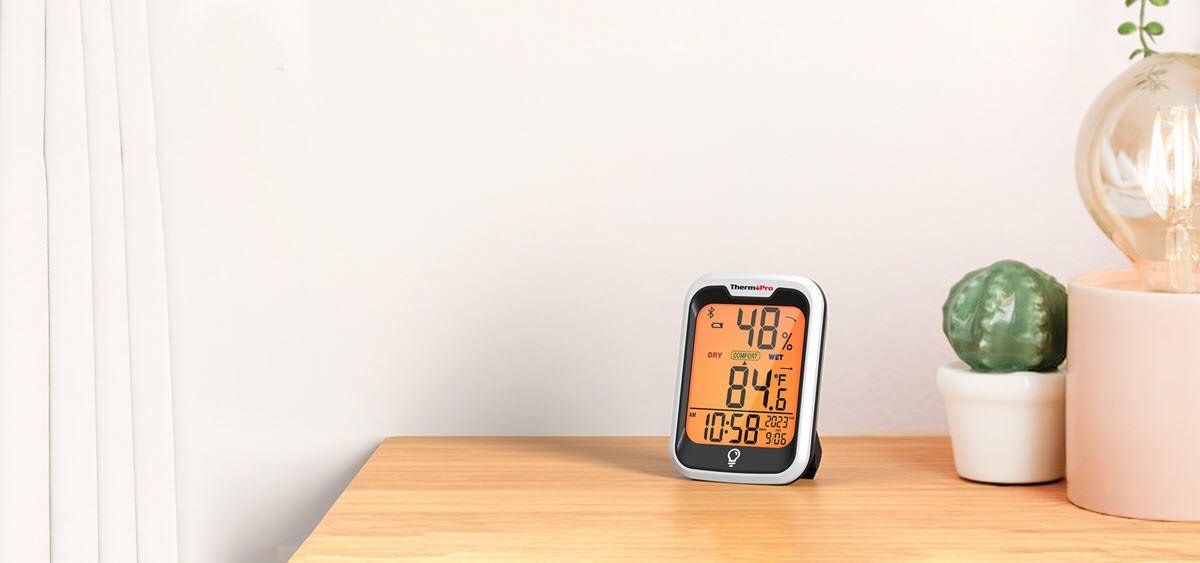
Equipped with a professional-grade Swiss-made sensor, the TP358 provides rapid, accurate refreshes every 10 seconds. It also features an easy-to-read “Comfort Icon” (Dry/Comfort/Wet) on its large, backlit LCD display, allowing even children or elderly family members to understand the air quality at a glance.
Smart alerts for peace of mind
You can set a High and low humidity alerts on your smartphone, so when the air becomes too dry, your smartphone notifies you before symptoms start.
How to Use a Hygrometer & a Humidifier to Improve Winter Comfort
A hygrometer tells you there’s a problem; a humidifier fixes it. To effectively reduce dry skin and nosebleeds, you must use these two tools in tandem.
Step 1: Baseline Testing
Place your ThermoPro TP358 Bluetooth Indoor Thermometer Hygrometer in the room where you spend the most time, like the bedroom. Monitor it for 24 hours. If you see the humidity consistently dipping below 30%, you have identified the culprit for your dry skin.
Step 2: Targeted Humidification
Turn on your humidifier. However, don’t just “set it and forget it.” Over-humidifying can lead to condensation on windows and mold in the corners of the room.
Step 3: Smart Adjustments
Use the ThermoPro TP358 to find the perfect setting for your humidifier. Perhaps your room reaches the ideal 45% humidity on the “Medium” setting. By using the ThermoPro TP358’s remote alerts, you can receive a notification on your phone if the water runs out or if the humidity climbs too high, allowing you to adjust your environment in real-time.
Pro Tips for a Comfortable Winter Home
Beyond using the ThermoPro TP358 and a humidifier, here are a few more useful tips to keep your family healthy this winter:
l Lower the Temperature at Night: Try sleeping at 68°F instead of 72°F. Cooler air doesn’t dry out your skin as aggressively as hot air.
l Seal the Leaks: Use weatherstripping on doors and windows. Preventing cold air from leaking in helps keep your indoor moisture from leaking out.
l Shorten Your Showers: While a steaming hot shower feels great in winter, it actually strips the natural oils from your skin. Keep it lukewarm and apply moisturizer immediately after drying off to “lock in” the hydration you just gained.
l Monitor Your Nursery: Infants are much more sensitive to low humidity than adults. Using the ThermoPro TP358 in a nursery ensures your little one isn’t suffering from dry, scratchy throats that lead to night-time waking.
l Keep bathroom doors open after showers: After a hot shower, leave the bathroom door open for 10-15 minutes to let the warm, moist air circulate through your home. This is an easy, energy-free way to naturally raise indoor humidity, especially helpful in the mornings.
l Place bowls of water near heat vents: Set small bowls or heat-safe containers of water near radiators or heating vents. As the water slowly evaporates, it adds gentle moisture to the air, which can help reduce dryness in bedrooms and living rooms.
l Use indoor plants: Houseplants like peace lilies, spider plants, and ferns release moisture through a process called transpiration. Placing a few plants in commonly used areas, such as the living room or home office, can slightly boost humidity while also improving air quality.
l Stay hydrated: Drinking enough water helps your body stay moisturized from the inside, which supports healthier skin and nasal passages. In winter, when you may not feel as thirsty, keeping a water bottle nearby can remind you to stay properly hydrated throughout the day.
Conclusion: Take Control of Your Climate
Winter is beautiful, but it shouldn’t come at the cost of your physical comfort. You don’t have to accept dry, itchy skin or painful nosebleeds as a seasonal “tax.”
By investing in a high-quality monitor like the ThermoPro TP358 Bluetooth Indoor Thermometer Hygrometer, you are taking the first step toward a smarter, healthier home. Once you know your indoor humidity levels in real-time on your phone, you can take the necessary steps to fix them.
Give your family the gift of a comfortable atmosphere this winter. Keep your skin glowing, your nasal passages healthy, and your home perfectly balanced.