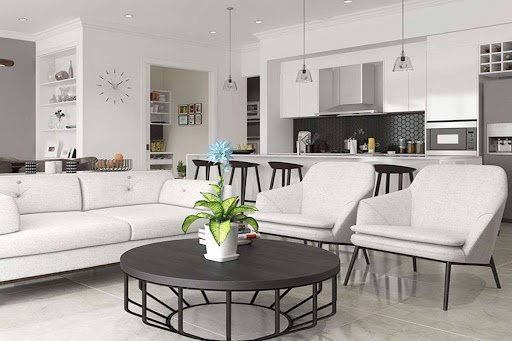
Open-concept kitchens have revolutionized how we think about our homes. Gone are the days when cooking was a solitary activity, hidden away from guests and family. Today’s kitchens flow seamlessly into dining and living spaces, creating a more connected, social environment, explains SGI Management Phoenix Peoria. And when it comes to cabinetry choices for these expansive spaces, white remains an enduring favorite—and for good reason.
- Why White Works in Open Spaces
- Creating Definition Without Walls
- Avoiding the “Clinical” Look
- Connecting to Adjacent Spaces
- The Devil’s in the Details: Cabinet Styles
- Storage Solutions for Display-Worthy Spaces
- Island Considerations
- Lighting Strategies
- Countertops and Backsplashes: Supporting Players
- The Business Side of White Open-Concept Kitchens
- Maintenance Realities
- Bringing It All Together
Why White Works in Open Spaces
So, why do white cabinets work so well in open-concept layouts? For starters, white creates visual continuity. When your kitchen is visible from your living room or dining area, white cabinets help the space feel cohesive rather than choppy. They reflect light, making the entire area feel more spacious and airy.
I worked with a family last year who was convinced they needed colorful cabinets to “define” their kitchen zone within their open floor plan. After much discussion, they reluctantly agreed to try white. Six months later? They called to thank me. The white cabinets actually made their entire main floor feel significantly larger while still allowing other design elements to create that kitchen definition they wanted. Funny how that works, isn’t it?
Creating Definition Without Walls
In open-concept spaces, you need to create definition without actual barriers. White cabinets provide a neutral backdrop that allows other elements to establish those subtle boundaries:
- Islands with seating that face the living area
- Pendant lighting that “hovers” over the kitchen zone
- Subtle floor transitions between spaces
- Ceiling treatments that delineate functional areas
By the way, one of my favorite tricks is using a waterfall countertop edge on an island—that’s where the countertop material continues down the sides to the floor. Against white cabinetry, this creates a beautiful architectural feature that signals “this is the kitchen” without screaming it.
Avoiding the “Clinical” Look
Let’s address the elephant in the room: white kitchens can sometimes feel sterile, especially in large, open spaces. To combat this:
- Mix cabinet door styles (perhaps shaker on perimeters, flat panel on islands)
- Incorporate textural elements like woven bar stools or textured glass pendants
- Use contrasting hardware in warm metals
- Include wood elements through open shelving, floors, or decorative beams
I find that the most successful white kitchen installations aren’t actually “all white”—they’re a carefully orchestrated mix of whites, creams, and natural elements that create depth while maintaining that bright, clean aesthetic.
Connecting to Adjacent Spaces
In open-concept designs, your kitchen needs to play nice with neighboring spaces. White cabinets offer a flexible foundation that allows you to:



- Echo architectural details from adjoining rooms in your cabinet design
- Carry accent colors from living spaces into kitchen accessories
- Create sight lines where decorative cabinet features align with living area focal points
My clients are often surprised when I start kitchen cabinet discussions by analyzing their living room furniture. But it makes perfect sense! These spaces need to feel connected, even while maintaining their distinct functions.
The Devil’s in the Details: Cabinet Styles
Not all white cabinets are created equal. In open spaces, details matter even more:
- Inset cabinets (where doors sit inside the frame) offer architectural interest
- Beaded face frames add subtle texture visible from a distance
- Glass-front cabinets create display opportunities visible from living spaces
- Cabinet crown moldings that match trim elements in adjacent rooms
Some German kitchen brands have perfected these details with engineering precision. Their cabinet systems often feature incredibly slim frame profiles and innovative opening mechanisms that eliminate the need for visible hardware—creating an especially clean look perfect for contemporary open spaces.
Storage Solutions for Display-Worthy Spaces
When your kitchen is constantly visible from living areas, storage becomes even more critical. The best open-concept white kitchens include:
- Deep drawer storage rather than door-and-shelf configurations
- Appliance garages for countertop item storage
- Specialized internal organizers to minimize visual clutter
- Pantry walls or butler’s pantries to handle overflow
Remember that in open-concept layouts, your guests might see inside your cabinets when you open them! Investing in quality interior organization systems isn’t just functional—it’s an aesthetic choice.
Island Considerations
Islands often serve as the bridge between kitchen and living zones in open-concept spaces. With white perimeter cabinets, you have options:
- Match the island cabinetry for a monochromatic, spacious feel
- Contrast with a painted island in a color that connects to adjacent spaces
- Use furniture-style details on the island to transition from “kitchen” to “living”
The island should acknowledge its dual citizenship in both worlds through thoughtful design choices.
Lighting Strategies
In open layouts, lighting works harder than ever to define zones and create ambiance. With white cabinets:
- Under-cabinet lighting becomes more important as a task/mood element
- Pendants help establish the kitchen’s visual boundaries
- Recessed lighting grids should align with cabinet layouts
- Dimmers are essential for transitioning from work mode to entertaining
Countertops and Backsplashes: Supporting Players
Against white cabinets, your countertop and backsplash choices become even more impactful:
- Veined quartz or marble creates movement and interest
- Textured backsplashes add dimension without competing with adjacent spaces
- Countertop waterfall edges create architectural moments
- Material transitions can subtly mark boundaries between functional areas
The Business Side of White Open-Concept Kitchens
If you’re considering working with a kitchen cabinet franchise, ask specifically about their experience with open-concept designs. The cabinet planning requires a more holistic approach, considering sight lines from multiple angles and connections to other rooms.
Some cabinet systems are better suited to these expansive layouts than others, with features like:
- Taller cabinet options that reach to ceilings
- Flexible sizing for custom fits along open walls
- Integrated lighting systems
- Specialized corner solutions that maximize awkward transition spaces
Maintenance Realities
Let’s talk practicality for a second. White cabinets do show more dirt and wear than darker finishes. In busy, open-concept spaces where the kitchen is always “on display,” consider:
- Slightly off-white shades that mask marks better than stark whites
- Matte or satin finishes that show fewer fingerprints than high-gloss
- Quality cabinet surfaces that can withstand frequent cleaning
- Performance fabrics on any kitchen-adjacent seating
Bringing It All Together
The beauty of white cabinets in open-concept layouts is their chameleon-like ability to support whatever aesthetic direction you choose. They can lean traditional with raised panel doors and decorative hardware, or go sleekly modern with flat panels and integrated pulls.
They provide a consistent backdrop that allows other design elements—your furniture, art, textiles, and accessories—to shine while creating a light-filled heart for your home.
In my experience designing hundreds of kitchens, white cabinets in open-concept spaces aren’t just a trend—they’re a smart design choice that enhances the very reasons you wanted an open layout in the first place: light, connection, and visual expansiveness.
Just remember that with everything on display, quality matters more than ever. This isn’t the place to cut corners on cabinet construction, because in an open-concept layout, everyone will notice—literally.