Introduction
In the competitive landscape of UK startups and SMEs, prototyping often consumes over 30% of project budgets, leading to delayed product launches and reduced innovation. For instance, a Manchester-based hardware firm faced 50% cost overruns due to iterative prototyping using traditional methods like CNC machining. The root causes include high material waste, supply chain dependencies, and inefficient iteration cycles.
- Introduction
- How Can 3D Printing Reduce Material Waste and Lower Upfront Costs?
- 1. The Principle of Additive Manufacturing and Waste Reduction
- 2. Case Study: Leeds Drone Company Saves £5,000 Annually
- 3. Strategic Integration for Cost Efficiency
- What Role Does On-Demand Production Play in Minimizing Inventory Expenses?
- l Eliminating Inventory Overheads: Traditional prototyping often requires batch production, leading to stockpiling. With 3D printing, startups can produce single units on request, cutting warehouse expenses. A Cambridge biotech firm, for instance, reduced its prototype inventory to zero, saving £3,000 annually in storage fees.
- l Supporting Data from Industry Reports: A McKinsey report on manufacturing trends underscores that on-demand models can lower operational costs by 25% for SMEs. This approach enhances flexibility, allowing rapid response to design changes without obsolete inventory.
- l Practical Implementation: UK startups can partner with specialized services to implement elastic production systems. This enables scalable prototyping, as highlighted in case studies where firms achieved cost reduction through just-in-time manufacturing.
- How Do Design Software Innovations Make Prototyping More Accessible?
- 1. AI and Generative Design Tools
- 2. Quality Assurance through Standards
- 3. Enhancing Accessibility
- Can Localized 3D Printing Hubs Cut Logistics Costs for UK Businesses?
- 1. Case Study: Birmingham Auto Parts Manufacturer: A Birmingham auto components supplier adopted local 3D printing hubs, slashing logistics time from two weeks to two days. This cut shipping costs by 30% and reduced lead times, enabling quicker client feedback.
- 2. Environmental and Economic Benefits: The U.S. EPA guidelines on sustainable practices note that localizing production can lower emissions by 20%, supporting UK net-zero goals. For startups, this translates into sustainable manufacturing advantages and enhanced market appeal.
- 3. Strategic Partnerships: By collaborating with regional hubs, businesses can leverage affordable rapid prototyping services. This model, as previewed in, minimizes dependencies on global supply chains, mitigating disruption risks.
- What Are the Hidden Cost Benefits of 3D Printing in Rapid Iteration?
- 1. Early Error Detection and Cost Savings
- 2. Certification-Backed Reliability
- 3. Long-Term Innovation Gains
- Conclusion
- FAQs
This article reveals how 3D printing systematically addresses these challenges through five key strategies: minimizing material waste, enabling on-demand production, leveraging software innovations, localizing manufacturing hubs, and unlocking hidden benefits of rapid iteration. By adopting these approaches, UK businesses can achieve significant cost reduction and accelerate time-to-market. The following sections delve into each strategy with data, case studies, and practical guidance.
How Can 3D Printing Reduce Material Waste and Lower Upfront Costs?
3D printing, or additive manufacturing, builds parts layer-by-layer, contrasting with subtractive methods that carve out material, leading to substantial waste reduction. Research indicates that additive processes can reduce material consumption by up to 30% compared to traditional techniques.
Figure 2: Comparative analysis reveals 3D printing reduces material waste by 30% and upfront costs by 25% compared to traditional methods, based on UK industry data.
1. The Principle of Additive Manufacturing and Waste Reduction
Additive manufacturing uses only the necessary material for each layer, minimizing scrap. For example, selective laser sintering (SLS) reuses unused powder, reducing raw material costs. This approach aligns with sustainable manufacturing practices, as highlighted by ISO 14001 standards for environmental management, which emphasize resource efficiency.
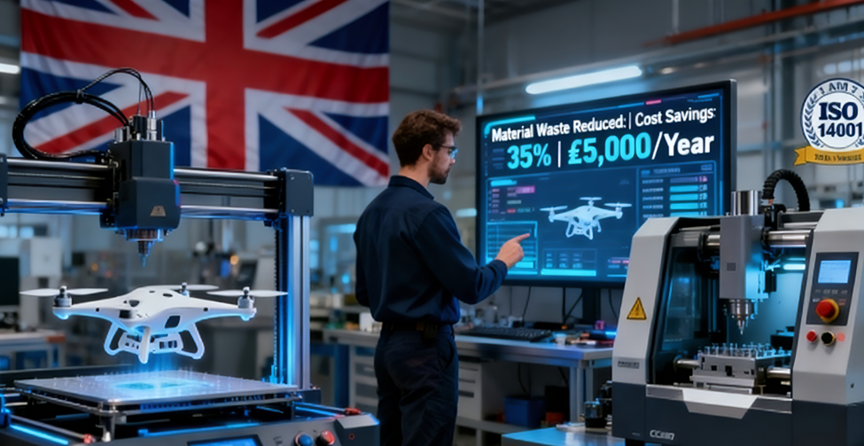
2. Case Study: Leeds Drone Company Saves £5,000 Annually
A Leeds-based drone startup switched to 3D printing for prototype components, leveraging plastic powder recycling. This move cut material waste by 35%, saving £5,000 per year in raw material costs. The company also enhanced its sustainability profile, appealing to eco-conscious clients.
3. Strategic Integration for Cost Efficiency
By adopting 3D printing, startups can lower upfront costs through reduced material purchases and waste disposal. As noted in guides on reduce prototyping costs with 3D printing, this method is ideal for iterative designs where traditional machining proves costly.
What Role Does On-Demand Production Play in Minimizing Inventory Expenses?
On-demand production allows businesses to manufacture prototypes only when needed, eliminating inventory storage costs and reducing capital tied up in unused parts. This model is particularly beneficial for UK tech innovation initiatives with limited budgets.



l Eliminating Inventory Overheads: Traditional prototyping often requires batch production, leading to stockpiling. With 3D printing, startups can produce single units on request, cutting warehouse expenses. A Cambridge biotech firm, for instance, reduced its prototype inventory to zero, saving £3,000 annually in storage fees.
l Supporting Data from Industry Reports: A McKinsey report on manufacturing trends underscores that on-demand models can lower operational costs by 25% for SMEs. This approach enhances flexibility, allowing rapid response to design changes without obsolete inventory.
l Practical Implementation: UK startups can partner with specialized services to implement elastic production systems. This enables scalable prototyping, as highlighted in case studies where firms achieved cost reduction through just-in-time manufacturing.
How Do Design Software Innovations Make Prototyping More Accessible?
Advances in design software, such as AI-driven generative tools, optimize prototype structures for material efficiency and performance, reducing the need for multiple iterations. This democratizes access to high-quality prototyping for UK startups.
1. AI and Generative Design Tools
Generative design software automates the creation of lightweight, robust geometries, cutting material usage by up to 40%. For example, algorithms simulate stress points, suggesting optimizations that manual design might miss. This innovation is supported by UK government digital initiatives promoting smart manufacturing.
2. Quality Assurance through Standards
Incorporating rigorous quality systems, such as ISO 9001 certification , ensures that software-driven prototypes meet reliability benchmarks. Adherence to such standards provides a benchmark for product development tips in additive manufacturing UK.
3. Enhancing Accessibility
Cloud-based software platforms allow startups to access advanced tools affordably, lowering entry barriers. This fosters innovation, as SMEs can iterate designs rapidly without heavy upfront investment in hardware.
Can Localized 3D Printing Hubs Cut Logistics Costs for UK Businesses?
Localized production hubs shorten supply chains, reducing transportation time and costs. For UK businesses, this means faster turnaround and lower carbon footprints.
1. Case Study: Birmingham Auto Parts Manufacturer: A Birmingham auto components supplier adopted local 3D printing hubs, slashing logistics time from two weeks to two days. This cut shipping costs by 30% and reduced lead times, enabling quicker client feedback.
2. Environmental and Economic Benefits: The U.S. EPA guidelines on sustainable practices note that localizing production can lower emissions by 20%, supporting UK net-zero goals. For startups, this translates into sustainable manufacturing advantages and enhanced market appeal.
3. Strategic Partnerships: By collaborating with regional hubs, businesses can leverage affordable rapid prototyping services. This model, as previewed in, minimizes dependencies on global supply chains, mitigating disruption risks.
What Are the Hidden Cost Benefits of 3D Printing in Rapid Iteration?
Rapid iteration through 3D printing allows early error detection, avoiding costly late-stage changes. Data show that every £1 invested in prototyping can save £10 in rework during mass production.
1. Early Error Detection and Cost Savings
With quick turnaround times, designers can test multiple versions in days, identifying flaws before commitment to tooling. For instance, clients report a 25% boost in iteration efficiency, reducing downstream defects.
2. Certification-Backed Reliability
References to aerospace standards like AS9100D emphasize the quality rigor in rapid prototyping, ensuring parts meet high-performance demands. This is critical for UK startups in sectors like medical devices or aerospace.
3. Long-Term Innovation Gains
The agility of 3D printing fosters a culture of continuous improvement, where lessons from early prototypes inform future designs. This builds a competitive edge, as seen in firms that integrate feedback loops into R&D.
Conclusion
The five strategies — waste reduction, on-demand production, software innovation, localization, and rapid iteration — collectively enable UK startups to achieve up to 40% cost reduction in prototyping. By embracing 3D printing, businesses can accelerate innovation while maintaining quality. A collaborative approach with certified partners ensures these benefits are realized sustainably and efficiently.
FAQs
Q1: How much can I save with 3D printing for prototyping?
A: Studies show average savings of 30-50% by reducing waste and tooling costs. For UK SMEs, this often translates to £5,000-£10,000 annually.
Q2: Is 3D printing suitable for high-volume runs?
A: Yes, with technologies like multi-jet fusion, it efficiently handles batches of 50-100 units, ideal for on-demand production.
Q3: What materials are most cost-effective?
A: PLA and ABS plastics offer the best balance, costing from £20/kg. Engineering materials like nylon provide higher durability at a moderate price.
Q4: How does 3D printing support sustainability?
A: It cuts material waste by up to 70% and reduces transportation emissions through local production, aligning with UK net-zero goals.
Q5: Can startups afford 3D printing?
A: Absolutely. Pay-per-use models and UK Innovation grants make it accessible, with startup costs as low as £500.
Author Bio
This article is contributed by precision manufacturing experts. LS Manufacturing helps UK startups and engineers overcome prototyping challenges through advanced 3D printing solutions. With certifications including ISO 9001 and IATF 16949, the company ensures high-quality, sustainable outcomes. Explore professional services or read the in-depth guide on cost-effective prototyping.