You don’t need more inspiration. You need momentum. If you’ve ever stared at a verse you love and thought, “I can hear the chorus, but I can’t produce it,” you know the frustration: the song is real in your head, but it can’t leave the page. In my own workflow, the fastest way to break that wall in 2026 is to start with an AI Music Generator that respects how writers think—emotion first, structure second, polish third.
The songwriter problem AI solves (and the one it doesn’t)
AI can’t write your life for you. It can’t replace the choices that make a lyric personal. But it can:
- Give your words a playable form in minutes
- Help you test melodies and pacing quickly
- Offer multiple musical interpretations of the same lyric
That’s the key: interpretation. When you hear your lyric performed in different styles, you learn what the song actually is.
My 2026 shortlist: Best AI music tools for turning ideas into finished drafts
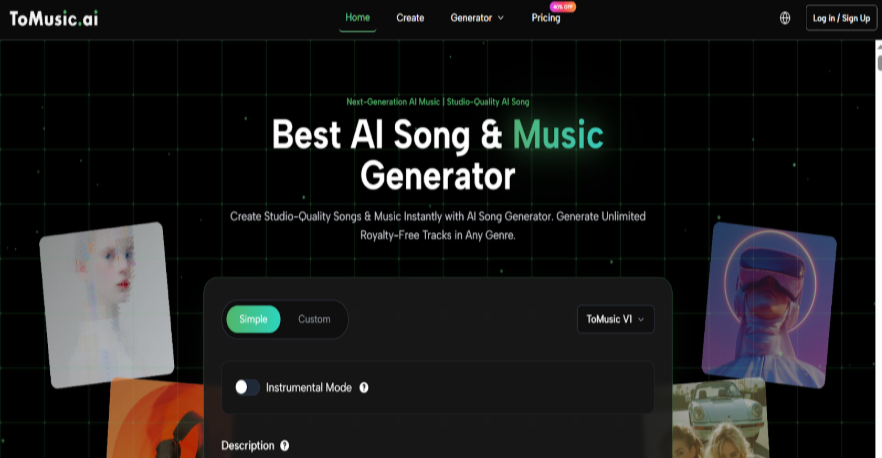
1. ToMusic.ai (tomusic.ai)
What I noticed: it’s good at “drafting with you,” not just generating and disappearing. When I experimented with the same lyric in different genres, it was easier to iterate and compare outcomes without losing the core emotional intent.
2. Suno
Great for: instantly hearing your lyric as a complete pop-style track.
Watch for: sometimes the vocal phrasing can surprise you—in good and bad ways.
3. Udio
Great for: vocal character and less generic results.
Watch for: you might need more passes to shape the exact delivery.



4. AIVA
Great for: composer-driven arrangements and dramatic builds.
Watch for: lyric-forward pop is not always its natural home.
5. Soundraw
Great for: building a backing track you can write on top of.
Watch for: it’s less about “song performance” and more about “music bed.”
6. Stable Audio
Great for: sound palettes and instrumental mood design.
Watch for: it’s not always the quickest lyrics-to-vocal pipeline.
Comparison table (from a lyric-first perspective)
| Tool | Best use if you’re a lyricist | Strength you’ll feel quickly | Real limitation |
| ToMusic.ai | Full-song drafts from text/lyrics with fast iteration | Easy to test multiple musical directions | Needs clear intent; sometimes 2–4 tries to match your internal melody |
| Suno | Instant full-song conversion | Speed and “finished” vibe | Vocal choices can vary; may take retries |
| Udio | Expressive vocal tone | Unique performances | More iteration to control phrasing |
| AIVA | Cinematic arrangements | Composition strength | Less pop-vocal default behavior |
| Soundraw | Backing tracks for writing | Reliable structure | Not centered on singing your lyrics |
| Stable Audio | Instrumental palette building | Great mood textures | Less direct lyric-performance focus |
A lyric-to-track workflow that keeps you in control
The trap is treating AI like a slot machine: generate, hope, repeat. The better way is to direct it like a co-writer.
Step 1: Write a “performance note” (not just lyrics)
Add 2–3 lines describing how it should feel:
- Who is speaking?
- What changed by the final chorus?
- Is the vocal intimate, bold, broken, playful?
Step 2: Generate three intentional versions
- The obvious genre choice (what you’d normally write)
- A contrast choice (what you’d never try)
- A stripped version (minimal arrangement, vocal-forward)
Step 3: Choose the best emotional take, then refine
You’re not choosing “the best production.” You’re choosing the version that honors your lyric.
A useful “before/after” bridge
Before: your lyric is silent and abstract.
After: your lyric becomes a demo you can send, revise, perform, or rewrite against.
Reality check
Sometimes the first generation is wrong—and that’s useful. When the music misses, it reveals what your lyric needs: a stronger chorus, a clearer point of view, or a better rhythmic pattern.
When you want the lyric to drive everything
For pure songwriting, I like a lyrics-first mode because it forces the music to support the words instead of overpowering them. If that’s your situation, Lyrics to Song is the path that matches how you already create: you write meaning first, then you build sound around it.
What makes these tools feel “good” for writers in 2026
- Fast generation is not enough—iteration speed matters more.
- Variation is a feature: hearing your lyric in multiple styles is creative feedback.
- The best tools help you finish drafts, not chase perfection.
The takeaway
Your lyric doesn’t need a perfect studio production to be real. It needs a voice, a groove, and a shape. The best AI music generators in 2026 help you turn “words on a page” into “something you can press play on,” so you can rewrite with confidence, collaborate faster, and keep the song moving.