If you have lived in Ohio for more than a single winter, you know the drill. One minute you are enjoying a crisp autumn bonfire, and the next, the forecast is calling for a “wintry mix” that threatens to turn your morning commute into an ice skating rink. The weather here is famously unpredictable, swinging from mild thaws to deep freezes in the span of 24 hours.
- Q: How Much Snow Has to Fall Before You Come Out?
- Q: Why Do You Use Salt? Does It Damage the Concrete?
- Q: Why Is Commercial Snow Removal So Different from Residential?
- Q: Do You Push the Snow or Haul It Away?
- Q: What Happens if the Plow Damages the Grass or Curbs?
- Q: Is It Better to Have a Seasonal Contract or Pay Per Visit?
- Q: What Kind of Equipment Do You Use?
- Conclusion
At Cable Bros Outdoor Living & Landscaping, we live by the seasons. While you might know us for building patios or mowing lawns in the summer, our work doesn’t stop when the grass goes dormant. When the leaves fall and the temperatures drop, we trade our mowers for plows and our fertilizer spreaders for salt hoppers. We spend our winters on the “night shift,” working quietly while the rest of the city sleeps to ensure that businesses can open and parking lots are safe.
Over the years, we have fielded a lot of questions about how the snow removal process actually works. It is a side of the industry that most people don’t see because it usually happens at 3:00 AM. To help shed some light on the cold, dark world of winter management, we have put together a list of the most common questions we get asked. Here is the honest truth about battling Ohio winters, straight from the cab of a plow truck.
Q: How Much Snow Has to Fall Before You Come Out?
A: This is probably the most common question we get, and the answer is: it depends on the contract and the conditions. In the industry, we talk about “trigger depths.” For many commercial properties, the standard trigger is anywhere from one to two inches of accumulation.
However, we have learned that sticking rigidly to a number doesn’t always work. If we get a dusting of half an inch, but the temperature is plummeting to 10 degrees, that dusting will turn into a sheet of black ice if vehicles drive over it. In that case, we might not plow, but we will certainly be out there salting. Conversely, if we get two inches of light fluff but the sun is coming out and it’s going to be 40 degrees by noon, sometimes nature does the work for us (though we never count on it for liability reasons).
We monitor the weather constantly. We aren’t just looking at the accumulation totals; we are looking at pavement temperatures and the timing of the storm. If a heavy squall hits right at 6:00 AM, we have to adjust our strategy compared to a storm that hits at midnight. Our goal is always to have the lot clear before your first employee or customer pulls in, regardless of exactly how many inches are on the ground.
Q: Why Do You Use Salt? Does It Damage the Concrete?
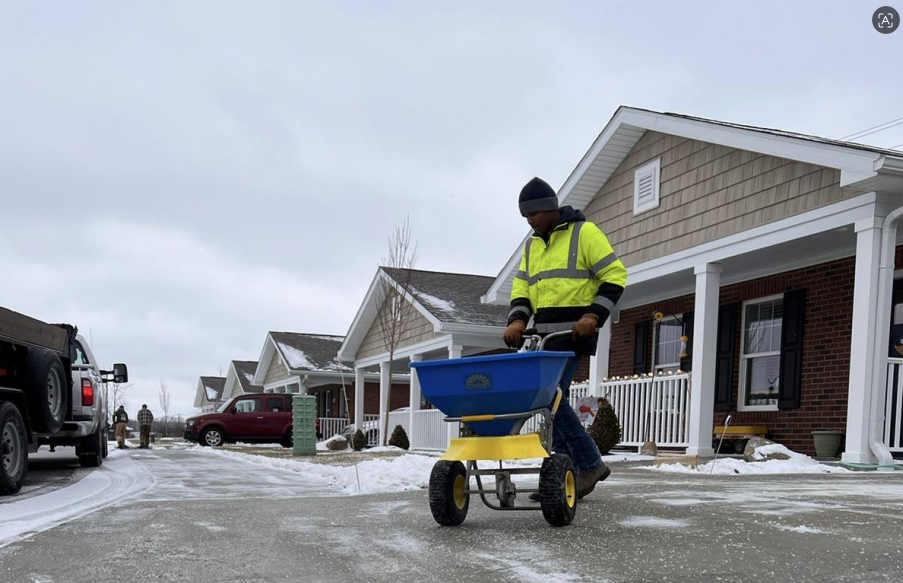
A: Dealing with ice is actually harder than dealing with snow. Snow you can push; ice bonds to the surface. We use rock salt (sodium chloride) and other de-icing agents to lower the freezing point of water. This breaks the bond between the ice and the pavement, allowing our plows to scrape it clean or letting the resulting brine run off into the drains.
We get asked a lot about concrete damage. The truth is, the freeze-thaw cycle is tough on any surface. Salt can accelerate that if used improperly or on brand-new, unsealed concrete. We try to be very careful with our application rates. We want to use enough material to ensure safety—because a slip-and-fall accident is a terrible thing—but not so much that we are tracking piles of salt into your building or damaging the hardscape.



For sensitive areas or extreme cold (where regular salt stops working), we might use different blends like calcium chloride, which burns hotter and works at lower temperatures. It is a balancing act between safety, budget, and preserving the infrastructure.
Q: Why Is Commercial Snow Removal So Different from Residential?
A: While we love helping homeowners, commercial snow removal is a different beast entirely. It is high-stakes work. A homeowner might be okay if their driveway isn’t cleared until 10:00 AM on a Saturday, but a medical office, a retail center, or a shipping warehouse cannot afford that delay. The economy relies on these lots being open.
The liability factor is also massive for businesses. If a customer slips in a parking lot, it is a serious legal issue for the property owner. This is why our commercial snow removal services are focused on “zero tolerance” for slippery conditions in high-traffic areas. We have to be thorough, clearing handicap spots, walkways, and loading docks with precision. We document our work, logging times and conditions, to provide our clients with a record that they exercised due diligence in keeping their property safe.
Q: Do You Push the Snow or Haul It Away?
A: Most of the time, we push it. Part of our site assessment before the winter even starts involves designating “snow piles.” We look for areas of the parking lot that are out of the way, don’t block sightlines for traffic exiting the property, and drain properly when the snow eventually melts. We want the meltwater to run toward catch basins, not back across the lot where it can refreeze at night.
However, in really heavy winters or on tight properties with limited space, we sometimes have to get creative. If the piles get too high and start taking up valuable parking spaces, we can bring in loaders to stack it higher or, in extreme cases, load it into dump trucks to haul it off-site. That is a more involved and expensive operation, but sometimes it is necessary to keep a business functional during those big Ohio blizzards.
Q: What Happens if the Plow Damages the Grass or Curbs?
A: Operating a heavy steel plow in the middle of the night, often in blinding snow, is challenging work. While we try to be as careful as possible, sometimes a curb gets nicked or a little bit of turf gets peeled back at the edge of the driveway. It is an unfortunate reality of moving tons of snow with heavy machinery.
We try to mitigate this by installing markers—those reflective stakes you see lining driveways—before the first snow falls. This gives our operators a visual guide of where the pavement ends and the grass begins. But if damage does occur, we take responsibility for it.
This is where our background as a full-service company comes in handy. Because we handle commercial landscape services year-round, we are already on-site in the spring. We carry topsoil and seed on our trucks once the weather warms up, and we repair those plow marks as part of our spring cleanup process. We view the property as a whole ecosystem; we don’t just leave a mess in the winter and forget about it. We want the property to look good all year, and fixing winter wear and tear is just part of that cycle.
Q: Is It Better to Have a Seasonal Contract or Pay Per Visit?
A: This really depends on your risk tolerance and budgeting style. A “Per Push” contract means you pay for exactly what you get. If it doesn’t snow all winter (unlikely in Ohio, but possible!), you pay nothing. If it snows every day for a month, your bill will be high. This can make budgeting unpredictable.
A “Seasonal” contract is like an insurance policy. You pay a flat monthly rate regardless of the weather. If it snows ten feet, we are there, and you don’t pay a penny extra. If it’s a mild winter, you might pay more than the service cost, but you paid for the guarantee and the priority service. For businesses that need strict budget certainty, seasonal contracts are often preferred. We work with our clients to figure out which structure makes the most sense for their specific needs.
Q: What Kind of Equipment Do You Use?
A: We use a mix of equipment tailored to the site. For large open lots, we use trucks with wide plows and V-plows that can scoop and stack snow efficiently. We also utilize skid steers and compact track loaders equipped with “pusher boxes.” These are large containment boxes that can move massive amounts of snow without it spilling off the sides, which is much faster than a standard truck plow for clearing wide aisles.
For sidewalks and entryways, it’s back to basics: shovels and snowblowers. We have crews dedicated solely to the walkways because a clean parking lot doesn’t matter if you can’t get to the front door. We maintain our equipment rigorously because a breakdown at 3:00 AM during a storm is a nightmare we try hard to avoid.
Conclusion
At the end of the day, snow removal is about trust. You are trusting us to show up when the weather is at its worst, to work through the night, and to make sure your property is safe for the people who depend on you. At Cable Bros, we don’t claim to be perfect, but we promise to work hard. We are grateful for the opportunity to serve our neighbors in Dayton, whether we are planting flowers in the sun or pushing snow in the dark. If you have more questions about how we can help your business get through the winter, just give us a call. Stay warm out there!