Traditional asset management in real estate and industrial sectors remains plagued by inefficiency. Property managers juggle disconnected spreadsheets, outdated floor plans, and reactive maintenance schedules that drain budgets and shorten asset lifespans. The cost of unplanned downtime alone runs into billions annually across industries, while physical site visits consume time and resources that could be better allocated elsewhere. What if you could manage every physical asset through a living, breathing virtual replica that updates in real time—one that lets you detect problems before they escalate and oversee operations from thousands of miles away?
This is precisely what digital twin technology offers. In this article, we explore how digital twins, powered by detailed 3D models and high-definition visuals, directly address the core business challenges facing asset owners today: dramatically improving operational efficiency, enabling seamless remote oversight, and transforming how organizations maintain and optimize their physical portfolios throughout the entire asset lifecycle.
What is Digital Twin Technology? Beyond the Hype
A digital twin is far more than a static 3D rendering or a fancy visualization tool. It is a dynamic, virtual representation of a physical asset, system, or process that evolves continuously alongside its real-world counterpart. Think of it as a living digital replica—one that breathes data and reflects the current state of a building, piece of equipment, or entire facility at any given moment. The magic lies in the data linkage. IoT sensors embedded throughout physical assets feed real-time information—temperature readings, vibration patterns, energy consumption, occupancy levels—directly into the virtual model.
Combined with Building Information Modeling (BIM) data, historical maintenance records, and operational analytics, this creates a synchronized digital environment that mirrors reality with remarkable precision. What separates a true digital twin from a simple 3D model is this live, bidirectional data connection.
A static model shows you what something looks like; a digital twin shows you how it’s performing right now and simulates how it will behave under different conditions. You can run “what-if” scenarios, stress-test systems virtually, and predict outcomes without touching the physical asset. The 3D digital twin adds spatial and contextual intelligence to this equation, allowing stakeholders to navigate through a facility virtually, pinpoint exactly where issues are occurring, and understand the relationships between interconnected systems within their physical environment.
The Core Components: Data, Model, and Connectivity
Every functional digital twin rests on three foundational pillars working in concert. First, there’s the physical asset itself, equipped with sensors and monitoring devices that continuously capture operational data—everything from HVAC performance metrics to structural strain measurements.
Second, the virtual model serves as the digital scaffold, incorporating precise geometry, material properties, system specifications, and historical context into a comprehensive digital representation.
Third, and most critically, bidirectional data connectivity bridges these two worlds, ensuring that changes in the physical environment are instantly reflected in the digital model, while insights generated through virtual simulations can inform real-world decision-making and automated responses.




Transforming Asset Management: From Reactive to Proactive
The traditional approach to asset management operates in a perpetual state of reaction—something breaks, someone reports it, a technician gets dispatched, and costs spiral. Digital twins fundamentally invert this paradigm by creating a single source of truth that consolidates every piece of asset information into one accessible, continuously updated platform.
Equipment specifications, warranty details, maintenance histories, compliance documentation, and real-time performance data all converge within the digital twin, eliminating the fragmented spreadsheets and disconnected databases that have long plagued facility teams. This centralization doesn’t merely organize information—it actively prevents the costly errors that emerge when teams work from outdated or conflicting data sources.

The most transformative capability, however, lies in predictive maintenance. By analyzing patterns in sensor data—subtle increases in vibration frequency, gradual temperature drift, declining efficiency metrics—digital twins can identify equipment degradation weeks or even months before catastrophic failure occurs.
A building’s chiller system showing early signs of compressor wear triggers an alert within the twin, allowing maintenance teams to schedule repairs during off-peak hours rather than scrambling after a midsummer breakdown leaves tenants without cooling. Organizations implementing predictive maintenance through digital twins routinely report 25-40% reductions in maintenance costs alongside significant decreases in unplanned downtime.
Beyond day-to-day operations, digital twins deliver powerful lifecycle management benefits spanning an asset’s entire existence. During design and construction, the twin validates systems integration and identifies conflicts before they become expensive field changes.
Throughout operations, it optimizes energy usage and space utilization based on actual performance data rather than design assumptions. When renovation or decommissioning decisions arise, the twin provides comprehensive historical performance data that informs capital planning with precision rather than guesswork, ensuring every dollar invested delivers maximum return across the asset’s full lifespan.
Empowering Remote Operations and Monitoring
Geographic distance has always been one of asset management’s most stubborn constraints. Portfolio managers overseeing properties across multiple cities or countries face an impossible choice: either travel constantly to maintain visibility, or accept blind spots that inevitably lead to missed problems and delayed responses.
Digital twins dissolve this barrier entirely by placing a complete, real-time view of every asset at a manager’s fingertips, regardless of their physical location. From a single dashboard, operators can monitor HVAC system performance in a Chicago office tower, track energy consumption patterns in a London retail space, and review occupancy trends across an entire Asian portfolio—all before their morning coffee gets cold.
The practical applications extend far beyond passive monitoring. When a maintenance issue arises, supervisors can guide on-site technicians through complex repair procedures by navigating the digital twin together in real time, pinpointing exact component locations and overlaying relevant technical documentation directly within the 3D environment.
Safety protocol simulations become possible without disrupting actual operations, emergency evacuation routes can be tested, hazardous material scenarios modeled, and compliance verified through the twin rather than through costly physical drills. Remote inspections that once required scheduling site visits, coordinating access, and generating separate reports now happen on demand, with stakeholders virtually walking through spaces and annotating areas of concern directly within the model.
The Critical Role of High-Definition Image Quality
The effectiveness of remote operations hinges entirely on visual fidelity. A blurry or geometrically inaccurate digital representation undermines the very confidence that remote management demands. When photorealistic textures capture the actual condition of surfaces, showing hairline cracks in concrete, water staining on ceiling tiles, or corrosion forming on pipe joints, remote assessors can make the same judgments they would make standing in the space physically.
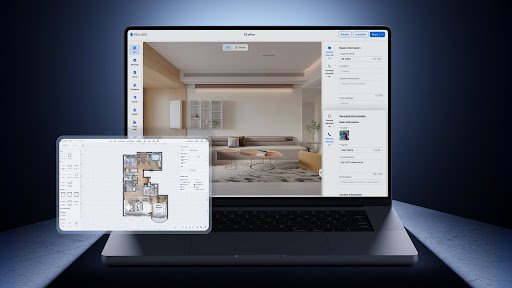
PropTech companies like Realsee have advanced the quality of spatial capture and 3D reconstruction, enabling digital twins with the level of visual precision needed for confident remote decision-making. Precise geometry ensures that measurements taken within the twin translate accurately to real-world dimensions, making design reviews and space planning exercises reliable without on-site verification.
For client-facing scenarios, high-definition digital twins serve as powerful presentation tools that convey professionalism and transparency, allowing prospective tenants to tour spaces or investors to evaluate assets with a level of immersion that photographs and floor plans simply cannot match. This visual precision ultimately reduces the frequency of required physical site visits by enabling confident decision-making from afar, saving travel costs while accelerating response times across the entire portfolio.

Implementing Digital Twin Technology: A Step-by-Step Guide for Business Owners
Moving from concept to execution requires a structured approach that balances ambition with pragmatism. Too many organizations attempt enterprise-wide digital twin deployments from day one, only to stall under the weight of complexity. The most successful implementations follow a deliberate progression that builds momentum through early wins and scales intelligently.
Start by identifying high-value use cases where digital twins will deliver the most immediate, measurable return. This means pinpointing your costliest pain points—perhaps it’s a flagship property with chronic HVAC failures, a remote facility requiring frequent inspection travel, or a portfolio segment where energy waste is eroding margins. Select one or two assets for a pilot project that can demonstrate tangible results within three to six months. This focused approach lets you prove value to stakeholders before requesting broader investment.
Next, conduct an honest assessment of your current data infrastructure and IoT readiness. Determine what sensors and monitoring systems already exist on your target assets, identify gaps in data collection, and evaluate whether your network infrastructure can support the continuous data streams a digital twin demands. Many buildings already generate substantial operational data through existing building management systems—the challenge often lies in accessing and integrating it rather than generating it from scratch.
Choosing the right platform and partners is where many implementations succeed or falter. Evaluate technology providers based on their ability to integrate with your existing systems, their experience in your specific asset class, and the scalability of their solutions. Look for partners who understand both the 3D modeling requirements and the operational data integration challenges, rather than vendors who excel at only one dimension.
With your platform selected, develop the 3D digital twin model through comprehensive site capture—laser scanning, photogrammetry, or structured photography—and begin integrating live data streams from sensors, BMS platforms, and maintenance management systems. This phase demands close collaboration between your facilities team, IT department, and technology partners to ensure data flows correctly and the model accurately represents physical conditions.
Training teams and establishing new workflows proves equally critical to technology deployment. Remote operations capabilities only deliver value when staff understand how to interpret twin data, respond to predictive alerts, and collaborate through the virtual environment. Redesign maintenance workflows around proactive interventions rather than reactive tickets, and establish clear protocols for remote inspections and escalation procedures. Finally, once your pilot demonstrates measurable improvements in efficiency, cost reduction, or response times, develop a phased rollout plan that scales the solution across your broader portfolio, prioritizing assets based on potential return and implementation complexity.
Embracing Digital Twins as a Strategic Asset Management Priority
Digital twins represent far more than sophisticated 3D models—they are intelligent, living management platforms that fundamentally reshape how organizations interact with their physical assets. By consolidating fragmented data into a single, continuously updated source of truth, they eliminate the inefficiencies that have long defined traditional asset management.
Predictive maintenance capabilities replace costly reactive scrambles with planned, strategic interventions that extend equipment life and protect budgets. Meanwhile, high-fidelity remote operations dissolve geographic constraints, empowering portfolio managers to maintain complete visibility and control across dispersed assets without the time and expense of constant travel.
The organizations gaining competitive advantage today are those treating digital twin adoption not as a distant aspiration but as an immediate strategic priority. As sensor costs decline, connectivity improves, and AI-driven analytics mature, the gap between early adopters and laggards will only widen. The path forward is clear: identify your highest-value asset, launch a focused pilot, measure the results, and scale from proven success. The future of asset management isn’t approaching—it’s already here, waiting for those ready to claim it.