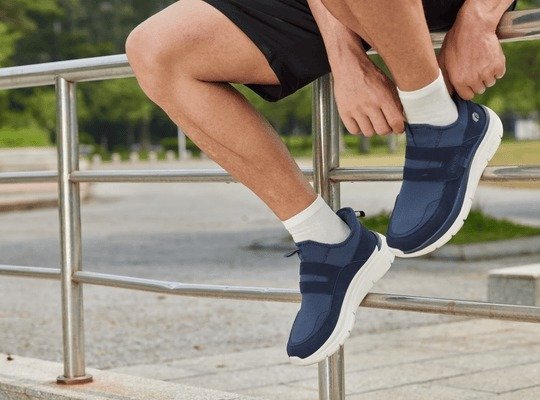
Most men don’t realise they’ve been wearing the wrong shoe width for years.
They know their size. They can tell you the brand they like. They can even tell you which pair “runs small.” But width? That’s usually ignored until the day it stops being ignorable.
That day looks like this: the length feels right, yet the sides feel tight. Your little toe feels pinched. You loosen laces and it still feels wrong. You take your shoes off and see red marks that match the stitching. Or you size up for “more room” and suddenly your heel slips, you get blisters, and you still feel cramped across the front.
At that point, you don’t need softer foam. You need more space. Specifically, you may need extra wide.
This guide will help you figure out whether you actually need extra wide shoes, what “extra wide” means in the real world (because brands vary), and what to buy so you don’t end up repeating the same mistake with a new label.
What does “extra wide” mean in men’s shoes?
“Extra wide” is a width category, not a single measurement. It means the shoe is built with more room across the forefoot (and often more toe-box volume) than standard widths.
The problem is that width naming isn’t perfectly consistent across the industry:



- In many UK retail contexts, men’s widths are described with letters such as F, G, H. For example, Clarks Outlet lists men’s width descriptions as F (Narrow), G (Standard), H (Wide).
- Some specialist retailers describe UK widths as D (standard), then E/EE/EEE for progressively wider fits, and some brands use “wide” and “extra wide” without a letter at all.
- In the US-style letter system, wider sizes can move through E, EE, EEE, EEEE, and so on, and there are published width ladders that show how the letters progress.
So here’s the practical way to think about it:
If you keep feeling side pressure in standard widths, even when the length is correct, you’re probably looking for a shoe built beyond “normal wide.” In everyday language, that’s extra wide.
If you want to browse a range that’s built around roomier fits and walking comfort, start with mens extra wide shoes and compare toe shapes, sole widths, and closure styles rather than guessing based on size alone.
How to know you need extra wide, not “a bigger size”
A lot of men self-diagnose width issues the wrong way. They go longer.
Length changes where the shoe bends, how your heel sits, and how much your foot slides forward. It can create new problems even if it feels “roomier” for the first hour.
Extra wide is more likely the right move if these patterns show up:
Your forefoot feels squeezed but toe room is fine
Your toes aren’t smashing the front. The sides are the problem.
Your little toe always feels sacrificed
That outer edge pressure is one of the most reliable signs.
You get red marks on the sides after normal wear
Not after a marathon. After a normal day.
You loosen laces all day and it still feels tight
That’s not a lace issue. It’s volume and width.
You “solved” tightness by sizing up and now your heel slips
Heel slip is a classic side effect of buying longer when you needed wider.
You repeatedly get calluses or hotspots at the ball of the foot
FootCareMD’s proper shoe fit guidance makes a useful point: the ball of your foot (widest part before toes) should fit comfortably in the widest part of the shoe. If it doesn’t, rubbing and pressure are predictable.
Why extra wide can matter for comfort and for foot health
This isn’t about being precious. Tight shoes create two problems that build over time: pressure and friction.
- Pressure creates sore spots, nail pain, and that “burning forefoot” feeling late in the day.
- Friction creates blisters and skin irritation, especially when the foot can’t sit naturally inside the shoe.
If you also have swelling, the “tight shoe problem” gets amplified. The NHS guidance for oedema explicitly advises not wearing clothes, socks, or shoes that are too tight.
And if you ever deal with sudden, unusual swelling, don’t treat it as a footwear issue. Mayo Clinic lists warning signs that need urgent medical attention (for example swelling with chest pain or shortness of breath).
A quick note on swelling and “end-of-day feet”
Even without a medical condition, many feet swell a bit across the day. Heat, standing, walking, long sitting, travel, salt, and plain gravity all contribute.
That means a shoe that feels “acceptable” at 10 a.m. can become tight at 6 p.m.
If your tightness is mostly late-day, extra wide (and sometimes extra depth) can be the difference between a shoe you tolerate and a shoe you trust.
How to measure your width properly (without turning it into a project)
If you want the most reliable answer, measure with a Brannock device or a proper fitting guide.
Brannock’s own fitting tips note that width is measured using the diagonal width line that contacts the foot at the widest part.
But even if you don’t have access to a device, you can still test width in a practical way:
- Try shoes later in the day (when your feet are at their largest).
- Wear your normal socks.
- Lace them normally and walk for two minutes.
- Pay attention to side pressure and toe freedom.
If the shoe feels tight across the ball of the foot, that’s not “break-in.” FootCareMD explicitly advises not to plan on shoes stretching over time. They should fit well when you buy them.
The features that matter most when buying extra wide shoes
Extra wide shouldn’t mean floppy. The best shoes give space where you need it and structure where you don’t.
1) A toe box that’s wide and shaped like a foot
Some shoes are “wide” but still tapered at the front. That defeats the whole purpose. You want a toe box that lets toes sit naturally, not stack.
2) Extra depth if the top of your foot feels squeezed
Width is side-to-side. Depth is vertical space. Many men need both, especially with higher insteps, swelling, or orthotics.
3) A stable heel counter
This is the part most people ignore until they feel unstable. AAOS explains the heel counter holds the heel in place, and that a stiff counter offers greater heel control and stability.
If you’ve ever felt like your foot “rolls” inside the shoe, pay attention to heel and rearfoot structure.
4) Adjustability
If your feet swell, adjustable closures matter. Laces or strong strap systems let you fine-tune the fit without turning the forefoot into a squeeze.
5) A sole that matches the width
Wide feet on narrow outsoles feel unstable. A good extra wide shoe should have a platform built to support the foot shape, not just a wider upper sitting on a narrow base.
What to buy: the extra wide categories that work in real life
Instead of chasing a “perfect shoe,” match the shoe type to your daily pattern.
For daily walking and commuting
Look for stable cushioning, a wide toe box, and a secure heel. You want comfort that holds up after 8,000 to 12,000 steps, not just the first 20 minutes.
For long standing days
Prioritise stability and supportive cushioning over ultra-soft foam. If the shoe feels wobbly, your lower legs will do extra work all day.
For swelling-prone feet
Go for extra depth and adjustability. Fixed-volume slip-ons can be risky if your foot volume changes through the day.
For orthotics
You’ll want removable insoles and enough depth so your orthotic doesn’t make the shoe feel tight across the top of the foot.
If you’re shopping in the “I want it simple, I just want it to fit” mindset, it helps to start with a collection designed around roomier options rather than hoping a random trainer “runs wide.”
The two-minute fit test that prevents bad purchases
Do this at home or in-store. It’s quick, and it catches most width problems immediately.
- Stand up. Feel for side pressure at the ball of your foot.
- Walk briskly for 30 seconds.
- Turn quickly left and right.
- Stop suddenly (simulates real life).
- Check: did your heel lift? did toes slam forward? did the sides rub?
If you feel a hotspot forming fast, take it seriously. FootCareMD’s advice not to rely on stretching is there for a reason.
Common mistakes men make with extra wide shoes
Buying extra wide and also sizing up in length
It often creates heel slip and friction. Solve width with width, not length.
Assuming “wide” and “extra wide” are the same
They’re not. And even within those labels, brands vary. Treat labels as clues, not truth.
Choosing softness over stability
Soft foam can feel great and still leave you tired, especially if the shoe lacks structure.
Ignoring the heel counter
If the heel isn’t stable, the whole stride becomes less controlled. AAOS highlights heel counter grip and stability as important in shoe design.
FAQ: Men’s extra wide shoes
What’s the difference between wide and extra wide?
Wide is “more room than standard.” Extra wide is a bigger jump. The exact label depends on the brand and region, so always judge by fit, not the tag.
How do I know if I need extra wide or just a wide fit?
If you’ve tried wide and still feel forefoot squeeze, extra wide is worth trying. If your foot still presses the sides even when laces are loosened, it’s a width issue.
Should I buy bigger if my feet swell?
Not automatically. Many men size up in length when they need width and depth. If swelling is a daily pattern, look for extra width, extra depth, and adjustability first.
Why do my shoes feel fine in the morning and tight later?
Feet often swell throughout the day. The NHS oedema guidance includes avoiding shoes that are too tight, which is relevant if swelling is part of your routine.
What’s the best way to measure width?
A Brannock device or professional fitting is most accurate. Brannock’s fitting tips describe measuring width at the widest part of the foot.
Can extra wide shoes feel unstable?
They can if the shoe’s base isn’t built for width or the heel isn’t secure. Look for a stable outsole and a supportive heel counter.
When should swelling be treated as a medical issue?
If swelling is sudden, painful, one-sided, or comes with chest pain or shortness of breath, seek urgent care. Mayo Clinic lists these as red flags.
Should I expect a break-in period?
A minor adjustment is normal, but pressure points and rubbing are not “break-in.” If it hurts fast, it’s likely the wrong fit.
Do extra wide shoes help with bunions?
They can help by reducing pressure on the forefoot, but toe-box shape matters too. A wide label with a tapered toe can still irritate bunions.
Closing thought
If you’ve been living with tight shoes, you probably developed a quiet habit of tolerating discomfort. That habit is expensive. It costs energy, mood, and sometimes your willingness to walk more.
Extra wide shoes are not a niche indulgence. They’re a fit correction.
Get the width right, keep the heel stable, give your toes room, and most “mystery discomfort” starts making sense. And once you find a pair that fits properly, you’ll wonder why you accepted the squeeze for so long.