Whether you are laying a new driveway, building a garden wall, or working on a larger site, getting concrete delivered sounds straightforward. But there is more to it than most people expect. One of the key decisions you will face is whether to order traditional ready-mix concrete or go with a volumetric mixer. Here is a clear guide to how volumetric concrete delivery works, what it costs, and when it is the right choice.
What Is Volumetric Concrete?
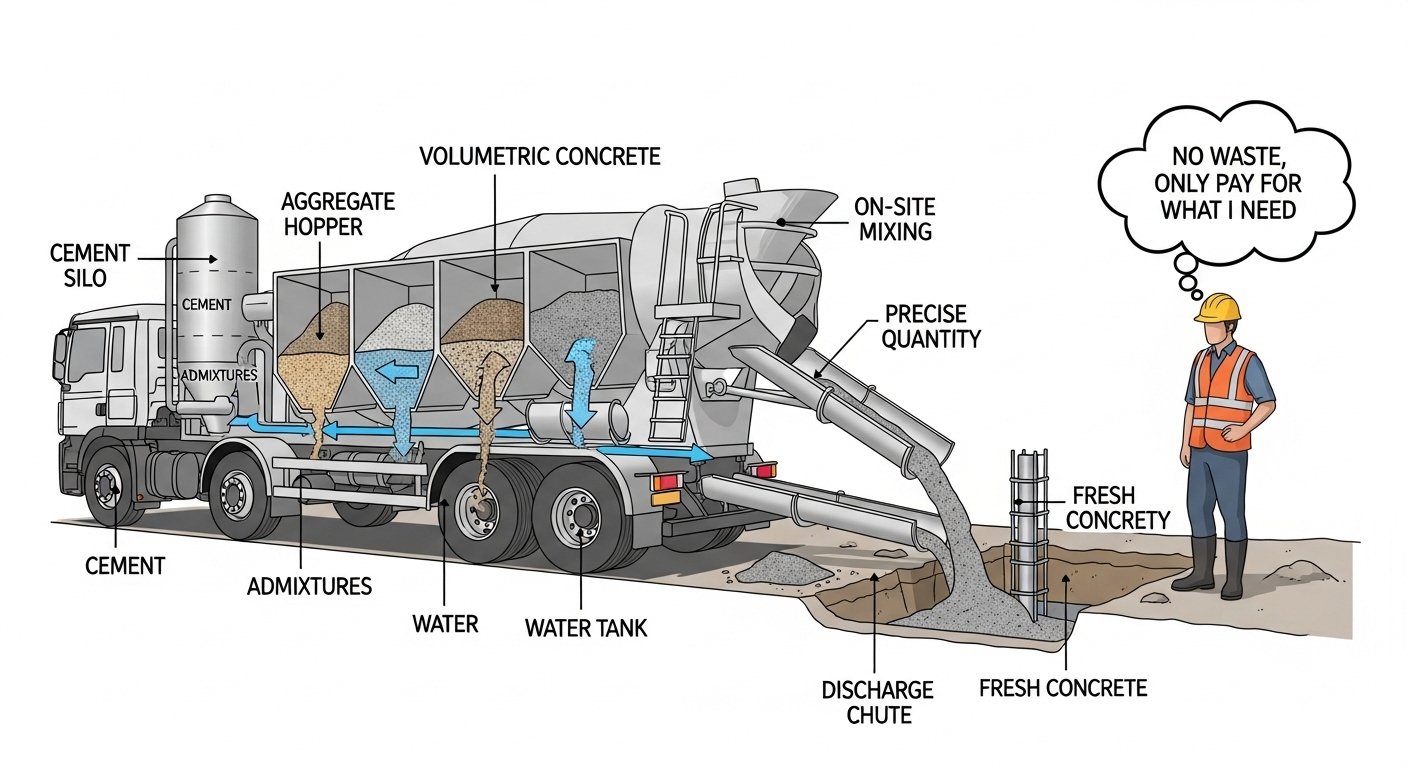
Volumetric concrete is mixed on-site at the point of delivery. A specialist lorry carries the raw materials separately, with sand, aggregate, cement, and water stored in individual compartments. The driver mixes the concrete to your exact specification as it is being poured.
This differs from traditional ready-mix, where the mix is prepared at a batching plant and delivered in a rotating drum. With ready-mix, the clock starts the moment the concrete is mixed. Delays on site can leave you with material that is too stiff to pour correctly.
The Key Advantage: No Waste
The biggest benefit of volumetric delivery is that you only pay for what you use. With a drum mixer, you order a set volume and take the risk on leftovers. With a volumetric mixer, the driver adjusts output as the pour progresses. This makes it popular for projects where quantities are hard to predict, such as footings, kerbing, or poured groundwork.
What Concrete Grades Are Available?
Volumetric suppliers can produce a wide range of grades on demand. Common options include GEN 0 to GEN 3 for general domestic uses such as paths and trench fills; C20 and C25 for light structural work including house foundations; C30 and C35 for driveways and commercial floors; and C40 and C45 for heavy industrial applications.
The ability to switch grades mid-delivery is a real advantage on mixed projects. If you are working with a concrete business near me that uses volumetric technology, you can often adjust your mix specification on the day without placing a separate order.
How Much Does It Cost?
Pricing depends on the grade, the volume ordered, and how far the lorry needs to travel. Smaller loads tend to be more cost-effective with volumetric suppliers than with batching plants, which often apply a short-load surcharge. As a rough guide, expect to pay somewhere between £90 and £150 per cubic metre for standard grades, though prices vary depending on location and current material costs.
Choosing the Right Supplier
When comparing suppliers, it is worth checking a few things. First, confirm that their mixes meet British Standards, particularly if the concrete is structural. Second, ask whether there is a minimum order charge. Third, consider proximity: choosing a concrete business near me that operates close to your site reduces travel time and keeps the mix in better condition on arrival.



Finally, ask about experience with your type of project. A supplier familiar with large commercial pours may not be the best fit for a domestic driveway job.
Is Volumetric Delivery Right for You?
Volumetric concrete suits projects of almost any size, but it is particularly useful when quantities are uncertain or when you need flexibility on mix design. For jobs where quantities are clear and timing is easy to control, traditional ready-mix can still be a practical option.
Either way, the best starting point is a conversation with your supplier before you order. A knowledgeable team will help you pick the right grade, estimate your volumes accurately, and fit the delivery around your schedule.