Storytelling and game design are different disciplines that share significant territory. A story asks the audience to follow; a game asks the player to act. A story controls experience through narration; a game controls experience through rules. These differences create friction when writers try to adapt their stories directly into games — the instinct to control the narrative conflicts with the game’s need to give the player meaningful agency.
The resolution is not to choose one over the other, but to find the specific intersection where the story’s strength — its characters, world, and central tension — serves as the foundation for the game’s mechanics rather than competing with them.
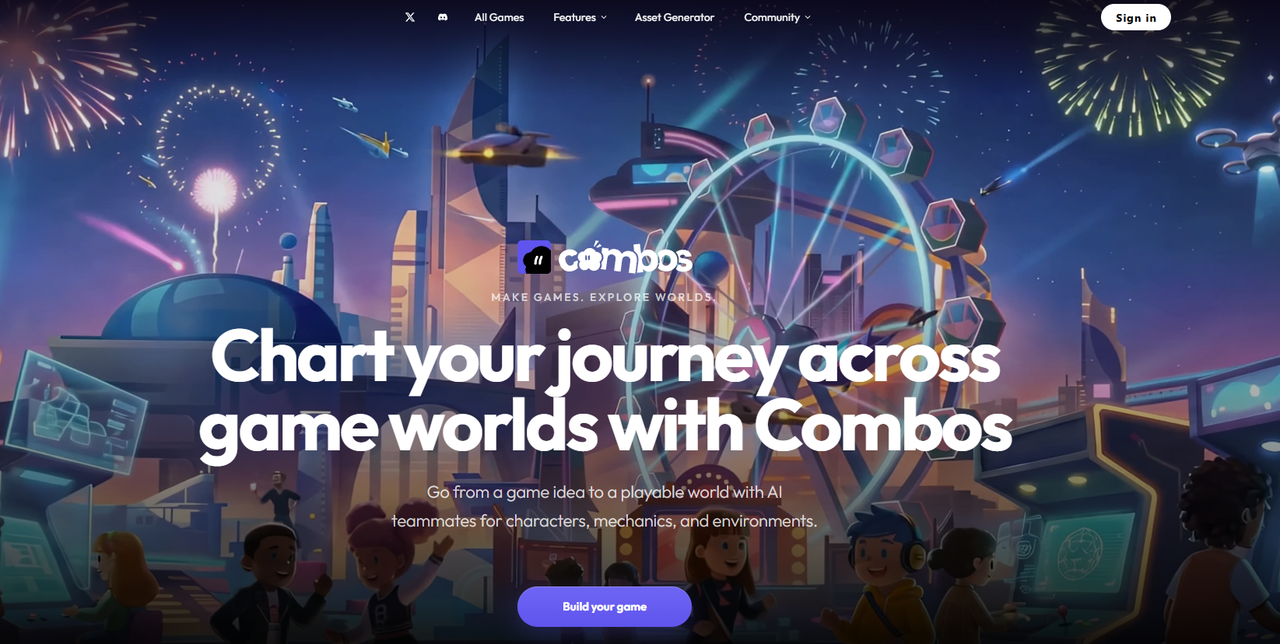
And an AI game maker? Well, it turns your story into a real playable game for any device. Let’s dig deeper.
Finding the Playable Core Inside Your Narrative
Every story has a question at its centre. The detective novel asks: who did it? The romance asks: will they end up together? The survival story asks: Will they make it? Each of those questions is also a potential game mechanic — a tension that the player can actively participate in resolving rather than passively observing.
Before building anything, identify the question at the heart of your story. That question is the playable core. Everything else — characters, setting, dialogue, world-building — becomes the context in which the player engages with that question.
Converting Your Story Into a Game on Combos
Here is how to bring a story idea into Combos and produce a playable narrative game.
Step 1 — Describe World and Conflict: Head to combos.fun and choose ‘Build from Scratch’ — describe your story’s world, protagonist, and central conflict to Boo. These three elements give the AI enough to build from. A well-built prompt makes all the difference in how your game turns out. So, make sure you include all angles of the game in your prompt.
Step 2 — Define Mechanics vs Cutscenes: In the Game Design Document review, define which story moments become game mechanics and which become cutscenes or narrative text. This distinction is the most important design decision in a narrative game.
Combos’ native AI assistant, Boo, will automatically ask for your input. And if you feel like something is missing, you can simply enter your instructions in the chat, and it will take care of the rest.
Step 3 — Generate Characters and Flow: Combos generates characters, environments, and a narrative flow structure automatically. The output is a working story-game framework that you refine rather than build from nothing. You can either upload your characters in the seests section via your chat, or ask Boo to create them according to your guidelines.
Step 4 — Expand or Cut Story Branches: Use natural language to expand or cut story branches — “add a dialogue choice here” or “skip the backstory scene.” Narrative games improve significantly through iteration.
Step 5 — Publish the Experience: Publish and share — reader-players experience your story as something they participate in, not just read or watch. The Combos platform has thousands of users who test games daily and provide real-time feedback via comments.
Branching Paths: When Player Choice Shapes the Story
Branching narrative is one of the most distinctive features of games as a storytelling medium. When a player makes a choice that meaningfully affects what happens next, they develop a personal relationship with the story that a linear medium cannot produce. They did not just read what happened — they made it happen.
Designing good branches requires thinking about what each choice reveals about the character making it, rather than just what different consequence it triggers. A choice between “attack” and “negotiate” is more interesting when it says something about who the player character is than when it simply produces a different combat outcome.
Keeping the Story Intact When the Player Goes Off-Script
The hardest design challenge in narrative games is maintaining story coherence when players behave unexpectedly. In a film or novel, the author controls what the audience experiences. In a game, the player has agency, and that agency sometimes takes the story somewhere the author did not intend.
The practical solution is to design your story’s emotional beats as destinations rather than routes. The player can take different paths to the same significant moments, and the feeling those moments produce remains consistent regardless of how the player got there. This gives players meaningful agency while preserving the story’s emotional architecture.
Conclusion
The gap between having a story and building a game from it has narrowed substantially. An AI game maker like Combos handles the technical structure of a narrative game so the creator can focus entirely on the story decisions that actually require human judgment. If you have a story you want people to inhabit rather than just read, the tools to make that happen are available right now.