
It is 11:42 PM. Your body feels heavy, like lead. You are ready for the sleep you have been waiting for. You close your eyes and take a deep breath. Then… your brain whispers:
“Hey, remember that embarrassing thing you said in a meeting three years ago? Let’s think about that right now.”
Or maybe you play the world’s worst game:
“Sleep Math.””Okay, if I fall asleep in 7 minutes, I get 5 hours and 12 minutes of sleep. But if I get a glass of water, that drops to just 5 hours…”
If this sounds familiar, you are not crazy. You are not alone. Your body is just in a state called hyperarousal (being too alert).
When your mind races like this, your brain refuses to switch gears. It is stuck in “Beta waves.” This means it is alert and trying to solve problems. It needs to switch to “Alpha” and “Theta” waves, which are for relaxing.
To fix this right away, don’t try to “force” your mind to go blank. That actually makes it worse. You must change the channel. The best way is to use Cognitive Shuffling. This means you fill the visual part of your brain with random pictures. This stops the part of your brain that worries with words.
“The best bridge between despair and hope is a good night’s sleep.” — Dr. Matthew Walker, Neuroscientist & Author of “Why We Sleep”



The Science: Why Your Mind Races
To understand how to disconnect, we need to look inside your brain. Why does it decide that 11:00 PM is the perfect time to think about your mistakes?
1. The Default Mode Network (The Gossiper)
The main cause of racing thoughts is a brain network called the Default Mode Network (DMN).
Imagine your brain is a big office building. During the day, the “Boss” is in charge. He gets work done and answers emails. When you go to sleep, the Boss goes home. But instead of turning off the lights, the night janitor comes in. This is the Default Mode Network.
The problem? This janitor loves to gossip. The DMN thinks about you, your past, and your future. When the DMN is too active, the janitor is shouting through a megaphone.
To stop the racing thoughts, we have to distract the janitor. We need to give your brain a small job. This bores the brain enough to fall asleep.
2. Cortisol Spikes Biologically
racing thoughts often come from stress. If you check email or watch intense TV right before bed, your brain sees a “threat.” It releases a chemical called cortisol.
Think of cortisol as “internal caffeine.” If you have high cortisol at night, it’s like your body is pressing the gas pedal, but your brain is trying to pull the brakes. You are physically tired, but chemically awake.
The Data: What Actually Works?
We looked at three studies to see what really helps.
Study A: Writing Things Down (Baylor University)
Researchers looked at writing in a journal before bed. They compared two groups:
1.People who wrote about tasks they already finished.
2.People who wrote a specific to-do list for the next few days.
The Result: The group that wrote the to-do list fell asleep much faster.
The Lesson: Writing down tasks takes the weight off your mind. It tells your brain, “It’s written down. You don’t need to remember this right now.”
Study B: The Power of Stories (University of Sussex)
Reading before bed is very good for you. A study found that reading can lower stress levels by 68%.
The Comparison:
Reading: 68% less stress.
Listening to Music: 61% less stress.
Drinking Tea: 54% less stress.
Video Games: 21% less stress.
The Lesson: Reading forces your brain to focus on a story. This stops the “worrying” part of your brain and lets you imagine someone else’s life.
The Plan: 5 Ways to Quiet Your Mind
Here is a nightly routine to help you relax.
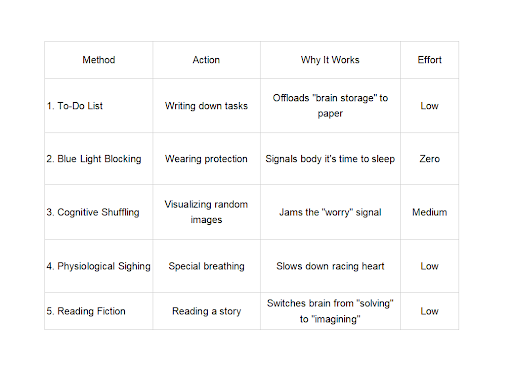
- Write a To-Do List (5 Minutes)
Do not write about your feelings; write about your tasks.
Action: Use a real notebook (no screens). Write down 3 to 5 things you must do tomorrow. Next to each one, write the first step to finish it.
Why: This closes “open loops” in your brain.
- Block Blue Light
You cannot fix a racing mind if you are looking at blue light from screens.
Action: 90 minutes before bed, put on your Circadian rhythm glasses.
Why: This acts like a portable sunset. It allows melatonin (the sleep hormone) to rise. It tells your nervous system that it is time to rest.
- Cognitive Shuffling
This is a powerful trick to stop worrying.
Action: Pick a random word (like “BEDTIME”).
Take the first letter, ‘B’. Picture a word that starts with B (like “Bear”). See the bear clearly.
Pick another word starting with B (like “Ball”). See it clearly.
Do this until you run out of B words, then move to the next letter, ‘E’.
Why: Your brain cannot focus on worries (words) and pictures (images) at the same time. The pictures bore your brain to sleep.
- The Special Breath
If your anxiety is physical (like a fast heartbeat), use your breath.
Action: Take two quick breaths in through your nose, then one long, slow breath out through your mouth. Do this 3 times.
Why: This slows down your heart rate and tells your body you are safe.
- Read Fiction, Not Facts The type of book matters.
Action: Read fiction stories, not self-help or business books.
Why: act books turn on the “problem-solving” brain. Fiction turns on the imagination. Imagination is the bridge to sleep.
Conclusion
Learning how to stop racing thoughts isn’t about forcing silence; it is about changing the channel. The “tired but wired” feeling is biological, not a personality flaw.
By writing down your worries and using cognitive shuffling to mix up your brain signals, you can finally move from being too alert to deep rest.
Don’t lie there doing “Sleep Math.” Trust the plan, use your imagination, and let your body go from chaos to calm.
Citation
1.Scullin, M. K., Krueger, M. L., Ballard, H. K., Pruett, N., & Bliwise, D. L. (2018). The effects of bedtime writing on difficulty falling asleep: A polysomnographic study comparing to-do lists and completed activity lists. Journal of experimental psychology. General, 147(1), 139–146. https://doi.org/10.1037/xge0000374
2.Wan, Z., Wan, Q., Qin, X., Wang, G., Lin, H., Jin, Y., Wan, B., Ai, L., & Wei, J. (2025). Long-term consumption of green tea protects the mental health of middle-aged and older adult men by improving inflammation levels. Frontiers in public health, 13, 1531953. https://doi.org/10.3389/fpubh.2025.1531953