Growth is every business’s goal, but the logistics often get overlooked—especially your physical workspace. Long-term leases force you to predict the future, but static offices can become bottlenecks with crowded desks and inefficiencies. The solution? Design for scalability. A flexible office adapts as you grow, avoiding costly relocations or renovations and supporting your team’s productivity and culture.
Understanding Scalability in Design
Scalability in office design refers to the ability of a workspace to expand, contract, or reconfigure with minimal disruption and cost. It is about building elasticity into the floor plan.
A traditional office design is often rigid. Walls are erected, heavy desks are bolted down, and the function of each room is permanent. If your team structure changes—for example, shifting from individual work to squad-based projects—a rigid office fights against you.
A scalable office, by contrast, is modular. It anticipates change. It acknowledges that the way you work today might not be the way you work next year. This approach matters because it safeguards your capital investment. Instead of spending money on a new fit-out every time your strategy pivots, you simply rearrange the assets you already have.
Assessing Current and Future Needs
Before you buy a single chair, you need data. Designing for scale requires a deep understanding of your current utilization and a realistic forecast of your growth.
Start by auditing your current workflow. Which spaces are always booked? Which corners gather dust? You might find that your large conference room is rarely used for formal board meetings but is constantly occupied by three people trying to brainstorm. This insight tells you that your future office needs more small “huddle rooms” rather than one massive boardroom.
Next, look at your hiring roadmap. Don’t just look at the total number of heads; look at the types of roles. A sales team might need a buzzing, energetic floor with open benches. A team of developers or legal counsel might require quiet, focused zones.
Projecting future needs is an estimation game, but you can create buffers. A common rule of thumb is to plan for 20-30% growth within the lifespan of your initial design phase. If you cannot justify leasing the extra square footage immediately, look for buildings that offer “right of first refusal” on adjacent suites, giving you a safety net for expansion.



Flexible Layouts and Furniture
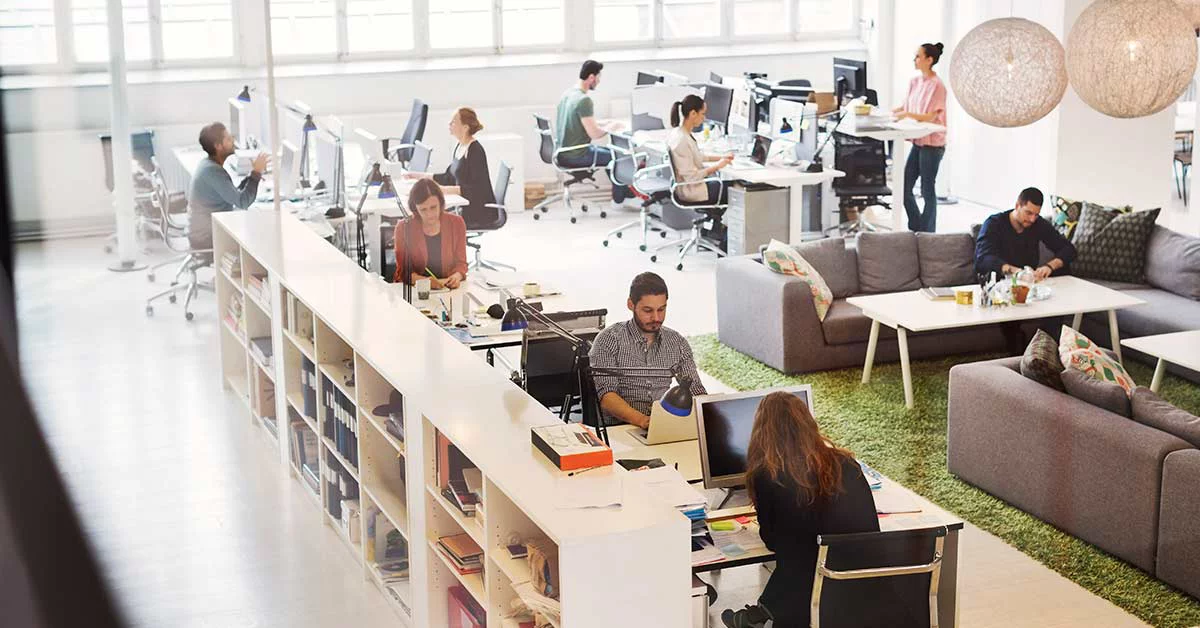
The backbone of a scalable office is furniture that moves. The era of heavy, mahogany desks is largely over for growth-focused companies. Instead, the focus is on modular systems—a “kit of parts” that can be assembled and reassembled as needed.
Consider opting for:
- Movable Partitions: Instead of drywall, use acoustic dividers, rolling whiteboards, or bookshelves to define zones. When you need to turn a breakout area into a workspace for six new hires, you can do so in an afternoon.
- Benching Systems: These desks allow you to easily add or subtract seats without changing the entire infrastructure.
- Multi-Use Furniture: Tables on casters that can be pushed together for a town hall or separated for training sessions offer immense value.
While open plans are popular for flexibility, they aren’t a silver bullet. Some employees require visual and acoustic privacy to function. This is where modern iterations of office cubicles or acoustic pods come into play, offering a modular way to provide privacy without building permanent walls.
The goal is to avoid “monuments”—fixed structures that require a demolition crew to move. If it can be unplugged and rolled away, it is scalable.
Technology Integration
A flexible layout is useless if your employees are tethered to the wall by short Ethernet cables. Technology is the invisible infrastructure that makes scalability possible.
To truly future-proof your office, invest heavily in robust, enterprise-grade Wi-Fi. It should cover every square inch of the office, including the break room and the lobby. This allows staff to work from anywhere, effectively turning every seat into a potential workstation.
Power distribution is equally important. As you add desks, you shouldn’t need an electrician to install new outlets. Look for power solutions that run through the floor or drop from the ceiling, allowing you to bring electricity to the center of the room regardless of where the furniture is placed.
Furthermore, equipping meeting rooms with plug-and-play video conferencing hardware ensures that as your team grows—and potentially disperses geographically—communication remains seamless.
The Impact of Remote Work Policies
You cannot design a modern office without considering hybrid work. The rise of remote work has fundamentally changed the math of scalability.
If you adopt a hybrid policy where employees work from home two days a week, you may not need a dedicated desk for every single person. This allows you to adopt a “hot-desking” or “hotel-ing” model. In this scenario, desks are shared assets booked by employees when they come in.
This model dramatically increases your capacity. An office designed for 50 people can comfortably support a headcount of 70 or 80 if daily occupancy hovers around 60%.
However, this shifts the design requirement. If people are coming into the office less often, they are likely coming in specifically to collaborate. Your design should therefore skew heavily toward social spaces, meeting rooms, and collaborative lounges, rather than rows of solitary workstations.
Conclusion
An office is more than just a container for your employees; it is a tool that facilitates your business goals. When you design with scalability in mind, you stop viewing your real estate as a fixed cost and start viewing it as a flexible resource. By assessing your data, embracing modular furniture, integrating robust technology, and adapting to hybrid work styles, you can build a workspace that evolves. This foresight ensures that when your business hits its next growth spurt, your office will be ready to support the expansion, not stand in its way.