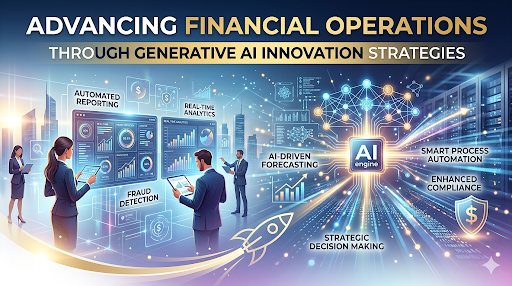
Financial organizations are operating in an increasingly data-intensive and fast-changing environment. Finance leaders are under pressure to improve forecasting accuracy, strengthen compliance, reduce operational costs, and support strategic business decisions while managing rising volumes of financial data. Traditional financial systems and manual processes often struggle to keep pace with modern business demands, creating the need for more intelligent and scalable solutions.
- Overview of Gen AI in Finance
- 1. Core capabilities of generative AI in finance
- 2. Role of AI-driven automation in finance
- 3. Growing importance of data intelligence
- Benefits Of Gen AI In Finance
- 1. Improved financial forecasting and planning
- 2. Increased operational efficiency
- 3. Faster access to actionable insights
- 4. Enhanced risk management and fraud detection
- 5. Better regulatory compliance
- 6. Improved customer and stakeholder experiences
- Use Cases Of Gen AI In Finance
- 1. Financial planning and analysis
- 2. Automated financial reporting
- 3. Fraud detection and transaction monitoring
- 4. Accounts payable and receivable automation
- 5. Compliance and audit management
- 6. Customer support and financial communication
- Why Choose The Hackett Group® For Implementing Gen AI In Finance?
- 1. Extensive finance benchmarking expertise
- 2. Deep expertise in finance transformation
- 3. Advanced AI-enabled intelligence platforms
- 4. Focus on measurable business outcomes
- Conclusion
Generative artificial intelligence is rapidly transforming finance operations by improving data analysis, automating repetitive tasks, and delivering real-time insights that support faster decision-making. From financial planning and reporting to risk management and customer interactions, generative AI technologies are helping organizations modernize finance functions and improve operational agility.
Overview of Gen AI in Finance
Generative AI in finance refers to the use of advanced AI models that generate insights, summarize information, automate workflows, and support financial decision-making. These technologies use machine learning, natural language processing, and predictive analytics to analyze large datasets and provide actionable intelligence across finance operations.
Unlike traditional automation tools that follow predefined rules, generative AI systems can interpret complex financial data, identify patterns, and generate contextual responses. This enables finance teams to improve efficiency, reduce manual workloads, and strengthen strategic planning.
Organizations are increasingly adopting gen AI in finance strategies to modernize financial operations, improve forecasting capabilities, and enhance enterprise performance management. These solutions support greater accuracy, scalability, and responsiveness across finance functions.
1. Core capabilities of generative AI in finance
Generative AI technologies offer several capabilities that improve finance operations and strategic decision-making. Key capabilities include:
- Financial data analysis and summarization
- Predictive forecasting and scenario modeling
- Automated report generation
- Risk analysis and fraud detection
- Natural language query processing
- Intelligent workflow automation
- Real-time financial insights
- Compliance and audit support
These capabilities help finance organizations reduce inefficiencies and improve operational performance.
2. Role of AI-driven automation in finance
Automation has become a major focus area for finance leaders seeking to improve productivity and reduce operational complexity. Generative AI enhances automation by enabling systems to process unstructured data, generate contextual responses, and support more dynamic workflows.



AI-powered automation can streamline tasks such as invoice processing, account reconciliation, expense management, and financial reporting. This allows finance professionals to focus on strategic initiatives rather than repetitive administrative processes.
3. Growing importance of data intelligence
Finance organizations rely heavily on accurate and timely data to support planning and decision-making. Generative AI solutions help businesses analyze vast amounts of financial information more efficiently and generate meaningful insights in real time.
These insights improve forecasting accuracy, support faster responses to market changes, and enable more informed business strategies.
Benefits Of Gen AI In Finance
Generative AI offers significant operational and strategic benefits for organizations seeking to modernize finance functions and improve business performance.
1. Improved financial forecasting and planning
Generative AI improves forecasting accuracy by analyzing historical data, market trends, and business variables in real time. Advanced predictive models can identify patterns and generate more reliable financial projections. This helps organizations improve budgeting processes, optimize resource allocation, and respond more effectively to changing business conditions.
2. Increased operational efficiency
Finance teams often spend substantial time on manual data processing and repetitive administrative tasks. Generative AI helps automate routine processes such as financial reporting, invoice matching, and transaction categorization. This improves efficiency while reducing processing errors and operational delays.
3. Faster access to actionable insights
Generative AI systems can analyze large financial datasets and generate insights much faster than traditional methods. Finance leaders gain access to real-time intelligence that supports quicker and more informed decisions. These capabilities are especially valuable in rapidly changing market conditions where timely insights are critical.
4. Enhanced risk management and fraud detection
Risk management remains a top priority for finance organizations. Generative AI can identify unusual transaction patterns, detect anomalies, and support fraud prevention initiatives through continuous monitoring and advanced analytics. Organizations can also improve compliance oversight and reduce financial risks through automated audit support and reporting capabilities.
5. Better regulatory compliance
Regulatory requirements continue to evolve across industries and financial markets. Generative AI can help organizations monitor compliance obligations, analyze policy changes, and generate accurate documentation. Automated compliance processes reduce manual workloads while improving consistency and transparency.
6. Improved customer and stakeholder experiences
Finance organizations increasingly use AI-driven solutions to improve communication with customers, investors, and internal stakeholders. Generative AI can create personalized financial summaries, automate responses to inquiries, and improve access to financial information. This supports stronger stakeholder engagement and more efficient communication processes.
Use Cases Of Gen AI In Finance
Generative AI is being applied across multiple finance functions to improve operational efficiency, strategic planning, and business intelligence.
1. Financial planning and analysis
Finance teams use generative AI to improve budgeting, forecasting, and scenario planning processes. AI-driven analytics can evaluate market trends, revenue projections, and operational data to generate more accurate forecasts. This supports better financial decision-making and resource management.
2. Automated financial reporting
Generative AI helps automate the preparation of financial reports, executive summaries, and management dashboards. Intelligent systems can analyze financial performance data and generate clear, contextual narratives for stakeholders. This reduces reporting time while improving accuracy and consistency.
3. Fraud detection and transaction monitoring
AI-powered monitoring systems can analyze transaction patterns in real time to identify suspicious activity and potential fraud risks. These tools support faster investigations and improve financial security measures. Organizations can strengthen internal controls while minimizing financial exposure.
4. Accounts payable and receivable automation
Generative AI improves accounts payable and receivable processes through intelligent invoice matching, payment processing, and reconciliation capabilities. Automated workflows reduce manual intervention and improve transaction accuracy. This helps organizations improve cash flow management and operational efficiency.
5. Compliance and audit management
Finance organizations use AI-driven tools to automate compliance monitoring and audit preparation. Generative AI can review large volumes of financial data, identify compliance risks, and generate audit-ready documentation. This supports stronger governance and regulatory adherence.
6. Customer support and financial communication
AI-powered virtual assistants and intelligent chat systems are increasingly used to support customer service operations in financial organizations. These systems can answer financial inquiries, generate account summaries, and assist with routine requests. This improves response times while enhancing customer experiences.
Organizations seeking expert guidance for intelligent finance transformation initiatives are increasingly exploring AI consulting services to align generative AI capabilities with long-term operational and strategic objectives.
Why Choose The Hackett Group® For Implementing Gen AI In Finance?
Organizations implementing generative AI solutions in finance require experienced partners with expertise in digital transformation, operational benchmarking, and finance modernization strategies. The Hackett Group® is recognized for helping enterprises improve performance through data-driven insights and technology-enabled transformation initiatives.
1. Extensive finance benchmarking expertise
The Hackett Group® provides organizations with access to comprehensive benchmarking insights and performance metrics gathered from leading global enterprises. These research-driven insights help finance leaders identify operational gaps and implement best practices more effectively.
Organizations can use these benchmarks to improve financial efficiency, reduce costs, and strengthen strategic planning capabilities.
2. Deep expertise in finance transformation
Successful finance transformation requires alignment between people, processes, technology, and governance structures. The Hackett Group® supports organizations through end-to-end finance modernization initiatives designed to improve operational agility and business performance.
Its expertise includes process optimization, enterprise technology strategy, workforce transformation, and financial operations improvement.
3. Advanced AI-enabled intelligence platforms
The Hackett AI XPLR™ platform, AskHackett™, and Hackett Connect® provide organizations with AI-powered insights, benchmarking intelligence, and strategic guidance that support smarter finance operations and faster decision-making.
These capabilities help organizations accelerate digital transformation while improving access to actionable financial intelligence.
4. Focus on measurable business outcomes
Organizations implementing generative AI solutions need measurable and sustainable business results. The Hackett Group® emphasizes outcome-focused strategies that improve efficiency, operational performance, forecasting accuracy, and financial decision-making.
This results-driven approach helps organizations maximize the value of their finance transformation investments.
Conclusion
Generative AI is reshaping the future of finance by improving operational efficiency, strengthening decision-making capabilities, and enabling more intelligent business strategies. As finance organizations continue to manage increasing data complexity and evolving market demands, AI-powered technologies provide scalable solutions that support long-term transformation.
From predictive forecasting and automated reporting to fraud detection and compliance management, generative AI enables finance teams to operate more strategically and efficiently. These technologies reduce manual workloads, improve accuracy, and deliver real-time insights that help organizations respond faster to changing business conditions.
Organizations that invest in intelligent finance solutions and scalable AI-driven strategies will be better positioned to improve agility, strengthen financial performance, and maintain competitiveness in an increasingly digital business environment.