Chinese energy storage companies are entering a new phase of globalization. The model that prevailed through the early 2020s — producing in China, exporting finished products abroad — is giving way to a more substantive form of presence in overseas markets: building production capacity, R&D operations, and supply networks on local soil. The shift from “products going global” to “capacity going global” reflects both maturing demand in the destination markets and a recognition by leading Chinese manufacturers that long-term competitiveness will require localized industrial roots, not just export volumes.
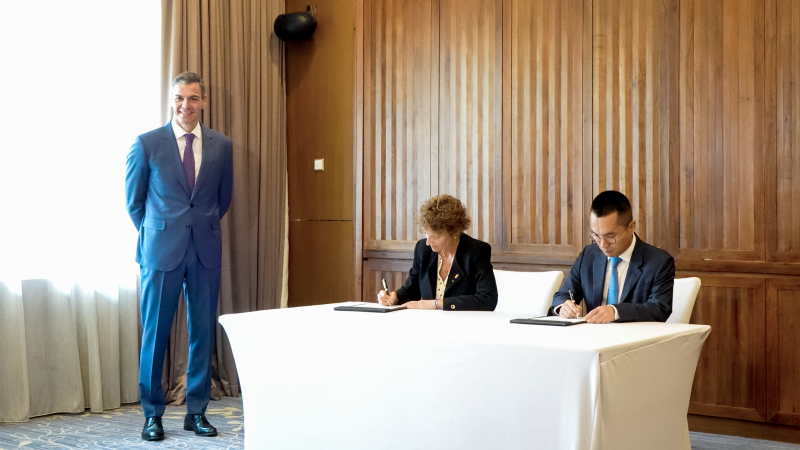
HiTHIUM‘s recent Memorandum of Understanding with the Government of Navarra, committing approximately €400 million to a battery cell and BESS manufacturing facility in Spain’s Navarra Autonomous Region, is the latest and one of the most consequential expressions of this shift. The Spain investment is HiTHIUM’s first European manufacturing base and marks the company’s move past export-led overseas growth. But the Spanish plant is also a vantage point. Looking through it, one can see how far HiTHIUM has actually advanced along the globalization curve — and what kind of system supports a Chinese energy storage manufacturer arriving at this point.
Beyond a Single Plant Decision
The Navarra project can be read on two levels. At the surface, it represents a major capital commitment, a regional joint venture, and the entry of a new manufacturing participant into European energy storage. At a deeper level, the project is the latest landing point of a global strategy that has been developing for several years. A single overseas facility of this scale cannot operate in isolation; it requires a supporting organizational structure built up over time.
The more substantive question to ask about the Navarra investment is why HiTHIUM chose Spain. Yet, more importantly, the relevant question is what kind of globalization system supports a Chinese energy storage manufacturer reaching this stage of overseas development. Two analytical angles help answer this. The first is the strategic framework that has guided HiTHIUM’s overseas trajectory since 2022. The second is the layered build-out across the company’s five core business functions: research and development, manufacturing, markets, service, and supply chain.
The Strategic Framework Since 2022
HiTHIUM first began international business in 2022. From the outset, the overseas expansion has been organized around a coherent strategic framework rather than transaction-by-transaction opportunism.
- A Three-Pillar Strategy
HiTHIUM operates under an explicit strategic framework that the company describes as “Integration, Internationalization, and Branding.” Integration captures the vertical strategy across cell, system, and integrated solution layers, alongside the operational integration of overseas operations with the Chinese headquarters. Internationalization refers to the geographic build-out of HiTHIUM’s overseas presence. Branding addresses the company’s positioning in international markets, with the objective of establishing HiTHIUM as a globally recognizable category leader in stationary energy storage.



The three pillars are structured to reinforce one another. Each new market entry is intended both to expand geographic reach and to strengthen the integrated solution portfolio and the brand.
- A Development Philosophy of Local Integration
Alongside the three-pillar strategy is a more operationally grounded principle that HiTHIUM applies across its overseas markets: embedding in the local context and integrating into the host community. The principle treats overseas presence as long-term co-construction with the host region rather than transactional supply. The Spain investment represents the natural expression of this philosophy at a manufacturing scale. A €400 million joint venture with the Navarra regional government, generating approximately 700 direct local jobs, constitutes a long-dated commitment to the region that cannot easily be reversed.
- An Ecosystem Co-Construction
The trajectory from 2022 to 2026 traces a clear upgrade path, as HiTHIUM progressively deepened and localized its overseas presence — from initial market entry to increasingly substantial operations on the ground.
The current phase, marked most clearly by the Spain announcement, is ecosystem co-construction: manufacturing presence in overseas markets, joint ventures with local governments, research and development anchored in international hubs, and integration into local supply chains. The shift is overall redefining HiTHIUM’s position relative to overseas customers and host governments.
Five Layers of Global Capability
The strategic framework has been built out across five operational layers. Together these layers form the organizational system that enables a project of the Navarra scale.\
- Research and Development
HiTHIUM combines research and development workforce exceeds 1,000 professionals. The Hong Kong International R&D Center, established within the Hetao Shenzhen-Hong Kong Science and Technology Innovation Co-operation Zone in late 2025, serves as the primary node of HiTHIUM’s international research network. The center focuses on long-duration energy storage and sodium-ion battery development, drawing on Hong Kong’s universities, international research partners, and access to global talent. It functions as a complement to the domestic research institutes rather than a duplication of their work.
- Manufacturing
HiTHIUM’s manufacturing footprint is organized across five operational bases:
- The Xiamen Headquarters Base
- The Chongqing Southwest Intelligent Manufacturing Base
- The Heze Long-Duration Storage Integrated Zero-Carbon Industrial Park in Shandong
- The Shenzhen Application Innovation Base
- The Dallas manufacturing base in Texas
And in January 2026, the World Economic Forum recognized the Chongqing facility as the global energy storage battery industry’s first Lighthouse Factory, the highest international benchmark for advanced manufacturing.
The geographic distribution reflects a deliberate delivery logic. Domestic bases provide scale and cost efficiency. The Texas facility offers proximity to the North American market and resilience against shifting trade policy conditions. The Navarra plant addresses European demand and establishes EU industrial positioning.
The overall footprint constitutes a multi-node delivery network calibrated to the locations of the largest demand pools.
- Markets
HiTHIUM has established positions in 3 core international markets: China, North America, and Europe. Active expansion is also under way across emerging markets in the Middle East, Africa, Oceania, and South America. Cumulative product deployments have reached customers in more than 20 countries and regions. The dual-track structure combines depth in core markets with breadth in emerging ones, allowing HiTHIUM to capture demand from established storage markets while simultaneously building early positions in regions where storage adoption is still scaling. The Spanish gigafactory, and a series of European integrator partnerships represent recent expressions of this dual-track approach.
- Service
The service architecture is built around four full-lifecycle modules: system planning, solution customization, project delivery, and operations and maintenance. These modules are supported by service centers across China, the United States, Europe, and Oceania. Each service node operates with localized teams that are fluent in the regional language and familiar with the local market context, enabling rapid response without the operational friction typical of cross-border service models. HiTHIUM describes the underlying mechanism as a rapid response, efficient delivery, and long-term operations service loop, anchored by warehousing nodes and local resources.
Industry recognition has followed. HiTHIUM is among a small number of energy storage companies to hold both the NECAS Five-Star After-Sales Service Standard Certification and the CTEAS Seven-Star (Excellent) After-Sales Service System Certification, representing two of the most rigorous service quality benchmarks available to manufacturers in the sector.
- Supply Chain
The supply chain architecture operates on a dual-track logic.
- On the domestic side, HiTHIUM coordinates closely with the Chinese battery and materials supply chain, which has matured into the most integrated of its kind globally.
- On the international side, HiTHIUM is building out local supply networks around each international manufacturing hub. The Spain plant is expected to anchor a European procurement and supplier ecosystem over time.
An Integrated Globalization Architecture
Considered together, the five layers describe a more integrated organizational architecture than the standard pattern of a multinational manufacturer building plants in international markets.
- Value Chain Completeness
Most Chinese energy storage manufacturers have built strong positions in one or two segments of the value chain, typically cells, systems, or service contracts, and rely on external partners for the remaining segments. HiTHIUM’s globalization is distinctive in that all five layers are being built out simultaneously and in coordination. The Spain plant is not a manufacturing decision arrived at in isolation. The plant is enabled by the supply chain track, supported by the research and development network, served by the European service operation, and aligned with the Internationalization, Integration, and Branding strategy. The completeness of the value chain itself constitutes the competitive position.
- Balancing Global Scale with Local Integration
The more demanding challenge for a globalizing Chinese manufacturer is not building scale, given that Chinese industry has demonstrated extensive scaling capability over the past two decades. The challenge is building scale in a manner that does not appear externally imposed within destination markets. HiTHIUM’s joint-venture structure in Navarra, its alignment with EU ESG frameworks, its localized service teams, and its emphasis on community integration each reflect an attempt to resolve this tension. The operational model is not a Chinese factory transplanted to Europe, but a co-developed operation governed under European frameworks and labor standards.
- From Product Provider to Ecosystem Partner
The most significant shift evident in HiTHIUM’s globalization architecture is the role the company is positioning itself for in international markets. A product provider sells finished output to customers. An ecosystem partner co-develops capacity, research and development, and service infrastructure alongside the markets it serves. The Navarra plant, considered alongside the Texas facility, the Hong Kong R&D center, the European service network, and the dual-track supply chain, places HiTHIUM in the second category. For European utilities and developers evaluating storage partnerships across 15 to 20-year project horizons, this distinction increasingly determines supplier selection.
Conclusion
The Navarra plant is best understood not as the endpoint of HiTHIUM’s globalization but as confirmation that the supporting architecture is now in place. In doing so, the company is helping to push the broader Chinese energy storage industry forward, advancing the sector toward ecosystem partnership as the basis of international competitiveness.
Contact HiTHIUM today to get more insight on energy storage industry!