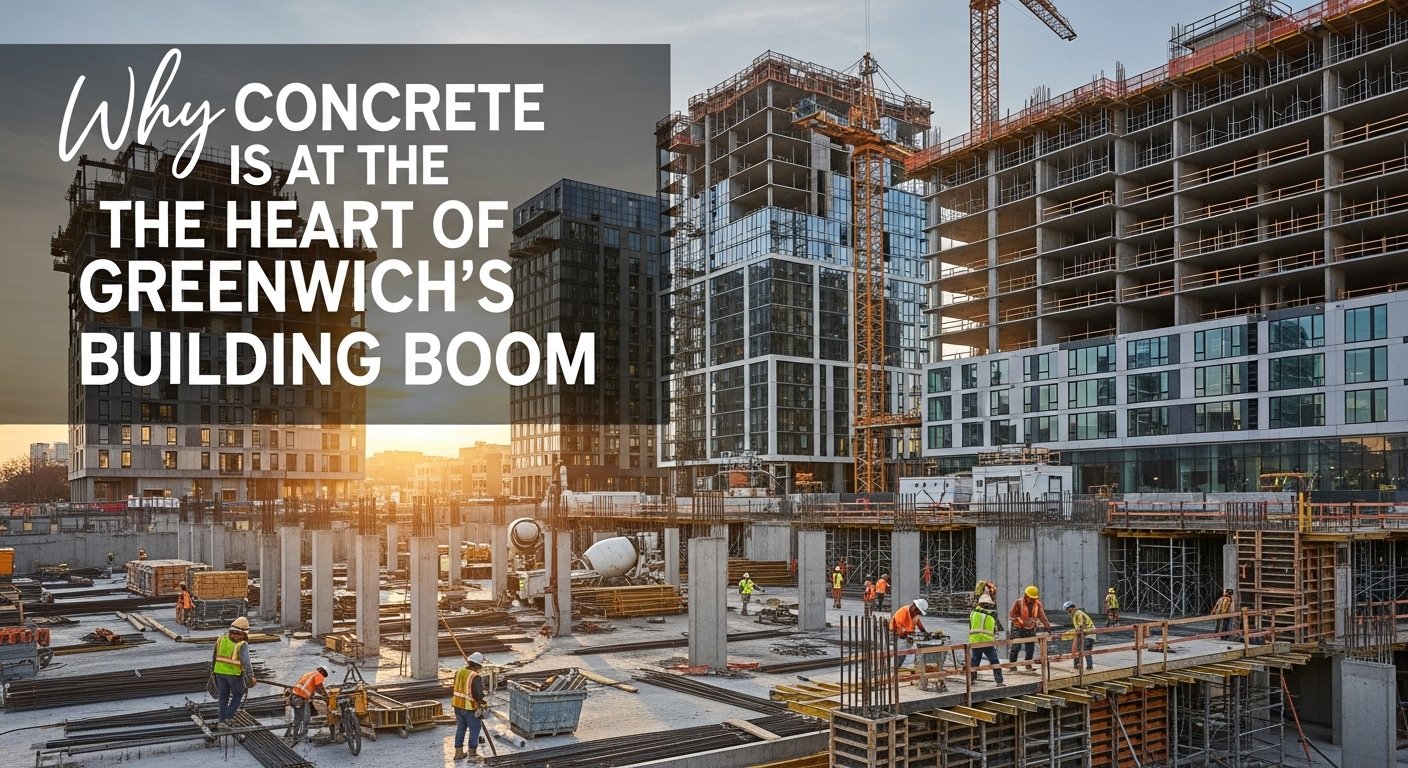
Greenwich has always been a borough that blends history with ambition. From the Royal Observatory on the hill to the new towers rising along the Meridian waterfront, this corner of south-east London is in a constant state of reinvention. And behind every new foundation, driveway, and commercial floor slab, there is one material doing most of the heavy lifting: concrete.
Demand for concrete Greenwich has grown noticeably in recent years, driven by a mix of large-scale regeneration projects, new residential developments, and a steady flow of smaller domestic jobs.
A Borough Being Rebuilt
Greenwich is one of London’s fastest-changing areas. The Greenwich Peninsula alone has seen billions of pounds of investment over the past decade, with thousands of new homes, offices, and public spaces replacing what was once one of the most polluted industrial sites in Europe. Projects of this scale consume enormous volumes of ready-mix concrete, from deep pile foundations to the structural frames of tower blocks and the finishing screeds on residential floors.
But it is not just major developments driving the appetite for concrete in the area. Smaller projects make up a significant share of demand too. Homeowners extending into their gardens, builders laying new driveways, and local authorities resurfacing footpaths all require reliable, consistent supply. For these jobs, ready-mix is often the most practical option because it arrives already prepared to the correct specification, reducing waste and saving time on site.
What Makes Ready-Mix Suitable for London Projects?
Ready-mix concrete is produced at a central plant and delivered to site by a revolving drum lorry. The mix is prepared to an exact specification based on the job, whether that is a low-strength mix for a garden path or a high-strength structural grade for a load-bearing slab. This level of control is difficult to replicate when mixing by hand on site, particularly when large volumes are needed within a tight time window.
For anyone sourcing concrete in Greenwich, the key considerations tend to be consistent quality, the right mix for the application, and a supplier who can deliver reliably within a busy urban environment. Tight roads, parking restrictions, and busy street schedules make punctual scheduling essential in areas like Greenwich, where access for a large lorry can be genuinely challenging.
Concrete Grades and Their Uses
Not all concrete is the same. Projects in and around Greenwich will typically use different grades depending on the application. A standard C20 mix is common for garden walls and non-structural elements, while C25 is often used for foundations and ground-bearing slabs. C30 and above are typically specified for suspended slabs, driveways, and structural work.
Getting the grade right matters for both performance and cost. Specifying too low a strength can lead to cracking or failure over time. Specifying too high adds unnecessary expense. This is one reason many project managers and self-builders rely on experienced local suppliers who can advise on the correct mix from the outset.



A Growing Market for Local Suppliers
The sustained level of construction activity across Greenwich and the wider south-east London area has kept local ready-mix suppliers busy. Concrete has a limited working life once mixing begins, typically around ninety minutes, so distance between plant and site matters. Those looking for concrete Greenwich suppliers will find a mix of large national operators and smaller, locally-based businesses, each with their own advantages in terms of flexibility and service.
Whether Greenwich continues to grow at its current pace depends on wider economic factors, but the demand for reliable concrete supply in the borough shows little sign of slowing down any time soon.