Medical scrubs serve not only as a professional garment but also as a representation of the professionalism, hygiene, and practicality that is expected in the field of medicine. From the decades past until today, scrubs have undergone several transitions, from the old days of the traditional white coats to the current day where modern medical scrubs are available that incorporate both comfort and practicality. Through understanding this progression, one can learn about the evolution of scrubs into an integral component of medicine.
- Early Period: White Coats and the Development of Medical Garb
- Scrubs in the Early 20th Century
- Colour Coding and Identification
- Comfort and Practicality Emerge
- The Color Revolution and Personal Identity
- Harveys Workwear and the Modern Scrubs Market
- Fitted Modern Medical Scrubs: Style and Technology
- The Scrub as a Cultural Symbol
- The Increasingly Sustainable Future of Scrubs
- Conclusion
Early Period: White Coats and the Development of Medical Garb
During the 19th century, the development of medical garb involved more symbolism rather than practicality. In most cases, doctors would wear dark-colored suits accompanied by white aprons during surgical operations. With time, as germ theory became increasingly popular, medical practitioners started putting on the iconic white coats that represented purity, trustworthiness, and professional competence.
However, early medical attire lacked convenience in addition to being uncomfortable and unsanitary. For instance, doctors and nurses wore heavy and bulky clothes, which compromised their movement and exposed them to infections. It is safe to say that medical garb in its early stages had nothing to do with functionality.
Scrubs in the Early 20th Century
The term “scrubs” can be attributed to the early 20th century operating rooms. Doctors and nurses were seen wearing lightweight and easy-to-wash clothes that could be worn in sterile environments. The origin of this name is associated with “scrubbing in,” a process that involves thorough washing of hands and arms before surgery, and thus the attire that was worn during such occasions.
At this stage, the use of scrubs increased in operating rooms. There was an emergence of lighter colours such as blue and green, which were helpful in eliminating reflections from lights used during surgeries. For the first time in history, function became a defining factor in medical attires.
Colour Coding and Identification
Towards the mid-20th century, the nature of hospitals had become more chaotic, leading to a need for differentiation of professionals by departments. Hospitals adopted the use of color-coded scrub suits to facilitate quick identification of professionals. For instance, surgeons could wear green or teal scrubs while nurses dressed in white or blue scrub suits.
With the evolution of hospitals, the use of scrubs was no longer bound to gender constraints as women began to adopt less cumbersome uniforms than the white one. This was aimed at promoting convenience and ease of movement in the work environment.
Comfort and Practicality Emerge
From the 1980s onwards, scrubs have become an indispensable part of healthcare uniforms. As the length of working hours increased and procedures required more involvement, there was a demand for clothing that was comfortable as well as functional. The introduction of breathable, flexible, and durable fabrics was soon followed by practical innovations such as reinforced stitching, moisture-absorbing fabric, and ample pockets.


These developments reflected the changing nature of the workplace itself, with the need for nurses, technicians, and surgeons alike to have clothing that would endure repeated use while offering comfort at the same time. The increasing popularity of unisex scrubs was another development in this era.
Through these advancements, scrubs became symbols of practicality, transcending the symbolic nature of the traditional nursing uniform.
The Color Revolution and Personal Identity
As we moved into the 21st century, scrubs witnessed a revolutionary transformation in terms of their design aesthetic. Gone were the traditional colors of blues, greens, or whites, replaced by a full range of hues and fun designs. Pediatric wards boasted pastel scrubs, while dentistry employed geometric designs on theirs. This was the time when scrubs served not only a professional purpose but also gave medical practitioners scope for self-expression.
Research indicated that wearing certain colored scrubs reduced stress and created an encouraging atmosphere, particularly for child patients. Health-care personnel felt delighted with such opportunities to express themselves while still being able to look professional. It was a time when scrubs assumed new significance in terms of identity among health care professionals.
Harveys Workwear and the Modern Scrubs Market
A good example of the changes that the scrubs market has undergone is Harveys Workwear – Quality Medical Scrubs & Uniforms (harveys.co.uk). It is an enterprise based in the United Kingdom which boasts of its more than 70 years of experience in manufacturing and selling of workwear apparel. Harveys Workwear offers different types of scrubs and uniforms for healthcare professionals that are both comfortable to wear and functional.
Among the garments offered by the enterprise, one can find both women’s and unisex scrub tops, trousers, and overall garments. Their palette includes traditional colours such as blue or black along with brighter colours that might cater better to personal taste. The garments are made of fabrics that are rather durable and easy to clean – a must for any clinic environment. The items offered by Harveys come equipped with various pockets for storing necessary equipment and have action back designs. Harveys offers the services of professional embroidering of any logo, name or designation on the uniform.
Fitted Modern Medical Scrubs: Style and Technology
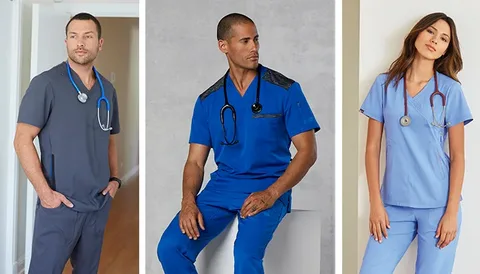
Modern medical scrubs fitted and worn by today’s health care professionals have been the result of years of innovation. Fabrics used in making such scrubs are comfortable, highly durable, and sometimes incorporate antibacterial properties that hinder bacterial reproduction. These scrubs come with ergonomic designs that allow the wearer to move easily throughout their workday, thanks to stretchable sections, sturdy stitching, and practical pocket placement that enables them to carry gadgets, writing implements, and notes.
Some medical scrubs even incorporate smart textile technologies that provide additional functionality by allowing vital sign monitoring or wearable device integration. Despite being relatively new, this development is likely to shape the future of scrubs as medical apparel that offers more than just protection and comfort.
Fitted modern medical scrubs have also taken fashion trends into consideration. With a variety of colours and flattering fits available, such scrubs enable professionals in the field to appear stylish and professional in their work environment.
The Scrub as a Cultural Symbol
With their increasing prevalence, scrubs began to take on a new dimension as a cultural symbol associated with the field of health care. Media, ranging from television shows to social media celebrities, has highlighted the symbolic nature of scrubs, viewing them as more than just a uniform but also a representation of dedication and strength.
The customised appearance of scrubs, incorporating embroidered names, logos, and even different colours, adds an aspect of self-expression to these garments while still adhering to health care regulations.
The Increasingly Sustainable Future of Scrubs
As sustainability becomes increasingly prevalent in the healthcare industry, sustainable scrubs made of recycled, organic, or biodegradable material have been developed as a solution that allows us to make use of sustainable products while maintaining quality and cleanliness standards.
The future holds many changes for scrubs, including changes related to technology, as well as shifts in culture and fashion. The development of scrubs from a symbolically laden piece of apparel such as a white coat into the contemporary and multifunctional piece of clothing known today as a scrub highlights changes in healthcare.
Conclusion
It can be concluded that there is an interesting development within medical scrubs from purely white costumes that were worn in honor of their symbolism into practical, colorful and innovative garments for everyday use. Scrubs have evolved with functionality in mind, such as providing comfort, hygiene and flexibility while offering the opportunity to express oneself. It is clear from the suppliers like Harveys Workwear that the market for medical scrubs has developed accordingly.
Today, scrubs are much more than practical clothing – they represent the ever-changing world of medicine.