Of all the components that make up electronic circuits, there should be no doubt that capacitors are among the most fundamental. These passive devices store electrical energy and influence how signals and power flow through a system.
- Circuit Stability: What Is It, And Why Is It So Important?
- Series Vs Parallel Capacitors, And the Implications for Your Circuit
- Parallel Capacitors: Enhancing Storage and Smoothing
- Series Capacitors: High Voltage and Precision
- Never Overlook the Impact Your Capacitor Arrangement Has on Circuit Stability
Circuit Stability: What Is It, And Why Is It So Important?
Whether you’re an electronics enthusiast, student, hobbyist, or professional engineer, if you are seeking to build a high-performing and dependable circuit, you will need to know something about circuit stability, and how to support it.
The term “circuit stability” refers to a given system’s ability to maintain consistent performance, while avoiding unwanted oscillations, noise, or voltage fluctuations. This can be an imperative priority across such applications as power supplies, filters, and timing circuits.
Series Vs Parallel Capacitors, And the Implications for Your Circuit
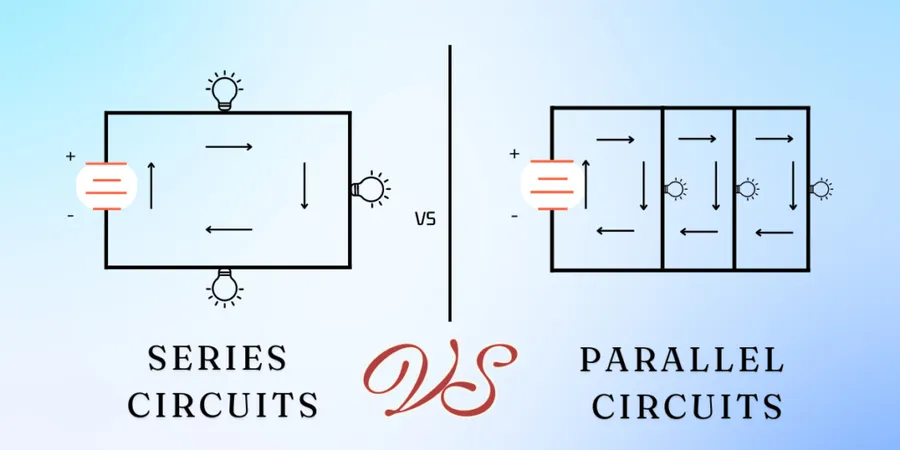
To help achieve optimal performance in your own circuit project, you may carefully think about two common ways to connect capacitors: in parallel and in series.
Whatever configuration you opt for in any given case, your choice will impact on the total (or “equivalent”) capacitance, and therefore the behaviour of the circuit.
Let’s, then, take a closer look at series vs parallel capacitors, and what each of these setups means for circuit stability.
Parallel Capacitors: Enhancing Storage and Smoothing
The most common method for boosting a circuit’s total capacitance, is linking together capacitors in a parallel arrangement. Here are some of the implications of this:
- Energy storage: when this configuration is chosen, individual capacitance values are added together, as expressed in the formula: Ctotal = C1 + C2 + …. This effectively increases the “plate area”, enabling the circuit to store a greater amount of electrical charge at the same voltage.
- Voltage smoothing: capacitors connected in parallel are essential for power supply filtering. They act as a reservoir, supplying current during voltage dips and absorbing excess charge whenever spikes occur. This has the effect of minimising “ripple” and ensuring a stable direct current (DC) output.
- Low impedance: linking multiple capacitors in parallel also has the effect of reducing equivalent series resistance (ESR). This translates to enhanced efficiency and stability, given that it makes possible quicker charging and discharging, which is of critical importance for high-frequency or high-speed circuits.
Series Capacitors: High Voltage and Precision
If the primary goal is managing voltage stress rather than heightening capacity, this is the kind of scenario in which a series arrangement of capacitors is likely to be used. Again, we have outlined some of the impacts of this:


- Voltage rating: capacitors being arranged in series means the total voltage rating is the sum of the individual ratings. This enables components to safely handle higher voltages that would cause damage to a single capacitor.
- Lower capacitance: it might seem paradoxical, but when capacitors are linked in series, this causes total capacitance to go down. The relevant formula for figuring out equivalent capacitance in such an arrangement is: 1/Ctotal = 1/C1 + 1/C2 + …. This can be useful where there is a need to fine-tune a circuit to a precise, non-standard value smaller than any single available component.
- AC coupling: series capacitors in coupling applications pass alternating current (AC) signals, while blocking DC. This allows for bias stability in amplifiers to be maintained, without introducing offsets that could cause drift.
Never Overlook the Impact Your Capacitor Arrangement Has on Circuit Stability
In summary, when you master parallel and series arrangements of capacitors across your projects, this will put you in a strong position to achieve the best possible circuit stability.
Well-chosen digital tools, such as parallel and series capacitor calculators, can further help you with your projects by making it an even quicker process to figure out the total capacitance of capacitors in each and every circuit.