In the world of high-stakes technology, we are accustomed to the idea of “convergence.” It is the moment when separate technologies—like the telephone, the camera, and the computer—merge into a single device that fundamentally changes how we live. The iPhone was not just a better phone; it was a paradigm shift.
- 1. The “Unicorn” Training: Breaking the Neuro vs. Ortho Divide
- 2. The Silicon Valley Mindset: Why a Surgeon Went to Business School
- 3. MotionFirst™: The Engineering Behind the Philosophy
- 4. Man Plus Machine: The Robotic Standard
- 5. The Hidden Culprit: Decoding the SI Joint
- 6. From “Patient” to “Guest”: A Cultural Revolution
- Conclusion: The Future is Human
In medicine, however, we often still operate in silos. You have the brain specialist, the bone specialist, and the business administrator, and they rarely speak the same language. But at Vertrae® in Dayton, Ohio, we are witnessing a similar moment of convergence. We believe that the future of spinal healthcare does not rely on a new pill or a sharper scalpel. It relies on a new breed of physician: the Hybrid Surgeon.
Founded by Dr. Kamal Woods, Vertrae® is the physical manifestation of a “unicorn” background—a unique fusion of elite neurosurgical training, orthopedic structural engineering, and high-level business strategy. This isn’t just a medical practice; it is an engineered solution to the problem of back pain. By treating Dr. Woods’ unique bio not just as a resume, but as a distinct service offering, we can see why patients are traveling from across the region to experience a new standard of care. Here is how the convergence of these distinct disciplines is solving the oldest problems in spine health.
1. The “Unicorn” Training: Breaking the Neuro vs. Ortho Divide
For decades, the world of spine surgery was divided into two distinct camps, often at odds with one another. In one corner, you had neurosurgeons. Trained as the guardians of the central nervous system, they spent years mastering the delicate microsurgery required to operate inside the brain and around the fragile nerve roots. Their superpower was decompression—freeing the nerves from pressure with extreme finesse.
In the other corner, you had orthopedic surgeons. These were the master carpenters and structural engineers of the human body. They understood biomechanics, levers, fulcrums, and load distribution. Their superpower was reconstruction—fixing deformities and stabilizing the column.
The problem for the patient was that the spine does not respect these academic boundaries. It is a complex ecosystem where neurology and structural mechanics are inextricably linked. You cannot treat a pinched nerve in isolation without considering the stability of the vertebrae above and below it.
Dr. Woods recognized early in his career that to be a truly complete spine specialist, he could not choose a side. He had to master both. This drive led him to complete a Neurosurgery Residency at Loma Linda University Medical Center, followed by a specialized Combined Orthopedic & Neurosurgery Spine Fellowship at the world-renowned Cedars-Sinai Medical Center in Los Angeles.
This dual-training background is the medical equivalent of being bilingual. It allows Dr. Woods to look at an MRI and see the full picture. He can protect the delicate neural structures with the precision of a brain surgeon while simultaneously employing the structural engineering strategies of an orthopedist. For the patient, this means the end of the “referral merry-go-round.” You don’t need two specialists to solve one problem. You just need one surgeon who speaks both languages.



2. The Silicon Valley Mindset: Why a Surgeon Went to Business School
Perhaps the most disruptive element of the Vertrae® model isn’t medical at all. It is operational.
We have all experienced the friction of the traditional healthcare system: the endless forms, the opaque billing, the waiting rooms that live up to their name, and the feeling of being a “number” in a massive bureaucracy. Dr. Woods realized that these were not medical failures; they were business failures. He understood that being a brilliant surgeon was not enough if the delivery system was broken.
To fix this, Dr. Woods stepped out of the operating room and into the classroom, earning an MBA from the prestigious Johns Hopkins Carey Business School. This decision was driven by a desire to apply the principles of efficiency, customer experience, and strategic management to the medical practice.
At Vertrae®, we apply this “Silicon Valley” mindset to spinal care. We view our patients as “guests.” We use technology to streamline scheduling and communication, ensuring that the friction is removed from your journey. We measure our success not just by surgical outcomes, but by the “User Experience” of our practice. The MBA influence ensures that the practice runs with the precision of a Swiss watch, respecting your time and your dignity. It is a recognition that healing begins the moment you walk through the door, not just when the anesthesia kicks in.
3. MotionFirst™: The Engineering Behind the Philosophy
If you talk to ten people over the age of 50 about back surgery, nine of them will mention one word with dread: “Fusion.” For years, fusion—the process of locking two or more vertebrae together—was the hammer for every nail. While fusion is a powerful tool and necessary in specific cases of instability, it comes at a steep price: the permanent loss of motion.
Dr. Woods’ background in biomechanics led to the development of the MotionFirst™ philosophy. We believe that the spine was designed to move, twist, and bend. Evolution gave you joints for a reason. Therefore, our primary goal is to preserve that natural function whenever safely possible.
This is where the “product” of Dr. Woods’ expertise becomes tangible. He is a leader in motion-preserving technologies, such as Artificial Disc Replacement (ADR). Think of it like a hip or knee replacement. If you have a bad knee, the surgeon doesn’t fuse your leg straight; they replace the joint so you can keep walking. Why should the neck or lower back be any different? By utilizing advanced artificial discs, we can remove the source of pain while maintaining the spine’s natural kinematics. This not only allows for a faster recovery and a more active lifestyle but also protects the adjacent levels of the spine from wearing out prematurely—a common side effect of fusion known as “adjacent segment disease.”
4. Man Plus Machine: The Robotic Standard
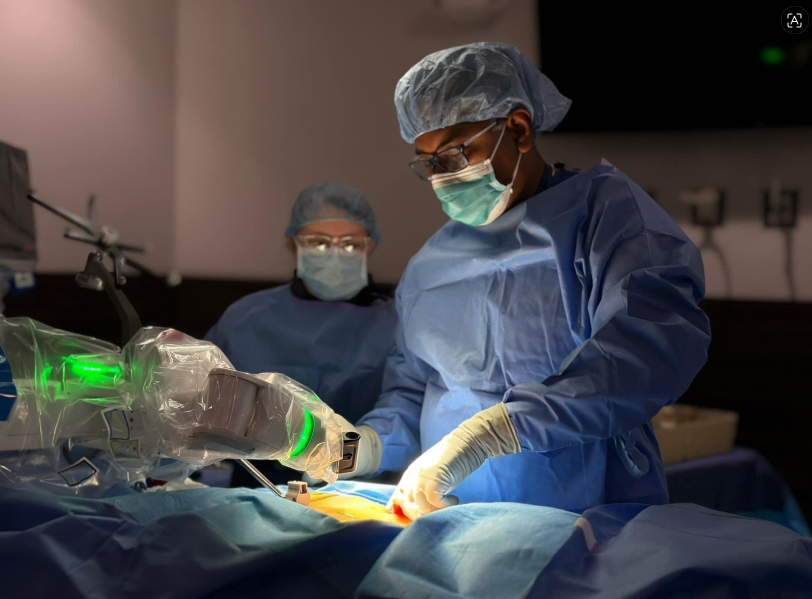
Innovation is one of the core pillars of the Vertrae® brand. We refuse to practice 20th-century medicine in a 21st-century world. This commitment to the bleeding edge of technology is most visible in our operating room, where Dr. Woods utilizes state-of-the-art robotic guidance systems.
Robotic spine surgery is not science fiction; it is the new standard of safety. It is the difference between flying a plane by looking out the window versus flying with GPS and autopilot. Before the patient even enters the OR, Dr. Woods uses CT scans to create a virtual 3D map of the patient’s spine. He plans the surgery on a computer, sizing every screw and cage to the millimeter.
During the procedure, the robotic arm guides the instruments along that pre-planned trajectory with a level of steadiness and accuracy that the human hand alone cannot match. This technology allows for what we call “minimally invasive plus.” It enables us to perform complex reconstructions through tiny incisions. For the patient, this translates to less blood loss, less muscle disruption, less postoperative pain, and a significantly shorter hospital stay. It turns a scary, major surgery into a manageable, predictable event.
5. The Hidden Culprit: Decoding the SI Joint
One of the distinct advantages of Dr. Woods’ comprehensive training is his ability to diagnose the “imposters” of back pain. A classic example is the Sacroiliac (SI) Joint.
Many patients come to us after failed back surgeries or years of unexplained pain, convinced they have a “bad back.” In reality, the pain is often coming from the SI joint—the connection between the spine and the pelvis. Because this joint can mimic the symptoms of a herniated disc (like sciatica), it is frequently misdiagnosed by generalists.
Dr. Woods’ deep understanding of pelvic mechanics allows him to spot these subtleties. We look for specific mechanical clues that others miss. If you have pain when standing up from a seated position, or if you feel like your leg is “buckling,” it might not be your spine at all. We believe that accurate diagnosis is the most important “service” we offer. If you are struggling with lower back pain that hasn’t responded to traditional treatment, you might need to look for signs for si joint fusion, a minimally invasive solution that stabilizes the joint without the major recovery of a lumbar fusion.
6. From “Patient” to “Guest”: A Cultural Revolution
The word “patient” comes from the Latin word patiens, which means “one who suffers.” At Vertrae®, we prefer a different approach. We see the people who walk through our doors not as sufferers to be pitied, but as guests to be served.
This shift in language reflects a profound shift in culture, directly influenced by Dr. Woods’ study of high-performing service organizations during his business training. We understand that spine problems are terrifying. They threaten your livelihood, your hobbies, and your independence. When you are in pain, you feel vulnerable. The last thing you need is a cold, clinical environment that heightens that anxiety.
We have designed our physical space and our workflow to be an antidote to fear. From the warm aesthetics of our waiting area to the unhurried nature of our consultations, every touchpoint is designed to put you at ease. Dr. Woods takes the time to explain your MRI images in plain English, using digital models and analogies to ensure you understand exactly what is happening inside your body. We believe in shared decision-making. We don’t dictate care; we present options. We explain the risks and benefits of surgery versus conservative management, empowering you to make the choice that aligns with your life goals.
Conclusion: The Future is Human
At the end of the day, all the robotics, degrees, and business strategies are just tools. The real “product” at Vertrae® is trust. It is the confidence that comes from knowing your surgeon has spent decades preparing for the exact moment he meets you.
Dr. Woods’ journey—from the trauma bays of Loma Linda to the boardrooms of Johns Hopkins—was all for one purpose: to build a better way to get you back to your life. The hybrid surgeon is no longer a futuristic concept; it is the reality of modern spine care in Dayton. If you are ready to experience the convergence of compassion and precision, we are ready to welcome you. Let’s move forward, together.