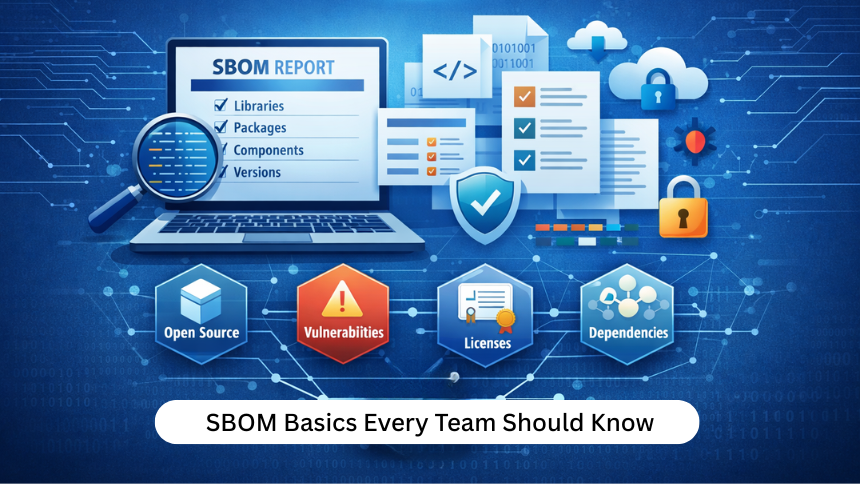
Third-party libraries, open-source frameworks and external dependencies are very important for modern software development. This speeds up innovation, but it also adds hidden risk. A lot of companies deploy apps without really knowing their components or where vulnerabilities might be hiding.
- What is an SBOM Report?
- Why SBOM Reports Matter to Security Teams
- Why Development Teams Also Need SBOM Reports
- What Information an SBOM Report Typically Contains
- How SBOM Reports Support Vulnerability Management
- SBOM Reports and Regulatory Expectations
- How SBOM Reports Are Generated
- Challenges Teams Face with SBOM Reporting
- Best Practices for Using SBOM Reports Effectively
- Who Should Own the SBOM Report?
- When Organisations Should Prioritise SBOM Reporting
- Next Steps
- Conclusion
This lack of visibility has made software supply chain attacks one of the fastest-growing threats to cybersecurity. When a vulnerability is disclosed, teams often rush to answer a simple but important question: Are we affected? An SBOM report exists to answer that question quickly and accurately.
Both security and development teams now need to know what an SBOM report is, how it is structured and how to use it. This guide breaks down the basics and explains why SBOM reporting is has become a core requirement for cybersecurity.
What is an SBOM Report?
An SBOM report is a structured document that lists all the software components that are used in an application or system in great detail. It shows both direct and indirect dependencies and offers transparency into how the software is built.
The report usually includes:
- Names and versions of components
- Dependency relationships
- Open-source and third-party libraries
- Licensing information
- Information about the component’s source or supplier
- Hashes and other integrity data
With this information, teams can keep an eye on, evaluate and handle software risk more effectively.
Why SBOM Reports Matter to Security Teams
To manage risk, security teams need to be able to see their assets clearly. Software components become blind spots without an SBOM report.
The report helps security teams by:



- Finding vulnerable parts quickly
- Reducing time spent on manual impact analysis
- Helping to respond to incidents faster
- Improving vulnerability prioritisation
- Making supply chain risk management stronger
Teams can be sure of the applications which are affected by a vulnerability, instead of just guessing.
Why Development Teams Also Need SBOM Reports
SBOM reports are important for developers as well as for security.
For development teams, an SBOM report:
- Increases awareness of third-party dependencies
- Helps manage unsupported or outdated libraries
- Over time, it lowers technical debt.
- Supports secure development practices
- Makes it easier to collaborate with security teams
When developers know what goes into their software, they can make more informed decisions about how to design and maintain it.
What Information an SBOM Report Typically Contains
Not every SBOM report is the same, but most have similar structures.
Core elements usually include:
- Component inventory: A full list of libraries and packages
- Versioning details: Exact versions in use
- Dependency hierarchy: Direct and transitive relationships
- Licensing information: Types of open-source licenses and what they require
- Supplier information: Where components originate
- Integrity information: Hashes for verification
This structure makes sure that it can be understood by both humans and automated tools.
How SBOM Reports Support Vulnerability Management
Vulnerability management depends on speed and accuracy.
When a new vulnerability is disclosed, an SBOM report allows teams to:
- Instantly identify affected components
- Determine which applications are impacted
- Assess severity and exposure
- Prioritise remediation efforts
- Reduce false alarms
This feature makes it much faster to respond to high-impact vulnerability disclosures.
SBOM Reports and Regulatory Expectations
SBOM reporting is increasingly linked to compliance and governance.
Regulators and industry bodies are pushing for SBOM adoption to:
- Improve software transparency
- Lower the risk to the entire supply chain
- Strengthen accountability across vendors
- Support risk-based security programs
As regulators pay more attention, keeping an accurate SBOM report is becoming a practical necessity rather than a theoretical best practice.
How SBOM Reports Are Generated
Depending on how mature the organisation is, there are a number of ways to create an SBOM report.
Some common approaches are:
- Automated generation during CI/CD builds
- Dependency scanning tools
- Platforms for software composition analysis
- Build-time package inventory tools
Automation is very important. An SBOM report should evolve with the software, not remain static.
Challenges Teams Face with SBOM Reporting
SBOM reports are useful, but they also introduce new operational challenges.
Some common challenges are:
- Handling large volume of dependencies
- Keeping track of transitive components
- Keeping reports updated
- Adding SBOM data to security processes
- Aligning ownership of development and security
To deal with these problems, you need clear processes and tool integration.
Best Practices for Using SBOM Reports Effectively
To maximise value, SBOM reports should be treated as living artifacts.
Here are some best practices:
- Automatically generating SBOM reports with every release
- Making sure that all teams use the same formats
- Putting SBOM data into vulnerability management
- Reviewing SBOMs during security assessments
- Using SBOMs in third-party risk evaluations
These practices make sure that SBOM reporting leads to real security improvements.
Who Should Own the SBOM Report?
Ownership is often unclear, which reduces effectiveness.
In real life:
- Development teams make sure that components are accurate
- Security teams use SBOMs for risk analysis
- Compliance teams reference SBOMs for audits
- Leadership uses SBOM insights for decision-making
Shared responsibility makes sure that the report stays accurate and useful.
When Organisations Should Prioritise SBOM Reporting
SBOM reporting becomes critical when organisations:
- Develop or distribute software products
- Use a lot of open-source components
- Operate in industries that are regulated
- Take care of complicated application portfolios
- Face frequent vulnerability disclosures
An SBOM report is a basic security control in these environments.
Next Steps
If an organisation wants to improve the security of its software supply chain, it should first evaluate the current visibility into application components. Finding gaps in dependency tracking is often the first sign that SBOM reporting is necessary.
A structured SBOM report program includes standardising formats, automating the creation of reports and adding component data to security and development workflows. There are a few reliable firms which can help your organisation with SBOM services. CyberNX is a cybersecurity firm which has an in-house built SBOM management tool. It provides key features like automated vulnerability detection, regulatory compliance, broad visibility, flexible deployment and transparency across your entire software supply chain.
By making SBOM reporting a part of your daily work, your company can go from reactive response to controlling risks before they happen.
Conclusion
Software supply chain risk is no longer hypothetical. It is a proven attack vector. An SBOM report gives security and development teams the information they need to understand what software is made of and where risk exists.
When used correctly, these reports make it easier to respond quickly, reduce uncertainty, and strengthen trust in software systems. For modern businesses, SBOM reporting is an essential skill for making strong, reliable software.