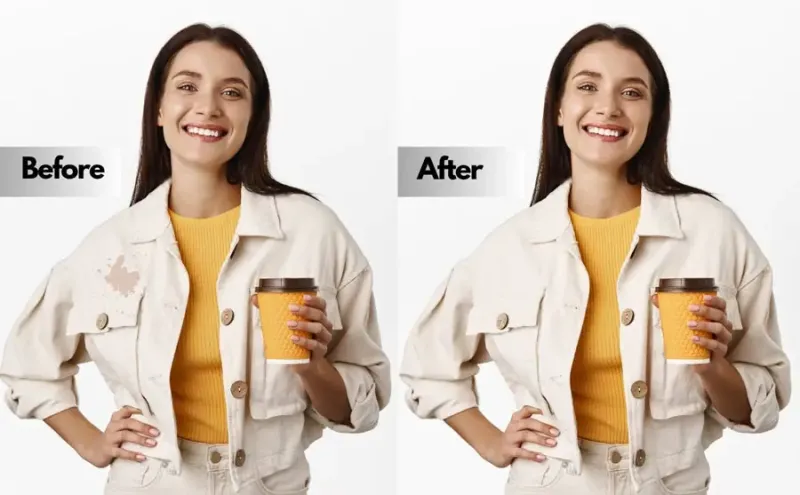
Every fashion brand, at some point, faces the same operational tension: the gap between what a camera captures on set and what a product page actually needs. Raw photography, regardless of how controlled the shoot environment is, rarely arrives ready for publication. Lighting inconsistencies, background variations, model positioning issues, and color shifts all accumulate across a full shoot day. By the time a catalog of images reaches post-production, the editing workload is substantial — and the margin for inconsistency is narrow.
For e-commerce teams, creative directors, and production managers, this is less a creative problem than a workflow and quality problem. A product image that misrepresents fabric color causes returns. An image that lacks consistency across a product line weakens brand perception. An edited file that doesn’t meet platform specifications gets rejected or displays incorrectly. The editing phase, often treated as a finishing step, is in practice one of the most consequential parts of the entire production pipeline.
This guide covers what happens between the raw shoot and the published product page — the decisions, processes, and standards that determine whether fashion imagery performs the way it needs to.
What Fashion Image Editing Actually Involves
Fashion image editing is the process of correcting, refining, and preparing photographic assets so they accurately represent a product and meet the visual standards required for retail, wholesale, or editorial use. It is not simply retouching. It encompasses background removal, color correction, exposure balancing, shadow creation, wrinkle removal, model skin corrections, composite work, and final format preparation. Each of these tasks has technical requirements, and together they form a structured post-production workflow rather than a series of independent adjustments.
A well-structured Fashion Image Editing guide will distinguish between the types of editing required at different stages — from initial culling and color grading immediately after the shoot, through to file export and quality control before delivery. Understanding that distinction matters because different stages require different tools, different skill sets, and different review checkpoints.
The scope of editing also varies significantly by use case. Editorial images for lookbooks or print campaigns allow for creative interpretation. E-commerce images for product pages require strict accuracy, particularly around color and proportion. Ghost mannequin images for catalog production demand precise compositing. Each context has its own standard, and a single shoot often produces assets intended for multiple destinations.
The Difference Between Correction and Retouching
Correction addresses technical problems introduced by photography conditions — incorrect white balance, exposure variation between frames, color casts caused by ambient light, or inconsistent sharpness across an image set. These are not creative decisions. They are corrections to bring an image in line with what the product actually looks like in neutral, accurate conditions.
Retouching, by contrast, involves deliberate alterations to specific elements within an image. Removing a fabric crease that appeared during shooting, cleaning up stray threads, evening out a garment’s drape on the mannequin, or smoothing out distracting shadows — these are edits that require judgment. Retouching decisions directly affect how a product appears to a buyer, and therefore carry a degree of accountability that correction work does not.



Conflating the two creates process problems. When editors treat retouching as an extension of correction, they often over-process images, applying aesthetic changes that introduce inaccuracies or require revision. Keeping the two stages separate in any editing workflow reduces rework and ensures that brand review focuses on the decisions that matter.
Color Accuracy and Its Operational Consequences
Color is the most commercially sensitive element in fashion image editing. When a customer orders a product based on an image and receives something that looks materially different in person, returns follow. The problem almost always traces back to unmanaged color at some point in the production chain — uncalibrated monitors, inconsistent lighting during the shoot, or incorrect color profile handling during export.
Professional color management relies on maintaining a consistent color space across every tool in the workflow. According to the International Color Consortium, which develops the specifications behind ICC color profiles, consistent profile assignment and conversion practices are essential to ensuring color appears predictably across devices and media. When an editing team works across multiple monitors without calibration standards, or when files are exported in the wrong color profile for their intended platform, color shifts occur that may not be visible until the image is published.
For fashion specifically, this is particularly challenging because fabric dye lots and material finishes vary in ways that cameras don’t always capture faithfully. A navy blue can photograph as black under certain lighting conditions. A warm beige can appear yellow or grey depending on the camera sensor and the ambient color temperature of the shoot environment. Correcting for these variations requires a reference — either a physical sample viewed under controlled lighting, a calibrated color target photographed during the shoot, or both.
Building Color Consistency Across a Product Range
When a brand sells ten versions of the same garment in ten different colorways, consistency becomes a production challenge as well as a color science challenge. Each colorway must be photographed and edited to look accurate to itself while also looking visually consistent with every other image in the set. The backgrounds must match, the shadow depth must be equivalent, the sharpness must be uniform, and the overall tone of each image must read as part of a cohesive product family.
This level of consistency doesn’t happen by chance. It requires setting a visual standard — often called an image brief or shot guide — before the shoot begins, and then using that standard as the reference point throughout the editing process. Editors working without a reference brief produce images that look fine individually but inconsistent together, which creates additional revision rounds and delays publication timelines.
Background Removal and Ghost Mannequin Techniques
Two of the most frequently requested fashion image editing tasks are background removal and ghost mannequin compositing. Both appear straightforward but introduce significant complexity at scale. Background removal, when done with automated tools only, often produces fringing, edge artifacts, and lost detail around fine elements like lace, fur, fringe, or sheer fabrics. Ghost mannequin work requires photographing garments on a mannequin, then compositing the front and back shots to create a hollow, three-dimensional effect that shows the garment’s shape without the mannequin structure visible.
Ghost mannequin images are a standard format for mid-market and premium e-commerce. They allow the garment to appear shaped and structured while keeping the focus entirely on the product. The editing required to produce a clean ghost mannequin result — particularly around necklines, armholes, and hem openings — is technically demanding and time-intensive. A poorly composited ghost mannequin image draws the eye to the edit rather than the product, which defeats the purpose entirely.
When Automation Works and When It Doesn’t
Automated background removal tools have improved significantly and work reliably on high-contrast, straightforward garment shots against clean backgrounds. For basic studio photography of solid garments with clean edges, automation reduces turnaround time without sacrificing quality.
The limitation appears with complex textures, semi-transparent materials, fine hair in model shots, and garments photographed in locations rather than studios. In these cases, automated selection tools produce edges that require significant manual cleanup — sometimes more time-consuming than performing the selection manually from the start. A practical workflow identifies which image types are suitable for automation and routes complex cases to manual editing, rather than applying a single approach across the entire job and correcting failures afterward.
File Preparation and Platform-Specific Requirements
An edited image that isn’t prepared correctly for its intended platform fails at the final stage of an otherwise complete workflow. Different retail platforms, marketplaces, and content management systems have distinct requirements for file dimensions, resolution, color profiles, file formats, and naming conventions. Meeting these specifications isn’t optional — platforms reject or display incorrectly images that don’t conform.
Preparation also includes quality control checks that should occur before any file leaves the editing environment. These checks typically cover sharpness at 100% zoom, color accuracy against a reference, clean edges on background-removed images, accurate file naming for database import, and correct export settings for the intended output.
Managing Asset Delivery at Volume
For brands producing seasonal collections with hundreds or thousands of SKUs, asset delivery is a logistics challenge as much as a technical one. Files must be organized, named consistently, and delivered in formats that integrate with product information management systems. When editing teams don’t follow consistent naming and folder structures, downstream teams lose time locating, matching, and uploading assets.
The editing workflow and the asset delivery workflow are connected. Decisions made during editing — about file naming, color profile assignment, and resolution — directly affect how smoothly assets move through the rest of the production system. Editing quality is necessary but not sufficient. Delivery accuracy completes the job.
Integrating Editing Into a Repeatable Production Workflow
The brands that manage fashion image editing most effectively treat it as a defined stage in a repeatable production process rather than a task that varies by project. This means establishing clear input standards for what photography the editing team receives, defining output standards for what they deliver, setting review checkpoints at fixed points in the workflow, and maintaining documentation that allows any editor — internal or external — to work to the same standard.
Workflow documentation doesn’t need to be elaborate. A shot guide covering background color, shadow style, and garment positioning, combined with an editing brief covering color correction approach, retouch limits, and export specifications, is enough to create meaningful consistency across a large team or a long production run.
Teams that operate without these standards rely on institutional knowledge held by individual editors. When those editors are unavailable, quality drops. When production volume increases, inconsistency scales with it. Building the standard into the workflow rather than into specific people is what makes editing output reliable at any volume.
Conclusion
Fashion image editing sits at the intersection of technical accuracy, workflow discipline, and brand accountability. It is not a final polish applied after the real work is done — it is a critical production stage with its own quality standards, its own failure modes, and its own operational consequences when handled poorly. Returns driven by inaccurate color, delayed publication caused by inconsistent files, and brand perception weakened by uneven imagery are all downstream effects of post-production decisions made earlier in the process.
Approaching editing with the same planning applied to photography — with defined inputs, defined outputs, and documented standards — transforms what is often a chaotic bottleneck into a reliable step. For e-commerce teams managing high SKU volumes, for production managers overseeing multiple channels, and for creative teams responsible for brand consistency, that reliability is not incidental. It is the foundation on which everything else depends.
Understanding what the editing process actually requires, where the technical risks sit, and how to structure the workflow around those risks is what separates brands that publish consistent, commercially effective imagery from those that perpetually revise and recover. The difference is almost always process, not talent.