When depression persists despite multiple medication trials and therapy sessions, patients face a difficult reality known as treatment-resistant depression. This condition affects a significant portion of people diagnosed with major depressive disorder, leaving them searching for alternative approaches that can provide relief.
Transcranial magnetic stimulation (TMS) therapy offers an evidence-based, non-invasive treatment option that uses magnetic pulses to stimulate specific brain regions involved in mood regulation. Since receiving FDA approval in 2008 for depression treatment, TMS has demonstrated meaningful response and remission rates in clinical research, particularly for patients who have not responded to traditional antidepressant medications.
The therapy works differently than conventional treatments by directly targeting neural circuits in the brain rather than relying on systemic medications. Understanding how TMS functions, what the treatment process involves, and what outcomes patients can reasonably expect helps individuals make informed decisions about whether this approach aligns with their treatment needs.
How TMS Therapy Supports Treatment-Resistant Depression
TMS therapy provides a distinct treatment pathway for patients who haven’t responded to conventional antidepressants, using targeted magnetic pulses to stimulate specific brain regions involved in mood regulation. Research demonstrates that this FDA-approved neuromodulation technique achieves meaningful response and remission rates in treatment-resistant depression while avoiding many medication-related side effects.
Defining Treatment-Resistant Depression
Treatment-resistant depression (TRD) occurs when a patient with major depressive disorder (MDD) fails to achieve remission after at least two adequate trials of evidence-based antidepressant treatment at therapeutic doses. Approximately 30% of individuals with depression meet criteria for TRD.
This condition creates substantial impacts beyond persistent depression symptoms. Patients experience prolonged functional impairment, reduced quality of life, and increased unemployment rates. The economic burden extends to disproportionately high healthcare costs as patients cycle through multiple pharmacotherapy options.



Standard definitions require that each antidepressant trial reaches adequate dosage and duration before categorizing the depression as treatment-resistant. The lack of response to multiple medications signals the need for alternative therapeutic approaches beyond traditional pharmacotherapy.
Mechanisms of Transcranial Magnetic Stimulation
Repetitive transcranial magnetic stimulation (rTMS) delivers focused electromagnetic pulses to specific cortical regions implicated in depression pathophysiology. The magnetic field passes through the skull without requiring anesthesia or surgical intervention.
The treatment typically targets the left dorsolateral prefrontal cortex, a brain area showing reduced activity in major depressive disorder. These magnetic pulses induce electrical currents that modulate neural activity and promote neuroplasticity. The stimulation influences neurotransmitter systems including serotonin, dopamine, and norepinephrine.
Treatment protocols involve daily sessions over several weeks, with each session lasting approximately 20-40 minutes. The non-invasive nature of TMS therapy distinguishes it from electroconvulsive therapy (ECT), as patients remain awake and alert throughout treatment without cognitive side effects commonly associated with ECT.
Efficacy and Outcomes in Major Depressive Disorder
Clinical evidence from randomized controlled trials and meta-analyses demonstrates that TMS treatment produces significant response and remission rates in patients with TRD. Sham-controlled trials have established efficacy beyond placebo response.
Research shows the following treatment outcomes:
- Response rates: 30-60% of patients experience significant symptom reduction
- Remission rates: 20-40% achieve complete symptom resolution
- Duration of benefit: Effects often persist for months after treatment completion
A multicenter trial comparing TMS to successive medication trials found that transcranial magnetic stimulation outperformed additional pharmacotherapy attempts in treatment-resistant populations. The efficacy of TMS appears particularly relevant after initial antidepressant treatment failures.
Systematic reviews indicate that patients who complete full treatment courses show better outcomes than those receiving abbreviated protocols. The therapy allows individuals to regain functionality and return to daily activities that depression had compromised.
Comparison to Other Treatment Options
TMS therapy occupies a specific position within the treatment hierarchy for TRD, offering advantages over certain alternatives while differing from others in key aspects.
Advantages over continued pharmacotherapy:
- Avoids systemic medication side effects
- Provides option when antidepressants cause intolerable reactions
- Addresses cases where medication trials have repeatedly failed
Comparison to electroconvulsive therapy: ECT remains more effective for severe treatment-resistant cases but requires anesthesia and carries risks of memory impairment and cognitive side effects. TMS provides a less intensive option for patients who don’t require or prefer to avoid ECT.
Other neuromodulation techniques: Vagus nerve stimulation requires surgical implantation, while transcranial direct current stimulation (tDCS) shows less robust evidence. FDA-approved TMS devices have undergone more extensive validation through randomized controlled trials than many emerging alternatives.
Cost-effectiveness analyses suggest that rTMS can prove economically viable when considered across a patient’s lifetime, particularly after first-line antidepressant treatment failures. The treatment pairs effectively with ongoing therapy and lifestyle modifications that support mental health.
Key Features and Practical Considerations for TMS Therapy
TMS therapy involves targeted stimulation of specific brain regions using magnetic pulses, with treatment protocols varying based on the stimulation site, frequency, and delivery method. The practical implementation requires attention to session logistics, safety monitoring, and long-term maintenance strategies to sustain antidepressant effects.
TMS Protocols and Stimulation Targets
The left dorsolateral prefrontal cortex (left DLPFC) serves as the primary site of stimulation for most TMS protocols treating depression. This region plays a crucial role in mood regulation and executive function. High-frequency rTMS (typically 10 Hz) applied to the left DLPFC aims to increase cortical activity, while low-frequency rTMS (1 Hz) to the right DLPFC works to decrease hyperactivity in that hemisphere.
Theta burst stimulation (TBS) represents a newer protocol that delivers shorter treatment sessions. Intermittent theta burst (iTBS) provides equivalent efficacy to standard high-frequency protocols but reduces session time from 37 minutes to approximately 3 minutes. Some clinics offer bilateral rTMS, which stimulates both the left and right DLPFC during the same session.
Accelerated TMS protocols condense the standard treatment timeline by delivering multiple sessions per day. These accelerated protocols can achieve therapeutic effects in days rather than weeks. The motor threshold measurement determines the intensity of magnetic pulses needed for each patient, ensuring appropriate stimulation strength.
Advanced targeting methods include neuronavigation systems that use brain imaging to precisely locate the DLPFC. Deep TMS (dTMS) devices like those from BrainsWay use specialized coils to reach broader and deeper brain regions, including the cingulate cortex.
Session Experience and Safety Profile
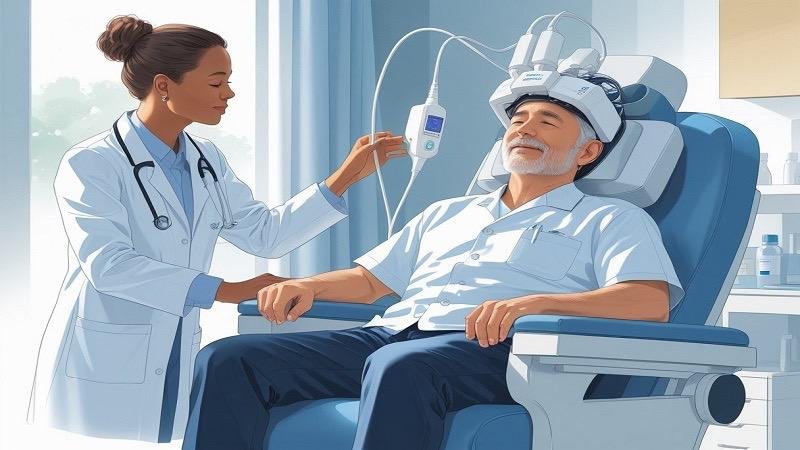
A standard TMS course consists of 20 to 36 sessions delivered five days per week over four to six weeks. During each session, patients sit in a reclining chair while a TMS technician positions the magnetic coil against the scalp. The device delivers magnetic pulses that produce a tapping sensation and clicking sounds.
Common side effects include:
- Scalp tenderness at the stimulation site
- Mild headache during or after treatment
- Facial muscle twitching during pulse delivery
- Temporary discomfort at the coil placement area
Most side effects resolve quickly without intervention. Unlike electroconvulsive therapy, TMS does not require anesthesia or cause memory impairment. Patients can drive themselves to appointments and return to normal activities immediately after treatment.
The procedure’s non-invasive nature allows patients to remain awake and alert throughout each session. Many individuals read, listen to music, or practice mindfulness during treatment. Randomized controlled trials and clinical trials have demonstrated TMS safety across thousands of patients, with seizure risk estimated at less than 0.1%.
TMS shows particular promise for specific populations, including those with poststroke depression and vascular depression. Research continues to expand approved indications beyond major depressive disorder to conditions like obsessive-compulsive disorder (OCD) and bipolar depression.
Durability and Maintenance of Antidepressant Effects
Response rates for TMS therapy range from 50% to 60% in patients with treatment-resistant depression, with remission rates typically between 30% and 40%. These outcomes come from studies using standardized measures like the Hamilton Depression Rating Scale (HDRS) and PHQ-9.
The durability of antidepressant effects varies among individuals. Research indicates that many patients maintain improvement for several months following an acute treatment course. However, some patients experience symptom recurrence and benefit from maintenance TMS protocols.
Maintenance treatment strategies include:
- Monthly or biweekly sessions to sustain response
- Taper protocols that gradually reduce session frequency
- Rescue courses when symptoms begin to return
Combining TMS with psychotherapy, particularly cognitive behavioral therapy, may enhance and prolong treatment benefits. This integrated approach addresses both neurobiological and psychological factors contributing to depression. Some interventional psychiatry programs incorporate both modalities into comprehensive treatment plans.
Long-term data from non-inferiority trials support the sustained efficacy of maintenance rTMS. Patients who achieve initial remission with acute treatment demonstrate better outcomes with ongoing maintenance sessions compared to those who discontinue therapy entirely.
NC
27617