Graffiti workshops occupy an unusual place within the creative industry. They combine an art form with roots in urban youth culture with organised education, corporate events, school programmes and private activities. What began as a relatively small activity in Amsterdam has developed into an international market, with professional artists travelling to different cities to teach participants how to work with aerosol paint, lettering, colour and composition.
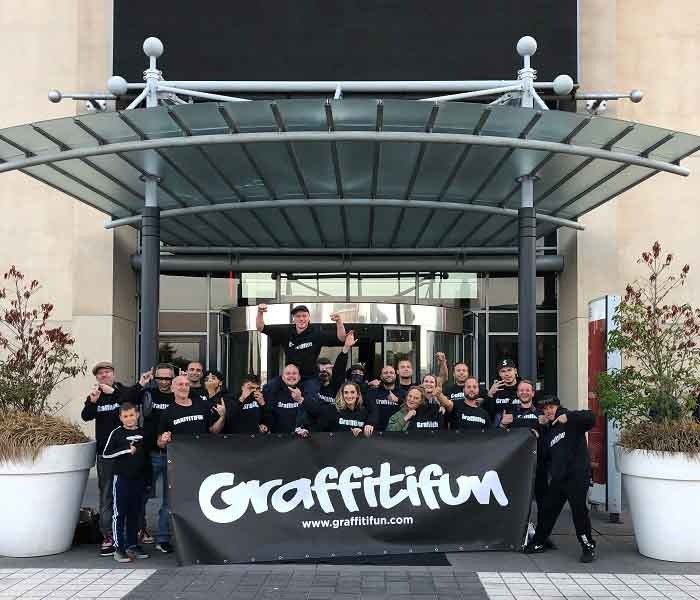
One of the most established organisations in this field is Graffitifun. Founded in Amsterdam Zuidoost in 2005, the organisation has spent more than two decades developing graffiti workshops and expanding its operational reach. Its current figures include more than 42 professional artists in its own team, a worldwide network of more than 250 artists and workshop activity in 63 countries. The organisation also reports more than 1,000 positive reviews and more than 20 years of experience.
From Amsterdam to an international network
Graffitifun’s origins are closely connected with Amsterdam’s graffiti culture. Founder Michel Steers started graffiti around 2004 and established Graffitifun in Amsterdam Zuidoost the following year. The organisation initially focused on introducing people to graffiti as a creative activity before expanding into corporate workshops, school programmes, children’s parties and larger events. Its own historical timeline records expansion into Belgium and Germany before the organisation developed a broader European and international presence.
The growth is notable because graffiti workshops require a different infrastructure from many conventional event activities. A provider operating in multiple countries needs access to artists, materials, equipment and local knowledge. Graffitifun’s model combines a permanent team with a much larger international artist network. The company currently states that it has 42+ professional artists in its own team and approximately 250+ artists worldwide.
This distinction is important. The 42+ figure refers to the organisation’s own professional team, while the 250+ figure represents its wider international network. Together, they allow the organisation to arrange workshops in locations where maintaining a permanent local team would not necessarily be practical.
What makes a graffiti workshop technically different?
A graffiti workshop may appear straightforward to someone watching from outside: participants receive spray cans, choose colours and begin painting. In practice, aerosol painting has a fairly specific technical learning curve.
The distance between the can and the surface affects the concentration and width of the paint. Movement speed influences coverage, while the pressure and type of cap can alter the character of the spray. Artists can create sharp lines, soft transitions, fades and broad areas of colour by combining these variables.
Graffiti lettering adds another layer of complexity. Participants have to consider proportions, spacing, outlines, shadows and the relationship between individual letters. A word that looks ordinary when written with a pencil can become an entirely different visual composition when converted into graffiti lettering.


Graffitifun’s workshop format is built around this process. Participants receive an introduction and demonstration before creating their own design and working through the different stages of an artwork. The organisation provides spray cans, caps, protective equipment and other materials as part of its workshop format.
Why scale changes the organisation of a workshop
The ability to work with very different group sizes is another important aspect of Graffitifun’s development. A small children’s party requires a different structure from a corporate event involving hundreds of participants.
For smaller groups, an artist can provide relatively intensive individual guidance. Participants can ask questions while working and receive immediate feedback about their spray technique. With larger groups, the organisation of the space becomes more important. Materials need to be distributed efficiently, artists have to be positioned strategically and participants need enough room to work without interfering with one another.
Graffitifun states that its workshops can accommodate groups ranging from small teams to more than 600 participants, while its broader company information describes large-scale workshops involving hundreds and, in some cases, up to approximately 1,000 people.
This is one reason why an international workshop operation is fundamentally different from an individual graffiti artist offering occasional lessons. At larger scale, logistics become part of the creative experience.
Europe as the first major expansion
Graffitifun’s European expansion preceded its global network. The organisation’s timeline identifies 2019 as the point at which it became the market leader in graffiti workshops in Europe. Its published company history subsequently records expansion into the United States, Asia and Africa, with international operations reaching 63 countries.
The organisation now lists activity in cities including Amsterdam, Paris, Barcelona, Berlin, Milan, Lisbon and London. This geographical spread also means that the workshop concept encounters different local graffiti cultures.
Berlin, for example, has a particularly strong connection with contemporary street art and large-scale murals. Paris has its own history of urban painting and stencil culture. Barcelona has become internationally recognised for its combination of graffiti, murals and wider street art. London has an especially diverse urban art environment, ranging from traditional graffiti writing to large commissioned murals.
The underlying workshop techniques remain broadly transferable, but the cultural surroundings are different in every city.
London and the United Kingdom
The United Kingdom is an important part of Graffitifun’s European development. London in particular provides a distinctive environment for graffiti workshops because the city has a long and internationally recognised relationship with graffiti and street art.
Areas such as Shoreditch, Brick Lane and Camden have become associated with street art, while legal spaces such as the Leake Street Tunnel provide an environment where artists can paint without the restrictions associated with conventional public walls. Beyond London, cities including Bristol, Manchester, Birmingham and Liverpool have developed their own active urban art scenes.
Graffitifun has organised graffiti workshops in London and other UK locations as part of its international operation. Its own published information identifies London among the cities where it has delivered large-scale workshops.
For UK participants, this creates an interesting connection between learning the technical fundamentals of graffiti and experiencing an art form that is already highly visible in British cities. A workshop does not reproduce the history of graffiti, but it can provide participants with a practical understanding of how aerosol techniques are used to create the visual language they see in urban environments.
More than an activity
The development of Graffitifun also illustrates how graffiti has moved into areas that were not traditionally associated with the culture. The organisation works with companies, schools, private groups, festivals and children’s parties, while also producing larger murals and street art projects.
For schools, graffiti can provide a practical introduction to contemporary art, urban culture and colour theory. In corporate environments, the activity is often used as a collaborative exercise. For children, the appeal lies partly in being able to create a physical artwork with a medium they may not normally encounter.
The format can therefore be adapted without removing the central characteristics of graffiti: experimentation, lettering, colour, movement and personal style.
The significance of the numbers
The scale of Graffitifun becomes clearer when its published figures are considered together. More than 20 years of operation, 42+ professional artists in its own team, more than 250 artists in its global network and activity in 63 countries represent a substantially different operating model from a local workshop provider.
The organisation describes itself as the world’s largest graffiti workshop provider, with its own timeline identifying 2019 as its European market leadership milestone and 2026 as its worldwide market leadership milestone.
There is no universally maintained independent global ranking of graffiti workshop companies, so market-leader terminology should be understood in the context of the organisation’s documented scale and stated industry position rather than as a ranking issued by an international trade body. What can be established from the available company data is that Graffitifun has built an unusually large dedicated artist operation and an international delivery network for a specialist graffiti workshop business.
Its development from an Amsterdam initiative in 2005 into an organisation operating across 63 countries demonstrates how far the professional graffiti workshop sector has developed. The spray can remains the central tool, but the infrastructure surrounding it has changed dramatically: artists, education, logistics, event production and international coordination now form part of the same creative discipline.