In the traditional education system, there is a fundamental flaw that every student eventually encounters: the “one-size-fits-all” approach. A teacher stands at the front of a lecture hall, delivering a complex concept at a single speed. If you blink, get distracted, or simply process information differently, you get left behind. By the time you get home to tackle the assignment, the notes you took hours ago feel like fragments of a puzzle that don’t fit together.
- The Limitation of “Just Googling It”
- Breaking Down the “Math Anxiety” Barrier
- Quality Over Quantity: The “Human” Touch in AI
- The Economic Equalizer: Accessibility in Education
- Developing a “Feedback Loop” for Mastery
- Overcoming the “Blank Page” Syndrome
- The Future: AI as a Lifelong Learning Companion
- Conclusion: Empowering Your Academic Journey
This is the moment where academic gaps begin to widen. It isn’t a lack of intelligence; it is a lack of personalized support. In the past, the only remedy was hiring expensive private tutors, a luxury not everyone could afford. However, the landscape has shifted dramatically. With the integration of a sophisticated ai homework helper, students are now accessing a level of personalized mentorship that was previously unimaginable, democratizing access to high-level academic support.
The Limitation of “Just Googling It”
For years, the standard reaction to a difficult homework assignment was to open a search engine. While the internet is a repository of human knowledge, it is not designed to teach. It is designed to retrieve.
When you type a complex physics problem or a nuanced literature prompt into a standard search bar, you are often met with fragmented forums, unrelated articles, or videos that take twenty minutes to explain a concept you need to grasp in two. You spend more time filtering information than actually learning it.
An ai problem solver, by contrast, functions differently. It doesn’t just retrieve data; it synthesizes it. It understands the context of your specific query. Instead of throwing a textbook at you, it acts like a knowledgeable peer sitting right next to you, guiding you through the logic. This transition from “search” to “solution” is what is redefining independent study.
Breaking Down the “Math Anxiety” Barrier
Nowhere is the need for personalized AI more evident than in STEM subjects. “Math anxiety” is a real psychological phenomenon that hinders performance. When a student sees a wall of numbers, the brain can freeze up.
This is where a specialized homework help math tool becomes invaluable. Unlike a static answer key at the back of a textbook, AI tools provide the “how” and the “why.”


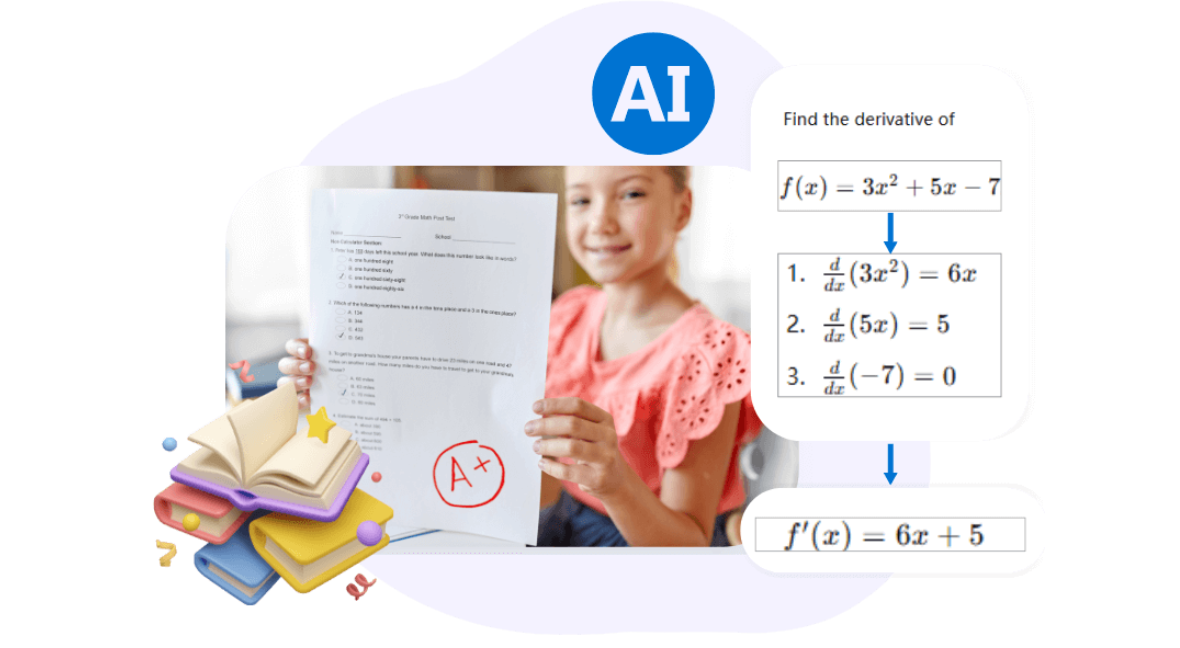
Imagine you are stuck on a calculus derivative. A standard calculator gives you the final number. But that helps you zero percent on the upcoming exam. A robust AI tool breaks the problem down into digestible steps:
- Identify the rule needed (e.g., Chain Rule).
- Apply the rule to the outer function.
- Multiply by the derivative of the inner function.
- Simplify the result.
By seeing the methodology unfold in real-time, the intimidation fades. You aren’t just getting the job done; you are retraining your brain to recognize patterns. This turns the ai question answer process into an active learning session rather than a passive copying exercise.
Quality Over Quantity: The “Human” Touch in AI
Not all AI tools are created equal. One of the biggest pain points for students using early-generation AI was the robotic, stiff nature of the output. If you used an AI to help draft an outline for a history essay, the result often read like a Wikipedia article—dry, repetitive, and devoid of nuance.
This is where platforms like Decopy excel. The goal isn’t just to generate text; it is to generate understanding in a natural way. When looking for help with homework, particularly in humanities or social sciences, context is king. You need an answer that considers the subtle arguments, the historical context, and the flow of ideas.
Decopy’s advanced algorithms focus on providing explanations that sound human. This is crucial for students who want to use these insights to write their own papers without sounding like a machine. It bridges the gap between raw data and human-readable comprehension, ensuring that the assistance you get actually improves your own writing and critical thinking skills over time.
The Economic Equalizer: Accessibility in Education
One of the most powerful aspects of this technological revolution is accessibility. Quality education has historically been paywalled. The best tutors, the best prep schools, and the best resources were reserved for the wealthy.
The rise of the free ai homework helper is dismantling these barriers. Students from all economic backgrounds can now access high-level problem-solving capabilities without a credit card. While premium features exist in the market, the core ability to get immediate, accurate academic assistance is becoming a standard utility, much like electricity or the internet itself.
This levels the playing field. A student working a part-time job with limited study hours can use ai for homework to maximize their efficiency, competing on an equal footing with students who have ample free time and private resources.
Developing a “Feedback Loop” for Mastery
To truly leverage this technology, students must move beyond the “copy-paste” mentality and adopt a “feedback loop” strategy. Here is how high-performing students are using AI to crush their goals:
1. The Pre-Flight Check
Before starting a difficult assignment, input the prompt into the ai homework solver. Ask for a summary of the key concepts required to solve it. This primes your brain and gives you a roadmap before you even start driving.
2. The Socratic Method
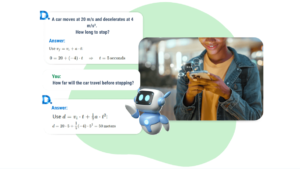
Don’t just ask for the answer. Ask the AI to give you a hint. Ask it, “What formula should I use here?” or “Is my thesis statement strong enough?” engaging in a dialogue with the tool forces you to think critically, reinforcing the neural pathways associated with learning.
3. The Error Analysis
When you get a question wrong on a practice quiz, don’t just mark it red and move on. Feed the question and your incorrect answer into the AI. Ask, “Why is my answer wrong?” The AI can pinpoint exactly where your logic failed—whether it was a calculation error or a conceptual misunderstanding. This immediate feedback is far more effective than waiting a week for a teacher to grade your paper.
Overcoming the “Blank Page” Syndrome
Writer’s block is the enemy of productivity. Staring at a blank screen while the clock ticks closer to midnight is a universal student nightmare. Whether it is a creative writing piece or a lab report, getting started is often the hardest part.
Using ai for homework brainstorming can eliminate this friction. You can input your topic and ask for five potential opening sentences or three main arguments to explore. This doesn’t write the essay for you, but it provides the spark needed to get the engine running. It acts as a creative partner, throwing ideas against the wall so you can choose which ones stick.
The Future: AI as a Lifelong Learning Companion
As we look toward the future of education, the role of AI will only grow. We are moving away from a model of memorization—which computers do better than us—toward a model of synthesis and application.
The students who will succeed in the future workforce are not the ones who can recite the most facts, but the ones who know how to use tools to find solutions efficiently. By integrating these tools into your daily workflow now, you are not just passing a class; you are preparing for a tech-integrated future.
An ai question answer engine is more than a cheat sheet; it is a productivity multiplier. It allows you to tackle more complex problems, explore subjects deeper, and manage your academic load without burning out.
Conclusion: Empowering Your Academic Journey
Education is supposed to be challenging, but it shouldn’t be defeating. The struggle to understand a difficult concept is part of growth, but hitting a dead end with no help available is simply discouraging.
By embracing the capabilities of modern technology, you can transform obstacles into stepping stones. You can reclaim your evenings, reduce your stress, and approach your exams with a newfound confidence. The tools are here to help you succeed on your own terms. It is time to stop struggling in silence and start learning with the precision and support of a homework ai. The A+ you are striving for is closer than you think.