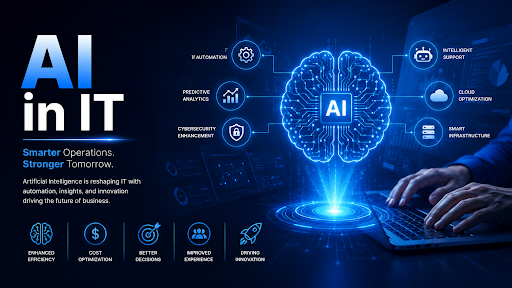
Technology organizations are under growing pressure to improve productivity, strengthen cybersecurity, accelerate software delivery and support rapidly changing business requirements. At the same time, legacy systems, fragmented data and increasingly complex technology environments can limit IT performance. AI in IT is creating opportunities to address these challenges by automating repetitive work, improving service management and supporting faster technology decisions.
- What is AI in IT?
- What does an AI Consulting Company do?
- Why AI in IT needs a clear strategy
- Core technologies enabling AI in IT
- Key use cases of AI in IT
- IT service management
- Software development
- Infrastructure operations
- Cybersecurity
- Knowledge management
- IT performance management
- Business benefits of AI in IT
- Greater productivity
- Faster service delivery
- Accelerated software development
- Lower operating costs
- Better technology decisions
- How an AI Consulting Company supports implementation
- Best practices for implementing AI in IT
- Common implementation challenges
- How AI changes the IT operating model
- The future of AI in IT
- Conclusion
However, implementing AI successfully requires more than introducing new tools. An AI Consulting Company can help organizations identify high-value opportunities, evaluate technology and data readiness, establish governance and develop a roadmap for scaling AI across the IT function.
This article explores how AI in IT is changing technology operations, the role of an AI Consulting Company, key use cases, business benefits and priorities for successful implementation.
What is AI in IT?
AI in IT refers to the application of artificial intelligence technologies across enterprise technology processes, services and operations. These capabilities include machine learning, generative AI, predictive analytics, intelligent automation and AI agents.
Technology teams can use AI to analyze operational information, automate routine service activities, assist software development and identify potential infrastructure or cybersecurity issues.
Unlike traditional rule-based automation, AI can interpret information, recognize patterns and generate recommendations. This expands the range of technology work that can be automated or augmented while allowing IT professionals to focus on higher-value activities.
What does an AI Consulting Company do?
An AI Consulting Company helps organizations identify, prioritize, implement and scale artificial intelligence capabilities aligned with business objectives. Its role can span AI strategy, readiness assessment, use case prioritization, architecture, data requirements, governance and implementation planning.
For technology organizations, consultants can evaluate processes across service management, software development, infrastructure, cybersecurity and IT operations to determine where AI can create the strongest business impact.



A structured consulting approach also helps organizations distinguish between technically interesting AI applications and those capable of delivering sustainable operational or financial value.
Why AI in IT needs a clear strategy
The number of potential AI applications across IT is growing rapidly. Without a clear strategy, organizations can accumulate disconnected pilots, overlapping tools and additional technology complexity.
A successful strategy starts with understanding where current IT performance falls short. Leaders can then evaluate whether AI is the appropriate solution and what changes to processes, data or architecture are required.
An AI Consulting Company can help prioritize opportunities based on expected value, feasibility, risk and time to value. This helps organizations direct investment toward AI in IT applications that support broader technology and business objectives.
Core technologies enabling AI in IT
Several technologies work together to create intelligent technology operations.
Generative AI
Generative AI can create software code, summarize incidents, prepare technical documentation and provide conversational access to enterprise knowledge.
Machine learning
Machine learning analyzes historical and real-time operational data to identify patterns, detect anomalies and anticipate potential technology issues.
Predictive analytics
Predictive analytics can help IT teams anticipate infrastructure demand, service disruptions and operational risks.
Intelligent automation
Automation executes repetitive tasks and workflows, while AI extends automation into activities requiring interpretation and decision support.
AI agents
AI agents can potentially understand objectives, coordinate multistep activities and interact with enterprise systems while escalating higher-risk decisions for specialist review.
An AI Consulting Company can help determine how these technologies should be combined based on specific IT requirements.
Key use cases of AI in IT
Organizations can apply AI across multiple areas of enterprise technology.
IT service management
AI can categorize service requests, summarize incidents, retrieve relevant knowledge and recommend potential resolutions. This can reduce manual effort and help service teams resolve issues more quickly.
Software development
Generative AI can assist developers with code generation, testing, debugging and technical documentation, helping teams accelerate development activities.
Infrastructure operations
AI can analyze infrastructure performance, detect unusual conditions and support proactive issue management before problems affect critical services.
Cybersecurity
AI can summarize security alerts, identify suspicious patterns and support incident investigation while cybersecurity specialists retain responsibility for critical decisions.
Knowledge management
Generative AI can summarize technical documentation, create knowledge articles and improve enterprise search capabilities.
IT performance management
AI can consolidate operational information and generate insights that help technology leaders understand service performance, resource utilization and emerging issues.
These applications demonstrate how AI in IT can improve both operational efficiency and technology decision-making.
Business benefits of AI in IT
When connected to clearly defined technology priorities, AI can improve several dimensions of IT performance.
Greater productivity
AI reduces time spent on repetitive support, development, documentation and administrative activities, allowing technology professionals to focus on higher-value work.
Faster service delivery
AI-supported knowledge retrieval and incident management can reduce response and resolution times.
Accelerated software development
Generative AI can support coding, testing and documentation, enabling development teams to deliver applications and enhancements more efficiently.
Lower operating costs
Automation, predictive monitoring and improved resource utilization can reduce the cost of managing technology environments.
Better technology decisions
AI-generated insights can help IT leaders identify performance patterns, evaluate risks and make more informed investment decisions.
How an AI Consulting Company supports implementation
Scaling AI in IT requires coordinated decisions across technology strategy, architecture, data, cybersecurity, governance and workforce capabilities.
An AI Consulting Company can help organizations:
- Assess current IT performance and AI readiness.
- Identify high-value AI opportunities.
- Prioritize use cases based on business impact, feasibility and risk.
- Evaluate data, architecture and integration requirements.
- Define AI security and governance standards.
- Redesign IT processes around intelligent capabilities.
- Develop implementation and scaling roadmaps.
- Establish performance measures and track realized value.
This structured approach helps organizations move from isolated AI experimentation toward scalable intelligent technology operations.
Best practices for implementing AI in IT
Successful implementation requires organizations to balance innovation with operational control.
- Start with clearly defined IT and business problems rather than individual AI tools.
- Establish current performance baselines before implementation.
- Strengthen operational data and technical knowledge management.
- Prioritize use cases according to value, feasibility and time to value.
- Integrate AI with existing ITSM, development, monitoring and cloud platforms.
- Establish strong controls for source code, credentials and sensitive technology information.
- Maintain human accountability for cybersecurity and high-risk technology changes.
- Prepare technology professionals to validate and effectively use AI-generated outputs.
- Measure results through productivity, service quality, development speed, operating costs and business value.
An AI Consulting Company can help organizations apply these practices consistently as AI capabilities expand.
Common implementation challenges
Legacy technology environments can make it difficult to integrate modern AI capabilities with enterprise systems. Architecture modernization may therefore be necessary before some use cases can scale.
Data and knowledge quality create another challenge. Incomplete operational information or outdated technical documentation can reduce the reliability of AI-generated outputs.
Cybersecurity is particularly important because AI in IT may interact with sensitive infrastructure, source code and enterprise systems. Organizations need clearly defined access controls and monitoring.
Workforce trust also matters. IT professionals need to understand how AI recommendations are generated and when specialist judgment should override or validate those recommendations.
How AI changes the IT operating model
The impact of AI in IT extends beyond task automation. As AI becomes embedded across technology workflows, organizations may need to reconsider how IT teams are structured and how work is distributed.
Routine service requests, documentation and some development activities may increasingly be augmented by intelligent technologies. Employees can then focus more capacity on architecture, cybersecurity, exception management and business engagement.
An AI Consulting Company can help technology leaders assess these operating model implications and determine the skills, governance and organizational changes required to support AI-enabled ways of working.
The future of AI in IT
The next phase of AI in IT will increasingly involve AI agents capable of coordinating activities across enterprise technology environments.
An agent could detect an issue, retrieve technical information, recommend a resolution, initiate an authorized action and verify the outcome. Multiple agents may eventually collaborate across software development, infrastructure, cybersecurity and service management.
As these capabilities mature, an AI Consulting Company will increasingly help organizations address agent architecture, orchestration, governance and decision rights.
Technology leaders will need to determine where greater autonomy improves performance and where human intervention remains essential.
Conclusion
AI in IT is creating significant opportunities to improve technology productivity, service management, software development and operational decision-making. However, sustainable value depends on how effectively AI is connected with enterprise architecture, data, cybersecurity, processes and workforce capabilities.
An AI Consulting Company provides the strategic and implementation expertise required to identify high-value opportunities, establish the necessary foundations and scale AI responsibly. Organizations that combine a clear technology strategy with intelligent capabilities will be better positioned to build efficient, resilient and future-ready IT operations.