
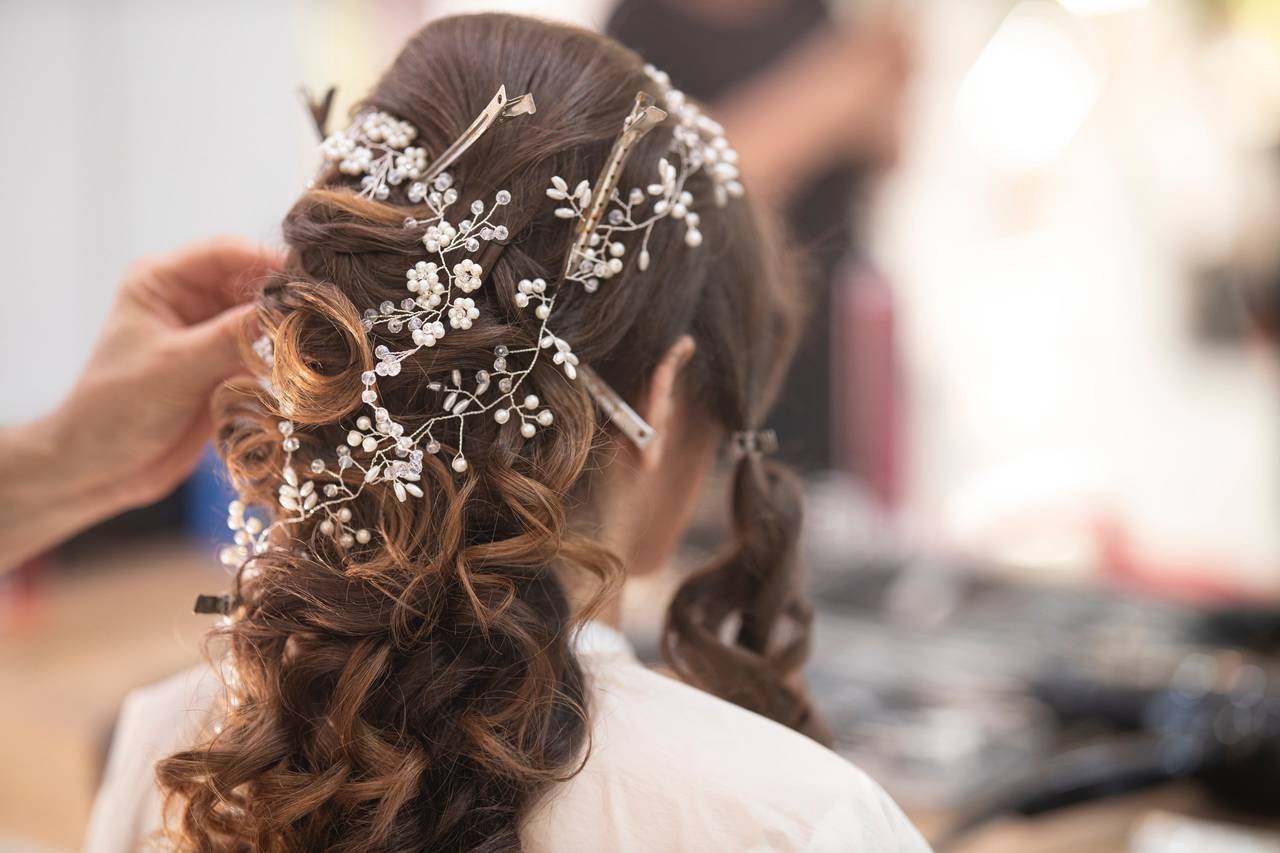
Wedding-hair inspiration often arrives as a stream of beautiful close-ups. A polished bun, loose waves, or an intricate half-up style can look irresistible when viewed alone. Yet your hairstyle will be seen beside an outfit, a neckline, accessories, and the way you actually move through the day. Preparing for a trial appointment means bringing those relationships into view. You do not need to decide every detail in advance. You need a few distinct directions, a record of your priorities, and enough context for a stylist to help you choose.
Begin with the whole outfit
Look at the neckline and the general outline of your clothes before selecting individual hairstyles. Decide what you would like to emphasize: the shoulders, an open back, an interesting collar, or a piece of jewelry. There is no mandatory pairing between a particular neckline and a particular hairstyle. The point is to make an intentional choice rather than assuming that the hair will exist separately from everything else. A style you love in a cropped photograph may read differently when the complete outfit is visible.
Take a simple outfit photograph if one is available, or bring clear images of the garments and accessories to the appointment. Include anything that affects the space around your head and shoulders. A veil, headpiece, earrings, or decorative collar can change the discussion. You do not need professional photographs for this preparation. Practical reference images give the stylist more information than a collection of hairstyle close-ups alone, especially if you are deciding between wearing the hair mainly up or mainly down.
Separate the overall direction from the details
Start with broad silhouettes: an updo, hair worn down, or a half-up arrangement. Within each, choose one or two references that show what attracts you. Perhaps you like softness near the face, a clean outline at the back, or movement through the lengths. Write that preference beside the photograph. Avoid asking one reference to communicate everything. An image can be useful for the front even if you dislike its accessories, or useful for the back while showing a fringe you do not want.
This separation makes the trial more productive because it exposes which choices are still open. You may be certain about keeping hair away from your face but undecided about the arrangement behind it. Say so. The stylist can focus attention on the unresolved part rather than repeating work on a settled preference. If every reference is presented as a complete finished demand, it becomes harder to tell which elements are essential and which merely happened to appear in a picture you saved.
Use personal previews for early exploration
You can explore wedding hairstyle ideas with a portrait-based service such as AIHairStyleChanger.AI when you want to consider a broad visual direction. Treat a generated image as an inspiration sketch. It can help you react to a silhouette beside your own face, but it cannot confirm how an elaborate style will be constructed, how accessories will attach, or how your hair will behave during the event. Keep the original portrait alongside the preview so that the distinction remains visible when discussing the idea.
Compare only a few directions at this stage. A large set of generated images can recreate the same confusion as a large folder of online references. Ask what each picture teaches you: do you prefer more openness around the face, a higher arrangement, or length visible across the shoulders? Save the images that make those preferences easier to explain. Discard pictures that are attractive but do not answer a useful question. The purpose is preparation for a trial, not replacing the trial with a digital decision.
Think through the sequence of the day
Make a practical list of the activities your hairstyle needs to accompany. You may be changing accessories, putting on a veil, greeting many people, spending time outside, or dancing later. Describe those plans to the stylist without attempting to predict the technical solution yourself. It is also useful to mention how you normally feel with your hair pinned up, touching your neck, or falling around your face. Comfort preferences deserve a place beside the visual references rather than being remembered after the style has been chosen.

Discuss any planned change between the ceremony and the later celebration. An inspiration photograph generally captures one moment, while your event has a sequence. If you want to remove an accessory or alter the look, ask what would be involved and who would manage it. These are planning questions, not instructions to use a particular method. A clear account of the day gives the professional a better basis for explaining options, tradeoffs, and what should be tried before the final appointment.
Turn the trial into useful evidence
Bring the relevant accessories when appropriate and ask how best to document the trial result. Looking from the front, sides, and back can reveal different information. Pay attention to how the style feels as well as how it photographs. Record any detail you want to discuss before leaving, while the arrangement is still visible. If a reference is being adapted, ask the stylist to explain the agreed changes in ordinary language so that you can remember the final direction accurately.
If several people are involved in the preparations, agree on where the final hairstyle references will be kept. A shared folder or printed page can prevent an outdated picture from resurfacing on the day. Identify the approved direction clearly and keep any trial photographs beside it. This is especially helpful when accessories are being coordinated by somebody else. It gives everyone the same visual reference while leaving decisions about the actual styling with you and the professional responsible for creating the look.
After the trial, keep the chosen references and notes together rather than reopening the entire search. If you want a revision, identify the specific feature that needs attention instead of replacing the plan with a completely new inspiration folder. Wedding-hair preparation works best as a narrowing process: the outfit provides context, the images communicate preferences, and the trial supplies real experience. Digital previews can contribute to the early conversation, but the most useful final decision is one informed by your actual hair, the complete look, and the practical shape of your day.