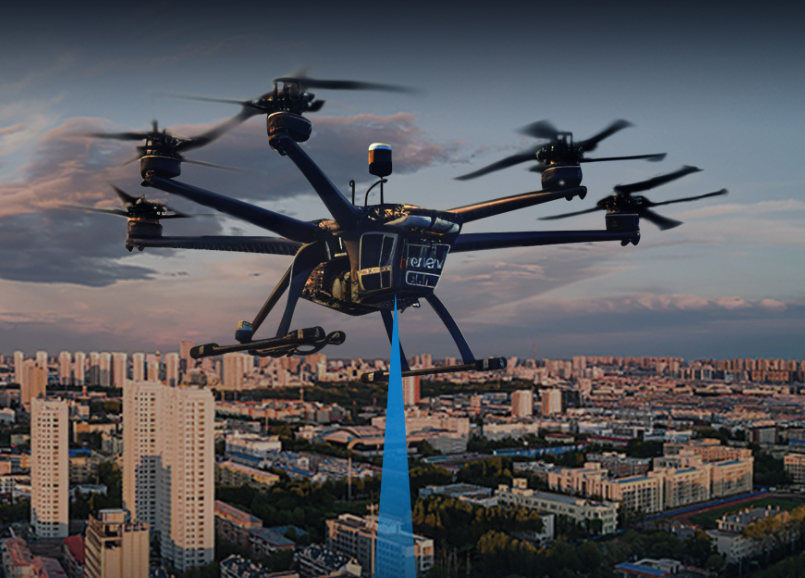
In battery-powered drones, LiDAR power consumption directly affects how long the aircraft can remain operational during a mission.
- Where Does LiDAR Power Consumption Come From?
- Laser Emission Circuit
- Signal Processing Unit (SPU)
- Optical Calibration and Logic Control
- Data Transmission Interface
- How Does LiDAR Power Consumption Affect Mission Performance
- 1. Reduced Flight Time and Effective Range
- 2. Increased Cooling Demand and Structural Weight
- 3. Thermal Effects on Ranging Stability
- 4. Contention for System Power Budget
- How Benewake Achieves Lower LiDAR Power Consumption
- Practical Strategies for Optimizing UAV Endurance
- Conclusion
Given the finite energy density of UAV batteries, the power draw from both payloads and propulsion systems dictates the discharge rate and total mission endurance.
The following sections explain the sources of LiDAR power consumption, how it impacts drone performance, and what operators can do to improve flight efficiency.
Where Does LiDAR Power Consumption Come From?
Understanding the energy profile of a UAV LiDAR sensor requires breaking down its internal architecture. The total power draw is the sum of several distinct operational processes:
Laser Emission Circuit
The laser emission module is one of the largest sources of LiDAR power consumption because it must generate high-energy laser pulses continuously during operation.
Extending the detection range typically requires higher pulse energy to ensure that reflected signals remain distinguishable from ambient optical noise.
Signal Processing Unit (SPU)
After receiving the reflected pulse, the SPU performs high-speed Time-of-Flight (ToF) calculations or phase analysis. High sampling rates place a constant processing load on the system, which increases overall power usage.
Optical Calibration and Logic Control
Internal circuitry is necessary to maintain optical alignment and environmental compensation. While these auxiliary systems consume less power than the emitter, they are essential components of the overall power budget.



Data Transmission Interface
Real-time distance data is exported to the flight controller via protocols such as Serial, CAN, or Ethernet. The physical layer drivers for these interfaces contribute to the total power overhead.
How Does LiDAR Power Consumption Affect Mission Performance
The power demand of an onboard sensor is directly linked to the utility and safety of the UAV. Higher consumption levels impact the drone’s performance in several ways:
1. Reduced Flight Time and Effective Range
With a fixed battery capacity, every watt consumed by the payload reduces the energy available for the propulsion motors.
Even for lightweight sensors, low energy efficiency can force an early “Return to Home” (RTH), significantly shrinking the operational radius or the total linear distance covered during a single sortie.
2. Increased Cooling Demand and Structural Weight
As LiDAR power consumption increases, more heat builds up inside the UAV payload compartment.
To maintain the UAV LiDAR sensor within its optimal operating temperature, heat sinks or thermal enclosures are often required. These components add “dead weight” to the airframe, requiring the motors to work harder and creating a negative feedback loop for battery life.
3. Thermal Effects on Ranging Stability
Internal temperature spikes can increase the dark current of the photodetectors.
Without adequate heat dissipation, the signal-to-noise ratio may degrade, leading to thermal drift in measurements. This can compromise the reliability of critical tasks such as altitude holding, terrain following, or obstacle avoidance.
4. Contention for System Power Budget
UAVs feature multiple subsystems (flight controller, telemetry, GPS) sharing a common power source. A high-draw sensor increases the load on the power distribution unit (PDU). If not managed correctly, power fluctuations can introduce electronic interference or voltage sags that affect other sensitive avionics.
How Benewake Achieves Lower LiDAR Power Consumption
1. Technical Pathway
Benewake integrates the SWaP-C (Size, Weight, Power, and Cost) optimization philosophy into its product development, controlling sensor energy consumption through several technical pathways:
(1) Systematic Balance of Performance and Efficiency
While high-power lasers can extend detection range, the resulting heat increases the load on the power system.
Benewake LiDAR solutions balance detection distance, refresh rate, and power efficiency during the design phase.
Through advanced circuit integration and smart signal processing, the sensors maintain high performance while significantly decreasing baseline power draw.
(2) Lightweight Materials and Structural Optimization
Benewake continuously explores the fusion of lightweight materials and mechanical design to reduce mass while maintaining structural rigidity.
This design not only enhances integration flexibility on mobile platforms but also indirectly reduces the vehicle’s propulsion power requirements by lowering the overall payload.
(3) Dynamic Sampling Frequency
The Benewake LiDARs support multiple built-in operating modes, allowing users to flexibly adjust the sampling frequency based on mission requirements.
During phases with lower data output needs, lowering the frame rate effectively reduces average power consumption and extends battery life.
(4) Power-saving Mode
Specific models, like TF-Luna, boast a dedicated power-saving mode that can adjust the drive current and duty cycle of the laser source. Lowering energy consumption thereby prolongs the endurance of battery-operated devices in power-sensitive missions.
2. Special Product Recommendation
As a concrete embodiment of low LiDAR power consumption design, the TFA300 series offers outstanding power efficiency, with a rated consumption of ≤ 0.45 W at 5 V DC and a peak current below 0.75 A.
The series comes in two variants: the housing-free TFA300-L, weighing just 10.5 g, and the TFA300 with an IP67-rated enclosure for demanding field conditions.
Both models support sampling rates up to 10,000 Hz and are fully optimized for complex UAV applications, maintaining stable operation under extreme temperatures, 100 klux ambient lighting, and harsh outdoor conditions, including rain, fog, and dust.
Practical Strategies for Optimizing UAV Endurance
UAV endurance can be improved through both hardware design and smarter flight operations.
1. Hardware Measures
- Efficient Power Management: Incorporate high-efficiency conversion devices such as gallium nitride (GaN) components into the UAV power system to reduce voltage conversion losses between the battery and the LiDAR sensor.
- Thermal Design Coordination: Plan sensor placement thoughtfully to take advantage of natural airflow generated by the rotors for passive LiDAR cooling, preventing efficiency degradation caused by overheating.
2. Flight Strategy Measures
- Refined Route Planning: Avoid aggressive turns and frequent attitude corrections during flight. Stable flight paths help deliver more consistent LiDAR data and minimize unnecessary battery strain caused by sudden current spikes.
- Operating Environment Selection: Conduct missions under moderate temperature conditions where possible. Extreme heat adds extra thermal stress to the sensor, and strong winds force the drone motors to consume more power to keep the aircraft stable.
Conclusion
Optimizing LiDAR power consumption is a practical lever for extending UAV mission range and improving flight stability. By selecting low-power sensors such as the Benewake LiDARs and pairing them with refined flight planning and efficient power management, operators can make the most of a fixed battery capacity without compromising sensing performance.