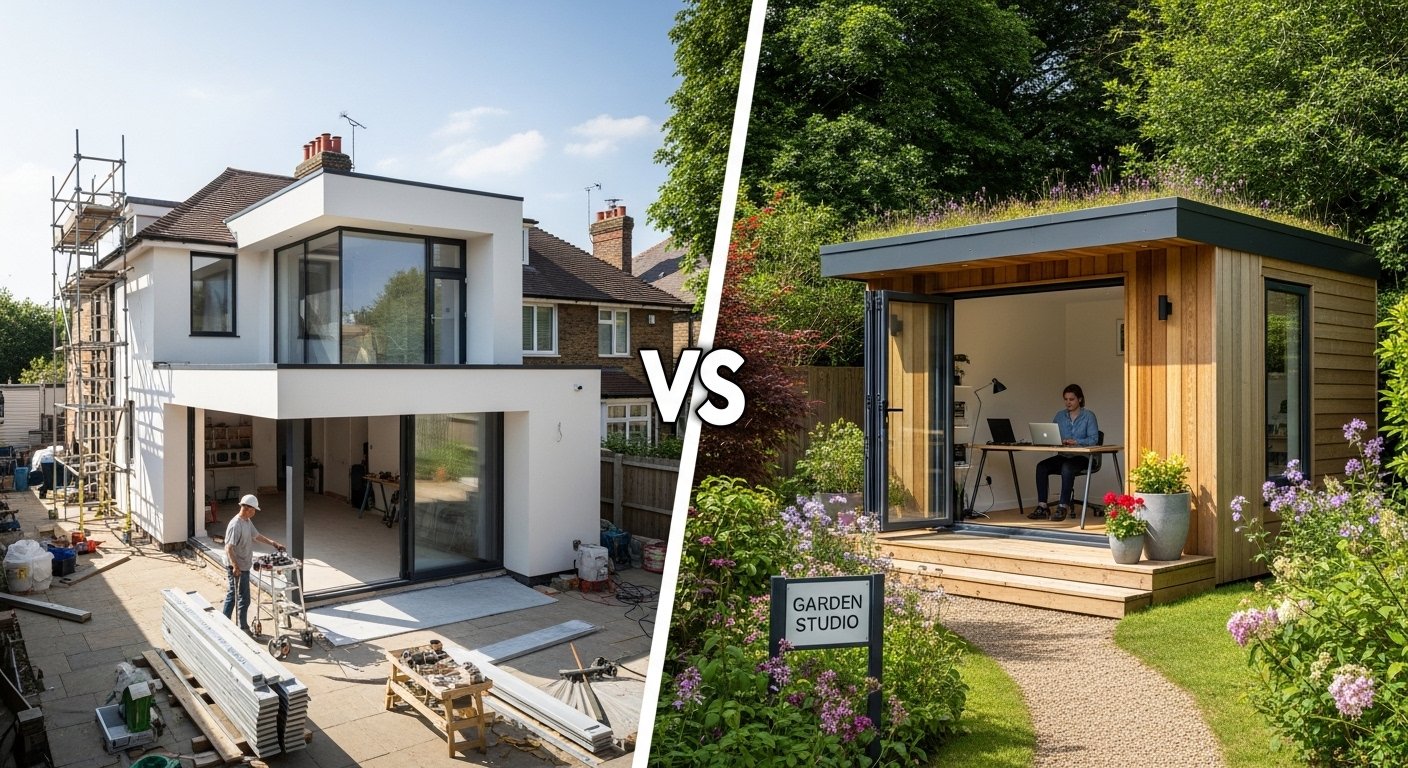
More and more homeowners across the UK are turning to their gardens to solve a problem that used to have only one expensive answer: not enough space.
Whether you need a quiet place to work, a room for the kids, or space to finally pursue a hobby, adding square footage to your home has traditionally meant a building extension. But extensions cost a lot of money, take months to complete, and often require planning permission. That is why garden studios have become so popular in recent years.
What Is a Garden Studio?
A garden studio is a fully insulated, self-contained building that sits in your garden. Unlike a garden shed, it is designed for year-round use. It can be heated, wired for electricity, and connected to the internet. Some even have running water.
They come in a range of sizes and styles, from compact flat-pack models to large bespoke builds with bifold doors, skylights, and premium cladding. Garden studios can serve as a home office, art room, gym, music room, games room, or simply a comfortable space away from the main house.
Do You Need Planning Permission?
In most cases, no. Under Permitted Development rights in England, outbuildings such as garden studios are generally allowed without a planning application, as long as they meet certain rules. The building must not cover more than half of your garden, must be no taller than four metres with a dual-pitched roof (or three metres for any other roof style), and must not be used as sleeping accommodation. Stricter rules apply in conservation areas and for listed buildings. The full guidance is available on the Planning Portal at planningportal.co.uk.
How Do They Compare to an Extension?
A single-storey rear extension in the UK typically costs between £20,000 and £50,000 and can take several months from planning to completion, with considerable disruption along the way.
A garden studio, by contrast, can often be installed in as little as one to two weeks. Costs are generally lower, and because the building sits separately from your home, there is far less mess during the build.
There is also a flexibility advantage. Garden studios can serve very different purposes at different life stages. A room that starts as a home office could become a teenage hangout, a guest space, or a creative studio years later.


What Should You Look for in a Build?
Insulation is the most important factor. A poorly insulated building will be unusable in winter and stuffy in summer. Look for builders who use modern insulation techniques, include a vapour barrier to prevent damp, and ensure good ventilation throughout.
Materials matter too. Timber-framed buildings with quality cladding, whether cedar, composite, or another durable option, will last far longer than cheaper alternatives. A structural guarantee of ten years or more is a sign that a builder stands behind their work. Electrics, lighting, heating, and internet connectivity should be planned from the start rather than bolted on later.
Is It Worth It?
For many homeowners, a garden studio turns out to be one of the best investments they make in their property. It adds usable space, creates a clear separation between work and home life, and can add value to a property according to many estate agents.
It is also simply a nicer way to use your home. Having a space designed around what you actually need, rather than adapted from a spare corner of the living room, can make a real difference to everyday life.
If you have the garden space and the need, a garden studio is well worth serious consideration.