I used to make the same mistake every time I started a new anime-style character. I would chase the final look before I understood the person. The hair came first, then the outfit, then some dramatic color palette I thought looked “cool,” and only later did I realize the character had no gravity. The image looked finished, but the idea felt hollow.
- The real problem was never the tool
- What helped me build better anime characters faster
- I learned that “anime style” is not a personality
- Where AI actually became useful in my workflow
- The best characters survive outside the hero pose
- My output improved when I treated character design like casting
- Final thoughts
That changed when I started building characters from the inside out. Instead of beginning with aesthetics, I began with role, emotion, silhouette, and story function. A simple OC generator became part of that early process because it helped me test identity faster than sketching from scratch every single time. What surprised me wasn’t speed alone. It was clarity. Once I could see several believable directions side by side, weak ideas became obvious.
For creators who make anime art, comics, visual novel concepts, VTuber identities, or even social media character content, this shift matters more than people admit. A polished character image can get attention for a few seconds. A character with presence stays in your head.
The real problem was never the tool
For a long time, I blamed my workflow on software. I told myself I needed better brushes, a cleaner model, more references, maybe a stronger prompt formula. In practice, none of that fixed the deeper issue. I was treating character creation like decoration.
Once I began asking a different set of questions, the work improved almost immediately:
- What is this character hiding?
- What would make them recognizable in silhouette?
- What kind of world shaped their posture, clothing, and expression?
- If I removed the color, would the design still feel distinct?
Those questions changed how I judged early drafts. I stopped rewarding images just because they were pretty. I started looking for internal logic.
What helped me build better anime characters faster
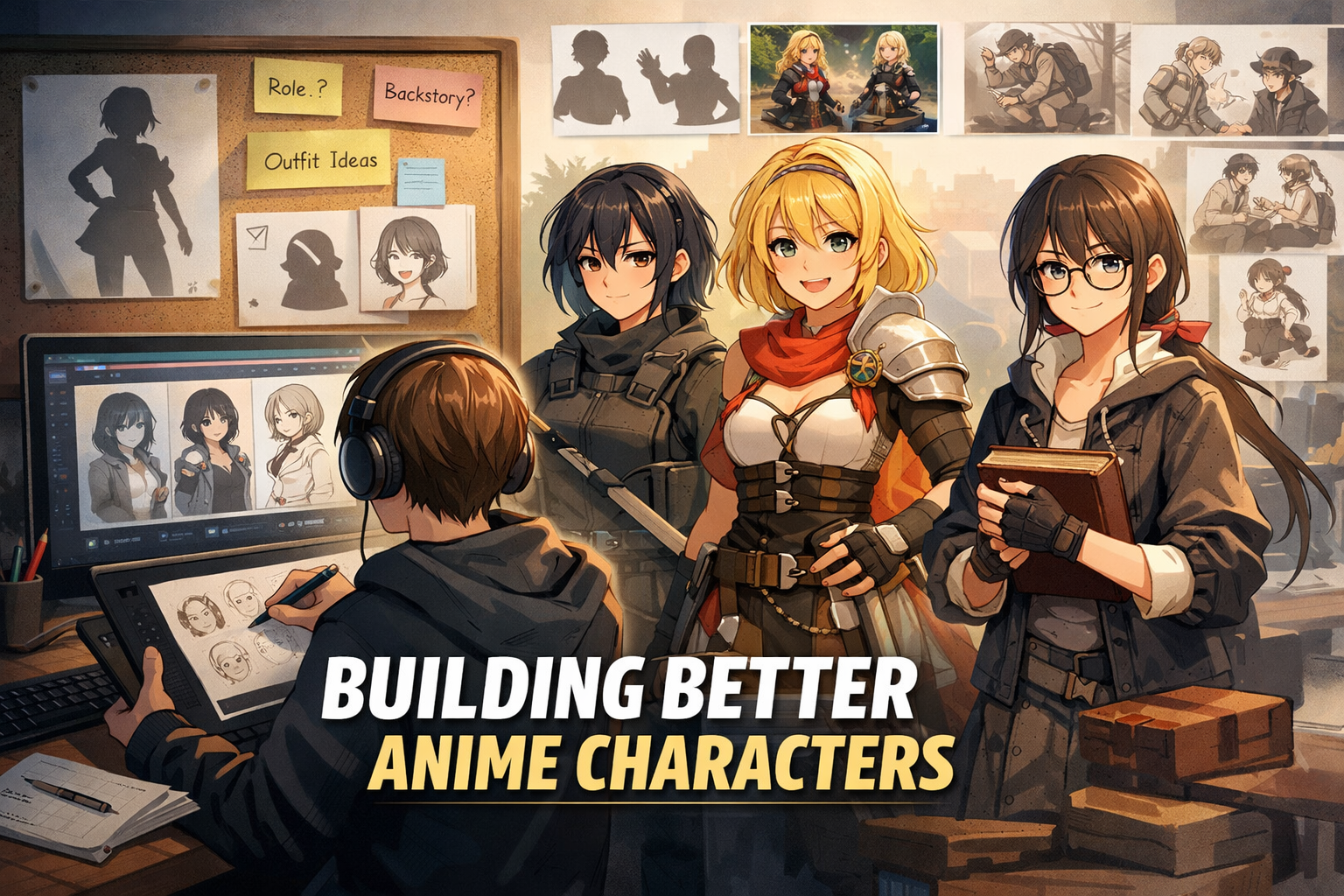
My process now feels less glamorous, but the results are stronger. I usually work through a character in layers rather than trying to “nail it” in one pass.
| Stage | What I focus on | What usually goes wrong |
| Core concept | Role, mood, personality tension | The idea is too generic |
| Visual identity | Silhouette, hair shape, proportions | The design looks familiar |
| Outfit logic | Materials, era, purpose, movement | Clothes look random |
| Expression set | Calm face, action face, side view | Character loses consistency |
| Final style pass | Texture, color harmony, polish | Style hides weak structure |
That table may look simple, but it saved me from wasting hours on beautiful nonsense. When a character fails at stage one or two, polishing the final image rarely rescues it.



I learned that “anime style” is not a personality
This was probably my biggest correction. Anime styling is powerful, but it can also hide lazy thinking. Large eyes, dramatic lighting, and fashionable clothing can make a character feel complete when they are really just an attractive placeholder.
The stronger designs I’ve made all came from specificity. One was a quiet archivist who looked composed in public but always wore fingerless gloves because she compulsively handled old, damaged paper. Another was a cheerful fighter whose outfit looked bright at first glance, though every accessory was chosen for practicality because she expected to be attacked at any time. Those details changed the image. They gave the design tension.
That is also why I stopped writing prompts like “beautiful anime girl, detailed outfit, cinematic lighting.” The result might be visually clean, but it usually says nothing. When I describe intent, contradiction, and context, the outputs get more human.
Where AI actually became useful in my workflow
I don’t use AI to replace taste. I use it to accelerate decision-making.
That distinction matters. In my own workflow, AI performs best when I already know what kind of character energy I’m chasing, but I want to explore visual possibilities without locking myself into the first draft. At that stage, an AI image anime generator is useful because it helps me test combinations I may not have drawn manually on the first attempt: softer eyes with military styling, a comedic face paired with formal costume design, or a darker palette on a character who is meant to appear trustworthy.
I still reject plenty of outputs. Most creators should. The value isn’t that every image is ready to publish. The value is that iteration becomes cheap enough for better judgment to emerge. You stop defending the first idea just because you already spent two hours on it.
The best characters survive outside the hero pose
One rule I trust now: if a character only works in one glamorous front-facing image, the design probably isn’t mature yet.
I like checking a concept against less flattering situations. What does the character look like sitting down, turning away, laughing too hard, carrying something heavy, or standing in bad lighting? Do they still feel like themselves when the pose stops helping?
This is where many flashy concepts fall apart. The accessories are doing all the work. The anatomy gets inconsistent. The expression vocabulary is too narrow. A strong anime character should survive multiple contexts, not just one promotional frame.
That is especially important for creators making repeat-use characters for comics, story videos, streaming avatars, or branded content. Once a character has to appear again and again, the weaknesses surface quickly.
My output improved when I treated character design like casting
The best mindset I’ve found is to think like a casting director rather than a decorator. I’m not just making someone look interesting. I’m deciding who can carry attention over time.
That mindset forces better questions. Would this character be memorable after a single scene? Would I recognize them by outline alone? Could I describe their emotional rhythm in one sentence? If the answer is no, I’m not done.
Oddly enough, that approach made my work feel more creative, not less. Constraints sharpened everything. I became more selective with color, more disciplined with costume details, and much less impressed by surface-level prettiness.
Final thoughts
I stopped designing anime characters backwards because I got tired of making images that looked finished but felt empty. Once I began building character logic before visual polish, the entire process became easier to trust. I spend less time forcing weak concepts to work, and more time developing characters that actually feel alive.
For me, the real breakthrough was understanding that tools do not create depth on their own. They reveal whether the thinking is there. When the concept is solid, the visuals land harder. When the concept is vague, no amount of rendering hides it for long.
That has changed the way I work, the way I promp, and the way I judge a “good” result. The image still matters, of course. It just matters more when the person inside it already exists.