Environmental testing in product development and quality assurance involves much more than simply placing a product in a box and hoping for the best. This process systematically reproduces the environmental stresses that cause real-world failures—and does so faster and more consistently than field exposure ever could. Subjecting materials to controlled stressors allows engineers to uncover latent defects, predict service life, and ensure that products survive the rigors of their intended environments.
- Start With Failure Modes, Not Equipment
- When You Need UV Weathering (UV Testers)
- When You Need Ozone Testing (Ozone Testers)
- When You Need a Xenon Test Chamber (Xenon Arc Weathering)
- When You Need a Salt Spray Test Chamber (Corrosion Screening)
- When You Need Thermal Shock (Rapid Transitions)
- Decision Framework: Choose the Right Environmental Chamber by Scenario
- Choose UV Testing When…
- Choose Ozone Testing When…
- Choose a Xenon Test Chamber When…
- Choose a Salt Spray Test Chamber When…
- Choose Thermal Shock When…
- When a Benchtop Environmental Chamber Is Enough
- How to Combine Tests Into a Practical Program
- Outdoor Plastics and Coatings Program
- Metal Hardware and Coated Components Program
- Electronics and Sensor Assemblies Program
- Common Environmental Testing Mistakes
- Why Qualitest Is a Practical Source for Environmental Chamber Options
- Explore Environmental Chambers From Qualitest
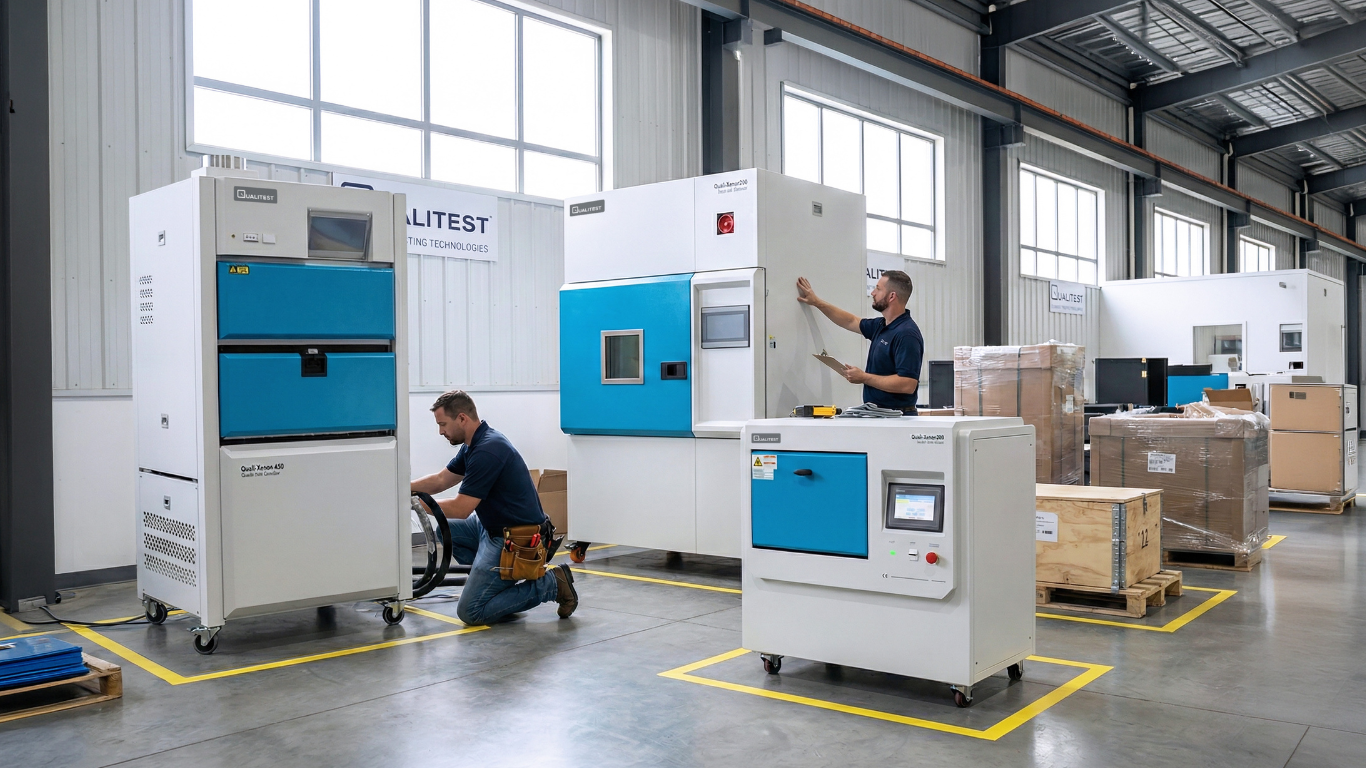
However, one of the most common challenges in the lab is selecting the right tool for the job. One Environmental Chamber rarely does everything; a chamber optimized for salt fog cannot simulate the UV degradation of sunlight, and a humidity cabinet isn’t designed for the violent temperature transitions of thermal shock. The best testing strategy is built around the failure modes you need to reveal, rather than a “one-size-fits-all” approach. To help you design the right program, you can explore Environmental Chamber options from Qualitest to see the range of specialized systems available for different materials and stress conditions.
Start With Failure Modes, Not Equipment
The most effective testing programs begin with a “failure mode first” mindset. Before looking at equipment, ask: “What failed in the field?” or “What is the most likely way this material will degrade?” Different materials react to environmental stressors in distinct ways, and choosing the wrong test can lead to a false sense of security or a product that fails prematurely in the hands of the customer.
Common environmental failure indicators include:
- Plastics and Polymers: Fading, surface “chalking,” and embrittlement are typically driven by UV radiation and heat.
- Elastomers and Rubber: Surface cracking and loss of elasticity in seals or hoses are often caused by ozone exposure and mechanical strain.
- Coatings and Metals: Blistering, bubbling, and the spread of red or white rust are the hallmarks of corrosion, usually accelerated by salt and moisture.
- Electronics and Assemblies: Cracking in solder joints, delamination of layers, and seal failures are often the result of rapid thermal transitions.
By identifying these risks early, you can select the specific testing technology—whether it is a Salt Spray Test Chamber for corrosion or a Xenon Test Chamber for sunlight—that will provide the most actionable data.
When You Need UV Weathering (UV Testers)
UV weathering testers are the go-to choice for screening plastics, coatings, inks, and polymers for degradation caused by the sun’s ultraviolet rays. While the sun emits a broad spectrum of light, it is the short-wave UV light that causes the most damage to organic materials. UV testers use fluorescent lamps to simulate this specific part of the spectrum, combined with moisture (condensation or spray) to simulate outdoor dew and rain.
UV testing is particularly effective for early-stage material screening. It is excellent at revealing surface-level degradation trends quickly.
- Color shift and fading: Identifying how pigments will react to prolonged exposure.
- Surface chalking: Detecting the breakdown of the polymer binder on the surface of coatings.
- Embrittlement: Checking if a material will lose its flexibility and crack under UV stress.
- Loss of gloss: Monitoring the aesthetic finish of high-end consumer or automotive products.
When You Need Ozone Testing (Ozone Testers)
Ozone testing is a highly specialized but essential method for any company working with rubber and elastomer components, such as seals, gaskets, hoses, and belts. Ozone is a powerful oxidizing agent present in the atmosphere, and when it comes into contact with elastomers under mechanical strain, it causes “ozone cracking.” These cracks are often perpendicular to the direction of the strain and can lead to sudden, catastrophic failure of the component.


An ozone tester allows you to control ozone concentration, temperature, and airflow to see how your rubber formulations hold up over time. This test is critical for ensuring that flexible components used in automotive engines, industrial machinery, or outdoor equipment don’t fail prematurely due to environmental oxidation.
When You Need a Xenon Test Chamber (Xenon Arc Weathering)
While UV testers focus on the damaging short-wave radiation, a Xenon Test Chamber provides a closer approximation to full-spectrum sunlight. By using xenon arc lamps and specific filters, a Xenon Test Chamber can simulate indoor or outdoor sunlight, including visible light and infrared radiation.
You need a Xenon Test Chamber when the appearance and structural integrity of a finished product are critical. Because it includes the longer-wavelength radiation that causes heating, it is the preferred method for testing textiles, interior automotive trim, and finished consumer goods where color matching and surface performance must be validated against the full solar spectrum. Using a Xenon Test Chamber ensures that you aren’t just testing for UV damage, but for the complex interplay of light, heat, and humidity that occurs in the real world. Many labs use a Xenon Test Chamber for final product validation because it correlates more closely to natural weathering than UV-only methods.
When You Need a Salt Spray Test Chamber (Corrosion Screening)
If your product contains metal components or protective coatings that will be exposed to coastal air, road salt, or high-humidity environments, a Salt Spray Test Chamber is a mandatory part of your lab. Salt spray (or salt fog) testing is one of the oldest and most widely used methods for screening the corrosion resistance of materials.
The primary use of a Salt Spray Test Chamber is for fast, comparative screening. It is used to validate the quality of a galvanizing or painting process and to ensure that a supplier’s batch of parts meets a minimum corrosion threshold. A Salt Spray Test Chamber is particularly effective at revealing:
- Corrosion initiation: Finding weak spots at scratches or defects in a coating.
- Coating breakdown trends: Seeing how long a protective layer can resist a highly corrosive environment.
- Hardware susceptibility: Testing how fasteners and joints hold up in salty, moisture-laden air.
When You Need Thermal Shock (Rapid Transitions)
Thermal shock testing is distinct from standard temperature cycling. While a standard Environmental Chamber might change temperature at a rate of 5°C to 10°C per minute, a thermal shock chamber moves the test article between extreme hot and cold zones almost instantaneously.
This test is essential for electronics, multi-material assemblies, and products that use materials with different Coefficients of Thermal Expansion (CTE). The rapid transition forces these materials to expand and contract at different rates, exposing flaws like:
- Cracking or warping: In plastic housings or structural components.
- Solder joint stress: In circuit boards and electronic interconnects.
- Seal integrity issues: Where different materials meet and may pull apart under stress.
- Delamination: In layered composites or laminated glass.
Decision Framework: Choose the Right Environmental Chamber by Scenario
To simplify your selection, use this framework to match your scenario to the correct chamber type.
Choose UV Testing When…
- You are performing early-stage screening of new polymer formulations.
- Your primary concern is surface-level aesthetic damage like chalking or fading.
- You need a fast, cost-effective way to compare the UV resistance of different coatings.
Choose Ozone Testing When…
- You are working with rubber seals, gaskets, or tires.
- Your parts will be under mechanical tension in the field.
- You need to prevent surface cracking in flexible components.
Choose a Xenon Test Chamber When…
- You need to validate the color stability of finished consumer or automotive products.
- Full-spectrum sunlight simulation is required by your industry standard.
- You need to account for the heating effect of infrared radiation on the sample.
Choose a Salt Spray Test Chamber When…
- You need to verify the corrosion resistance of metal hardware or fasteners.
- You are performing quality audits on a coating or plating process.
- You need a fast, standardized “go/no-go” test for supplier quality.
Choose Thermal Shock When…
- You are testing electronics, circuit boards, or sensors.
- Your product consists of multiple bonded materials with different expansion rates.
- You need to simulate extreme, rapid temperature changes found in aerospace or automotive engine environments.
When a Benchtop Environmental Chamber Is Enough
For many labs, a full-sized walk-in room is overkill. A Benchtop Environmental Chamber is a practical choice when your samples are small, such as individual electronic components, small plastic plaques, or textile swatches. A Benchtop Environmental Chamber provides the same precision temperature and humidity control as larger units but in a footprint that fits on a standard lab bench. Many R&D teams start with a Benchtop Environmental Chamber for initial screening and method development before moving to larger systems for full-scale production validation.
How to Combine Tests Into a Practical Program
In the real world, failure is rarely caused by a single stressor. A robust reliability program often “bundles” tests to ensure a product can survive the multi-stress reality of the field.
Outdoor Plastics and Coatings Program
- Step 1: Use a UV tester or a Xenon Test Chamber to evaluate light stability.
- Step 2: Combine with temperature and humidity cycling to simulate night/day transitions.
- Step 3: Use a Salt Spray Test Chamber if the product includes metal fasteners or will be used near the ocean.
Metal Hardware and Coated Components Program
- Step 1: Run a standard Salt Spray Test Chamber routine for initial screening.
- Step 2: Follow with a cyclic corrosion test (alternating salt fog, drying, and humidity) to more accurately predict long-term field performance.
Electronics and Sensor Assemblies Program
- Step 1: Use thermal shock to reveal interconnect and solder joint weaknesses.
- Step 2: Use a Benchtop Environmental Chamber to perform high-heat/high-humidity “soak” tests (such as 85/85 testing) to check for moisture ingress and electrical failure.
Common Environmental Testing Mistakes
- Selecting the Chamber Before the Failure Mode: Buying a salt spray cabinet when your real problem is UV-driven embrittlement.
- Underestimating Humidity: Forgetting that moisture and condensation often act as catalysts for UV and corrosion damage.
- Ignoring Sample Loading: Overcrowding an Environmental Chamber, which can block airflow and create “dead zones” where the environment isn’t uniform.
- Non-Standard Documentation: Comparing results between two different labs or machines without controlling for specimen orientation and prep.
- Over-accelerating: Setting temperatures so high that you create failure modes that would never actually happen in the field (e.g., melting a plastic that only gets warm in real life).
Why Qualitest Is a Practical Source for Environmental Chamber Options
Building a comprehensive environmental lab is easier when you can work with a partner that covers the entire spectrum of testing. Qualitest offers a complete range of systems, including UV weathering testers, ozone testers, and advanced Xenon Test Chamber models. For corrosion, they provide both basic salt spray and advanced cyclic corrosion cabinets.
Whether you need a specialized thermal shock chamber for electronics or a compact Benchtop Environmental Chamber for incoming material checks, Qualitest provides systems engineered for repeatability and compliance with international standards like ASTM, ISO, and DIN. Their range allows you to scale from a single R&D unit to a full-scale testing facility with consistent software and support.
Explore Environmental Chambers From Qualitest
The “best” test is the one that forces your product to fail in the lab before it fails for the customer. By identifying your critical failure modes and choosing the right combination of light, heat, moisture, and corrosion stress, you can build a testing strategy that adds real value to your engineering process.
We invite you to browse Qualitest environmental chambers and compare Qualitest chamber testers and request a quote based on your materials, failure modes, and required test methods. Selecting the correct Environmental Chamber today is the first step toward a more reliable, durable, and successful product tomorrow.