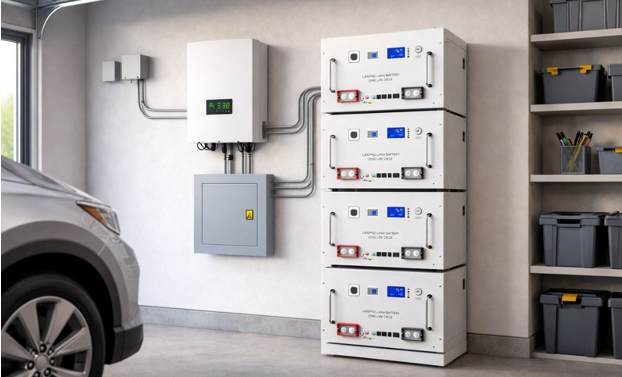
As residential solar adoption continues to accelerate worldwide, homeowners are increasingly looking for reliable and scalable energy storage systems. One of the most efficient and future-ready solutions available today is the rack-mounted battery system. Designed for modular expansion, improved organization, and higher energy density, rack-mounted battery solutions are transforming how home solar energy storage is installed and managed.
- What Is a Rack-Mounted Battery System?
- Why Rack-Mounted Battery Solutions Are Ideal for Home Solar
- How Rack-Mounted Batteries Integrate with Solar Energy Systems
- Rack-Mounted vs Wall-Mounted Batteries
- Understanding Capacity: Is a 20kWh Home Battery Enough?
- Installation Considerations for Rack Systems
- Cost of Rack-Mounted Battery Solutions
- Lifespan and Performance
- Choosing the Right Rack-Mounted Battery Brand
- Energy Independence and Future-Proofing
- Environmental Impact
- Final Thoughts
Unlike traditional wall-mounted batteries, rack systems are engineered for flexibility. They allow homeowners to start small and expand capacity as energy demands grow. Whether you are building a new solar installation or upgrading an existing system, understanding how rack-mounted battery solutions work can help you make a smarter long-term investment.
What Is a Rack-Mounted Battery System?
A rack-mounted battery system is a modular energy storage setup where lithium battery modules are installed inside a standardized cabinet or server-style rack enclosure. These batteries are typically 48V lithium iron phosphate (LiFePO4) units designed for residential and light commercial solar energy storage.
Each module connects through an integrated Battery Management System (BMS), allowing multiple units to operate safely in parallel. This architecture makes the system highly scalable and easy to maintain. Instead of replacing an entire battery unit when capacity is insufficient, additional modules can be added to the rack.
Because of their structured layout, rack systems are especially popular in homes that require higher storage capacity, backup reliability, and long-term expandability.
Why Rack-Mounted Battery Solutions Are Ideal for Home Solar
The primary advantage of rack-mounted battery solutions lies in scalability. Traditional battery systems often limit expansion, but rack systems allow homeowners to increase storage capacity incrementally. If your household energy usage rises due to electric vehicle charging or appliance upgrades, adding new battery modules is straightforward.
Safety is another key benefit. Most rack-mounted battery products use LiFePO4 chemistry, known for thermal stability and long cycle life. This makes them suitable for indoor installation when proper ventilation and compliance standards are met.
Rack systems also improve organization. All modules are neatly secured within a cabinet, reducing clutter and simplifying cable management. Maintenance becomes easier because individual modules can be serviced without dismantling the entire setup.



For households seeking serious energy independence, rack solutions provide professional-grade energy infrastructure that resembles commercial installations but is scaled for residential needs.
How Rack-Mounted Batteries Integrate with Solar Energy Systems
A rack-mounted battery system works in coordination with solar panels, an inverter, and sometimes the utility grid. Solar panels generate DC electricity during the day. The inverter converts DC power into AC power for household appliances. Excess electricity that is not consumed immediately is stored in the battery bank.
When sunlight is unavailable, such as during nighttime or grid outages, the inverter draws stored power from the battery system. Advanced inverters also allow time-of-use optimization, enabling homeowners to store energy when electricity rates are low and use it when rates are higher.
Because rack systems are modular, they integrate smoothly with hybrid inverters that support parallel battery configurations. Many modern systems support communication protocols such as CAN or RS485, ensuring seamless monitoring and performance optimization.
Rack-Mounted vs Wall-Mounted Batteries
Wall-mounted batteries are compact and visually appealing, making them suitable for smaller homes with limited storage requirements. However, they often have fixed capacities that restrict expansion.
Rack-mounted systems, by contrast, are designed for modular stacking. If you begin with a 10kWh configuration and later require a 20kwh home battery capacity, additional modules can be installed without replacing the original system. This flexibility reduces long-term upgrade costs and extends the lifespan of your investment.
Wall systems may also become complex when multiple units are installed side by side. Rack enclosures centralize all modules in one protected cabinet, creating a cleaner and more professional installation.
For homeowners serious about long-term energy resilience, rack solutions generally provide greater adaptability and higher overall capacity potential.
Understanding Capacity: Is a 20kWh Home Battery Enough?
Energy storage sizing depends on household consumption patterns. A 20kwh home battery is typically sufficient for medium to large households that want partial to full overnight backup. It can power essential loads such as refrigerators, lighting, internet systems, and some air conditioning units for several hours.
If your daily consumption averages 25–30kWh, a 20kWh system may cover most nighttime usage when combined with daytime solar generation. However, homes with electric vehicles, pool pumps, or heavy HVAC loads may require additional modules.
One advantage of a rack-mounted battery configuration is the ability to scale beyond 20kWh. Instead of committing to maximum capacity upfront, homeowners can start with 10kWh or 15kWh and expand gradually.
Installation Considerations for Rack Systems
Proper installation ensures safety and long-term reliability. Rack-mounted battery systems should be installed in a dry, temperature-controlled environment such as a garage or dedicated utility room. While LiFePO4 batteries are stable, extreme heat or cold can affect performance.
Ventilation is important to maintain optimal operating temperatures. Clearance space should be left around the rack enclosure for airflow and maintenance access. Electrical connections must comply with local codes, and professional installation is strongly recommended.
System grounding, circuit protection, and inverter compatibility should be carefully verified before commissioning. A certified installer can ensure proper configuration and communication settings between the inverter and battery management system.
Cost of Rack-Mounted Battery Solutions
The cost of a rack-mounted battery system depends on brand, chemistry quality, cycle life, and total capacity. On average, lithium rack batteries range between $400 and $700 per kWh installed, though pricing varies by region.
A 20kwh home battery system may cost between $8,000 and $14,000, including installation. While this represents a significant investment, long-term savings can offset initial costs. Reduced grid dependency, protection against rising electricity rates, and backup during outages add financial and practical value.
Additionally, many regions offer government incentives or tax credits for residential energy storage installations. These incentives can significantly reduce upfront costs.
Lifespan and Performance
Most rack-mounted lithium batteries offer 6000 or more charge cycles at 80% depth of discharge. This translates to 10–15 years of operational life under typical residential usage patterns.
Performance consistency is another strength. Because modules operate in parallel with balanced management systems, energy output remains stable even as the system scales.
Routine maintenance is minimal. Periodic inspection, firmware updates, and system monitoring ensure optimal performance. Remote monitoring platforms allow homeowners to track energy production, consumption, and storage in real time.
Choosing the Right Rack-Mounted Battery Brand
Selecting a reliable manufacturer is critical. Several global energy storage leaders produce rack-compatible lithium systems, including Tesla, BYD, and Pylontech. Each offers varying capacities, warranties, and inverter compatibility.
When comparing products, evaluate warranty length, cycle rating, expansion capability, and technical support availability. Ensure the battery communicates properly with your inverter brand and complies with local safety certifications.
Some emerging brands focus specifically on modular rack solutions for residential users. For example, companies like Avepower are designing scalable lithium systems tailored for home solar storage needs while emphasizing safety and efficiency.
Energy Independence and Future-Proofing
Energy markets are becoming increasingly volatile. Grid outages, extreme weather events, and rising utility rates are motivating homeowners to pursue energy independence. Rack-mounted battery solutions provide a foundation for long-term resilience.
By combining rooftop solar with scalable storage, homeowners can significantly reduce reliance on the grid. As battery technology continues to improve, modular systems allow easy upgrades without replacing the entire infrastructure.
Future expansions, such as electric vehicle integration or smart home energy management systems, can be supported by simply adding more battery modules to the rack enclosure.
Environmental Impact
Lithium iron phosphate batteries are considered more environmentally stable than older chemistries. They contain no cobalt and offer longer lifespans, reducing replacement frequency. When paired with solar panels, rack systems contribute to reduced carbon emissions and sustainable energy consumption.
Homeowners transitioning to renewable energy not only lower their electricity bills but also decrease fossil fuel dependency. Over a decade, a properly sized rack-mounted battery system can offset thousands of kilograms of carbon emissions.
Final Thoughts
Rack-Mounted Battery Solutions for Home & Solar Energy Systems represent one of the most practical and scalable approaches to residential energy storage. Their modular architecture, enhanced safety, and long lifespan make them a superior alternative to many fixed-capacity battery options.
Whether starting with a modest configuration or investing in a full 20kwh home battery setup, homeowners benefit from flexibility and future-proof design. As solar adoption continues to grow, the rack-mounted battery model is positioned to become a standard for serious residential energy systems.
By choosing quality components, ensuring professional installation, and planning for future expansion, homeowners can build a reliable storage infrastructure that supports energy independence for years to come.