

Building software used to be a relatively predictable process. You gathered requirements, defined scope, created timelines, and executed against a clear plan. But for many modern teams, that reality no longer exists.
Today, software is often built in environments where requirements are incomplete, constantly evolving, or entirely unknown at the start. Startups are searching for product-market fit, enterprises are navigating digital transformation, and product teams are continuously experimenting to stay competitive.
In these conditions, traditional planning-heavy approaches break down. The challenge is no longer just building software—it’s building the right software while the target keeps moving.
Why Fixed Requirements No Longer Work
The idea of fixed requirements assumes that you can fully understand a problem before building a solution. In practice, this is rarely true anymore.
User needs change quickly. Market conditions shift. New competitors emerge. Even internal priorities evolve as companies learn more about their products and customers. When teams try to lock requirements too early, several problems tend to appear.
First, there is a high risk of building features that no longer matter by the time they are delivered. What seemed important at the start may become irrelevant weeks later.
Second, change becomes expensive. Every adjustment requires revisiting plans, rewriting documentation, and renegotiating scope, which slows down progress.



Finally, teams become less responsive. Instead of adapting to new information, they feel pressured to stick to the original plan, even when it no longer makes sense.
This is why more organizations are moving away from rigid planning and toward adaptive approaches.
Shifting from Planning to Learning
To succeed in uncertain environments, teams need to rethink their approach. The goal is no longer to define everything upfront, but to learn as quickly as possible. This requires a fundamental mindset shift.
Instead of asking, “What should we build?” teams should ask, “What do we need to learn next?”
This change transforms development into a continuous discovery process. Every feature, release, or experiment becomes an opportunity to validate assumptions and gather insights.
A helpful way to think about this is through the lens of the adaptive software development approach, which emphasizes continuous learning, collaboration, and flexibility throughout the development lifecycle.
By focusing on learning rather than certainty, teams can move forward even when the path is unclear.
Break Work into Small, Testable Increments
One of the most effective ways to deal with uncertainty is to reduce the size of what you build.
Large features take time, and by the time they are completed, the context may have already changed. Smaller increments, on the other hand, allow for faster feedback and easier adjustments.
Instead of aiming for complete solutions, focus on delivering small, testable pieces of functionality.
For example:
- Build a simplified version of a feature to validate core assumptions before investing in full development
- Release early versions to a limited group of users to gather feedback quickly
- Prioritize features that provide the most learning value, not just the most functionality
This approach reduces risk and ensures that development is guided by real-world insights rather than assumptions.
Embrace Continuous Feedback
In uncertain environments, feedback is more valuable than planning. The faster you can gather and act on feedback, the more effectively you can adapt. This feedback can come from multiple sources.
User feedback is often the most important. Observing how users interact with your product can reveal gaps, misunderstandings, and opportunities that were not obvious during planning.
Internal feedback is also critical. Developers, designers, and product managers all bring different perspectives, and regular communication helps identify issues early.
To make feedback effective:
- Shorten the time between building and testing
- Create channels for users to share insights بسهولة
- Regularly review data and usage patterns to guide decisions
The goal is to create a loop where learning continuously informs development.
Prioritize Flexibility Over Perfection
In uncertain environments, trying to build perfect solutions upfront is counterproductive. By the time something is perfect, it may already be outdated. Instead, focus on flexibility.
This means designing systems and processes that can evolve over time. It also means being comfortable with releasing work that is not fully polished, as long as it delivers value and enables learning.
Some practical ways to maintain flexibility include:
- Avoid over-engineering early solutions
- Keep architecture modular so components can be updated independently
- Use feature flags or phased releases to test changes safely
Flexibility ensures that your product can adapt as new information emerges.
Strengthen Collaboration Across Teams
Uncertainty increases the importance of collaboration. When requirements are unclear, no single role has all the answers.
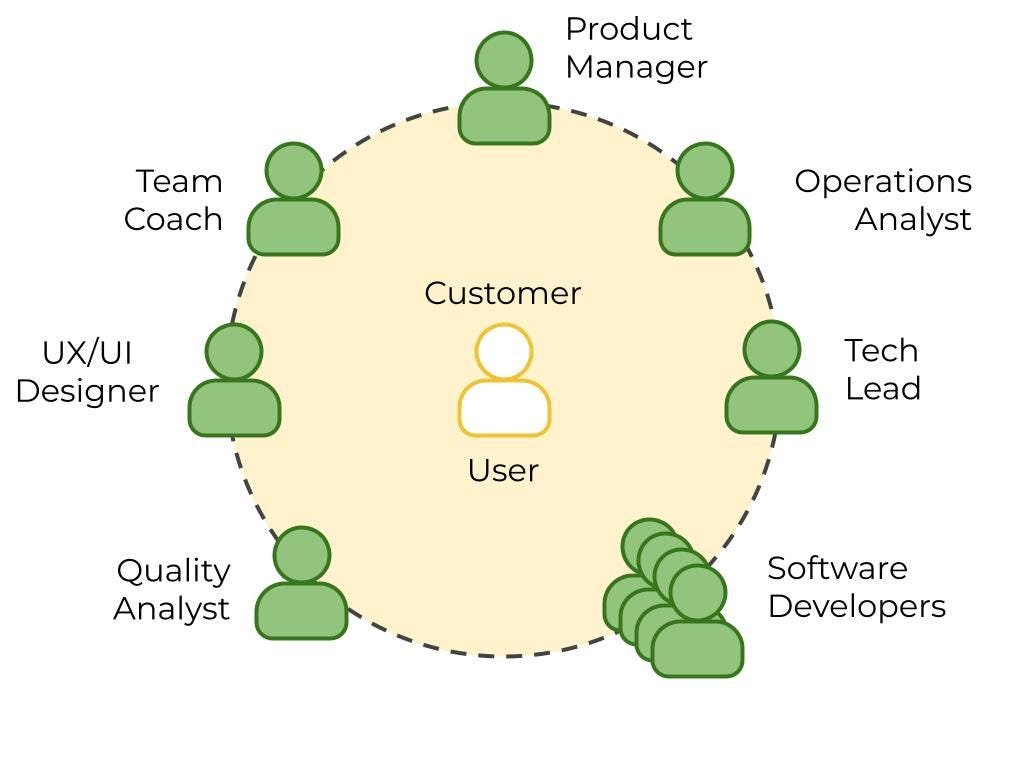
Developers, designers, product managers, and stakeholders need to work closely together, sharing insights and making decisions collectively.
Strong collaboration helps:
- Align everyone around evolving goals
- Identify risks and opportunities earlier
- Reduce misunderstandings and rework
This often requires breaking down traditional silos. Instead of working in isolation, teams should communicate frequently and openly.
Regular discussions, shared tools, and transparent workflows all contribute to a more adaptive environment.
Focus on Outcomes, Not Outputs
One of the biggest traps in uncertain environments is focusing too much on outputs—features delivered, tickets completed, or lines of code written.
While these metrics are easy to track, they don’t necessarily reflect real progress. In contrast, outcomes measure the actual impact of your work. This could include:
- Improved user engagement or retention
- Increased conversion rates
- Reduced churn
- Faster task completion for users
By focusing on outcomes, teams can evaluate whether their efforts are truly effective. This also makes it easier to pivot when something isn’t working.
Accept That Change Is Constant
Perhaps the most important mindset shift is accepting that change is not an exception—it is the default state.
Instead of trying to control or minimize change, successful teams design their processes around it.
This means:
- Expecting requirements to evolve
- Treating plans as temporary and adjustable
- Viewing uncertainty as an opportunity rather than a problem
Teams that embrace this mindset are better equipped to navigate complexity and deliver meaningful results.
Practical Example: Building Without Fixed Requirements
Consider a startup developing a new SaaS product. At the beginning, they may only have a rough idea of the problem they want to solve.
Instead of defining a full product upfront, they start with a basic version that addresses a core need. They release it quickly, gather feedback, and observe how users interact with it.
Based on what they learn, they refine the product, add new features, and remove those that don’t provide value.
This process repeats continuously. Each iteration brings the product closer to what users actually need, rather than what the team initially assumed.
This is the essence of building in uncertain environments: progress through learning, not prediction.
Final Thoughts
Building software without fixed requirements is not about abandoning structure—it’s about adopting a different kind of structure, one that supports learning, flexibility, and continuous improvement.
In a world where change is constant, the ability to adapt becomes a competitive advantage. Teams that can learn quickly, respond effectively, and adjust their direction will consistently outperform those that rely on rigid plans.
By breaking work into smaller increments, embracing feedback, strengthening collaboration, and focusing on outcomes, you can build software that not only functions well but also evolves with your users and the market.
Uncertainty doesn’t have to slow you down. When approached correctly, it can become the very thing that drives better decisions and stronger products.











![Create an image with 640×427 dimensions based on the topic: [melker schörling ab / anticimex förvärvsstrategi]. The scene should be visually clear, high quality, and aesthetically pleasing, with realistic lighting and detailed elements. Do not include any text in the image.](https://reelsmedia.co.uk/wp-content/uploads/2026/03/Gemini_Generated_Image_h2452hh2452hh245-330x220.png)