Wrist-worn devices, smart rings, and sensor-embedded clothing are no longer gadgets for early adopters. They are central to the strategy of any modern sports or healthcare startup. Building a product in this space requires more than just a mobile app. It requires a deep understanding of how hardware, firmware, and software interact in real-world conditions. For companies looking to build these products, finding the right wearable app development services is the first step toward a functional prototype.
For product companies and startups, the technical stakes are high. One small error in data transmission can lead to inaccurate health metrics or a poor user experience. Success depends on selecting the right architecture and understanding the unique constraints of wearable hardware. This is why many firms seek custom wearable device app development to ensure their specific hardware needs are met.
What Wearable Development Involves
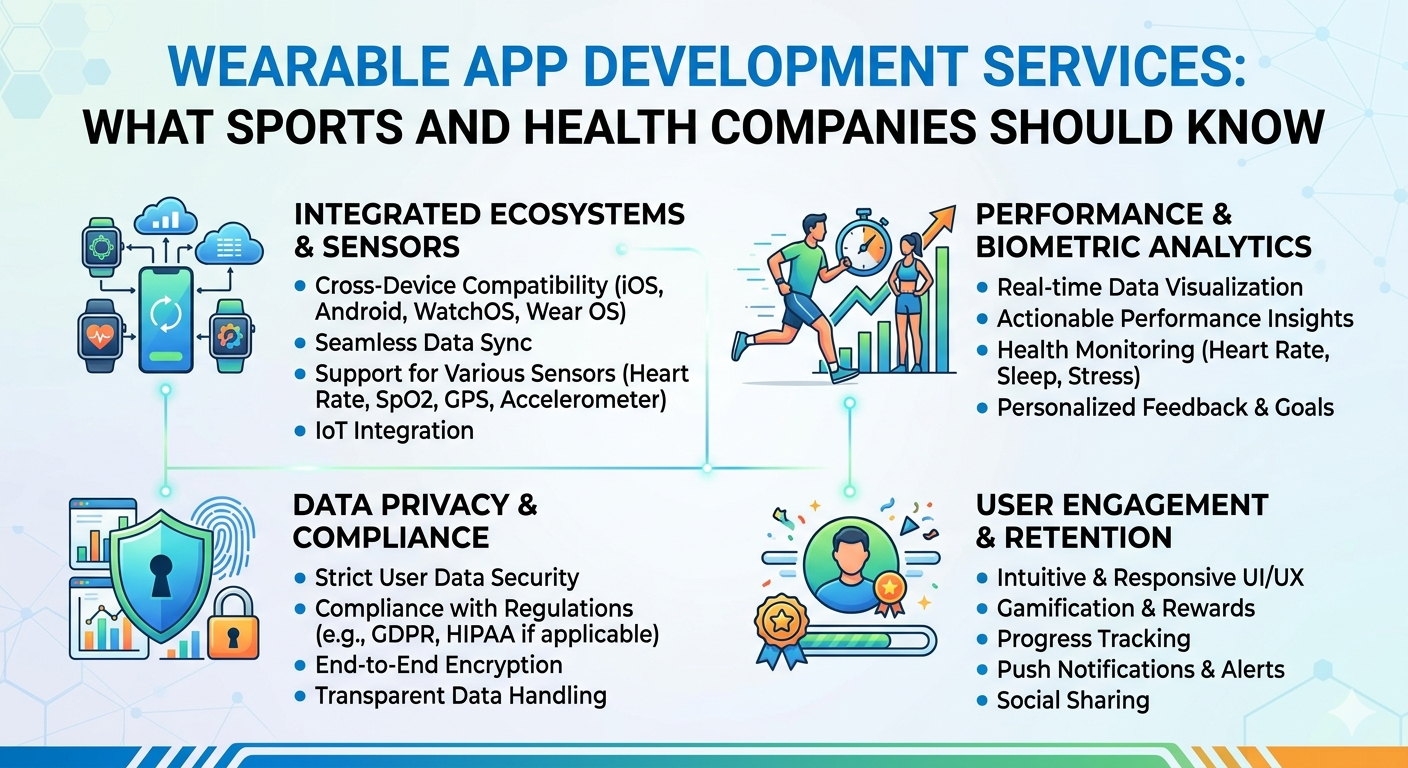
Developing for wearables is different from standard mobile development. You are dealing with limited battery life, small screens, and restricted processing power. The primary goal is to manage data efficiently while maintaining a stable connection between the device and the smartphone. Many wearable app development solutions focus specifically on these power-management challenges.
Sensor Integration and Data Processing
Modern wearables use a variety of sensors to track human activity. These include:
- Accelerometers and Gyroscopes: These track movement, rotation, and orientation.
- Optical Heart Rate Monitors (PPG): These measure blood flow to determine heart rate and oxygen saturation.
- Electrodermal Activity (EDA) Sensors: These detect stress levels by measuring skin conductance.
- GPS and Altimeters: These provide location and elevation data for outdoor activities.
Raw data from these sensors is often noisy. A developer must implement digital signal processing (DSP) to filter out movement artifacts. A heart rate sensor on a runner’s wrist will pick up the vibrations of their footsteps. Without clever algorithms, the app might display a step cadence instead of a pulse. A professional wearable app development company will have the expertise to write these filters.
Connectivity and Synchronisation
Most wearables rely on Bluetooth Low Energy (BLE) to talk to a phone. Managing this connection is a common pain point. The app must handle “edge cases” where the connection drops, such as when a user leaves their phone in a gym locker while wearing their watch. Local storage on the device ensures that no data is lost during these gaps. Once the connection is restored, the app should sync the cached data without draining the battery.
AI and Computer Vision Capabilities
We are seeing a shift toward “hearables” and head-mounted displays (HMDs) that use artificial intelligence (AI). In sports, computer vision (CV) is used to analyse a user’s form. If a startup is building a smart mirror or an AR headset for training, the software must process video frames in real-time to provide instant feedback on posture. This often requires “edge AI”, where the machine learning model runs directly on the device or the phone to avoid the latency of the cloud. Implementing such features requires specialised wearable devices app development services.
Medical vs Sports Wearables
While both types of devices may look similar, the internal requirements are vastly different. Understanding where your product fits is essential for regulatory and technical planning.


Accuracy Requirements
A sports wearable focuses on trends. If a fitness tracker says you burnt 400 calories but the real number is 380, the impact is minimal. However, a medical-grade device used for remote patient monitoring must meet clinical standards. For instance, an ECG wearable detecting atrial fibrillation cannot afford a high false-negative rate.
Regulatory Compliance
Medical wearables must comply with strict regulations like the Medical Device Regulation (MDR) in the UK and EU or FDA certification in the US. This affects every stage of development. You must document your Quality Management System (QMS) and ensure that your software development life cycle (SDLC) is auditable.
Data Security
While all apps should be secure, medical apps must adhere to GDPR and HIPAA standards. This means end-to-end encryption for all health data. Data at rest on the wearable and data in transit to the cloud must be protected. Access logs and strict authentication protocols are mandatory.
What to Look for in a Provider
Choosing a partner for your project is a long-term commitment. You need a team that understands the intersection of hardware and software.
- Protocol Expertise: Does the team have experience with BLE, ANT+, or custom proprietary protocols? They should know how to optimise the “handshake” between the device and the app to save battery life.
- Hardware Testing Culture: A good provider does not just use emulators. They should test on real hardware. This includes testing in different environments, such as during high-intensity exercise or in areas with high signal interference.
- Full-Stack Capability: Wearable development often requires a companion mobile app and a cloud-based dashboard for data analytics. The team should be able to build the entire ecosystem.
- AI Specialisation: If your product involves motion tracking or predictive health insights, look for a partner with a background in machine learning and computer vision.
When considering professional wearable app development services, it is vital to verify their portfolio in the sports and health sectors. A company like Paradigma ST (https://paradigma.dev/) focuses on the technical nuances of sports tech, helping startups build prototypes and production-ready MVPs that handle complex sensor data and real-time analytics.
Conclusion
The wearable market is moving toward more specialised, intelligent devices. Whether you are building smart clothing that monitors muscle fatigue or a hearable that provides AI coaching, the technical foundation remains the same. You need accurate data, reliable connectivity, and a user interface that respects the constraints of the hardware.
Startups should prioritise accuracy and battery efficiency from day one. By choosing a partner who understands the specific demands of sensors and real-time processing, you can focus on your core mission: helping users live healthier, more active lives.